Finding the Avant-Garde: Migration as a Method
Writing migration now is essential, as we face relentless injustice, moral injury, and violence to the Earth. We must learn from migrants, who make place under duress. They are the avant-garde.
Architectural histories of migration demand expansive methods. Inclusive selection of objects and subjects. Rigorous availing of all historiographical tools. A commitment to a politics and an ethic. To this end, between 2009 and 2024, I labored to refine migration as a method.
Figure 1. A provisions shop near Ifo camp, where migrating people encounter settlement at Dadaab. Photo by author, 2011.
Let us remember the African origins of all of humanity’s migrations, alongside the continent’s recent forced migrations, from modern enslavement to contemporary refugee crises , a vivid arc I studied in Architecture of Migration: The Dadaab Refugee Camps and Humanitarian Settlement. The refugee settlement in this book, in lands crossing Somalia, Kenya, and Ethiopia—reduced in the parlance to a “borderland”—is a site for concept histories and theory; an environment belonging to long narratives, not recent crisis; an ecology, even while the security state’s military target; and a place that, for many, is home. Dadaab is historically and architecturally special.
But problems studying Dadaab were anything but unique. How to learn about migrant places? Do they appear in the written record? Can we find plans and sections? Which nation-state’s archives speak of a community that fled it, or one that it hosts? When aid workers evacuate a camp under attack, do file cabinets of documents follow them? Running on foot, do parents carry photos of home? Contrary to what it may seem, such questions are germane to histories well beyond those of a refugee camp.
““We must learn from migrants, who make place under duress. They are the avant-garde.””
I brought a scholarly focus to Dadaab because “refugee camps are not supposed to leave a trace.” Saidiya Hartman—“determined to fill in the blank spaces of the historical record and to represent the lives of those deemed unworthy of remembering”—asks, “how does one write a story about an encounter with nothing?” This tracelessness, this nothing, calls into question all architectural historical method. Why must the African refugee settlement, like the Black subject, be disturbingly called to order to register itself through a void rather than a fulsomeness? To resist this misdirection, an architecture of migration—creating parity between aesthetic, political, and social value—offers a corrective. Interrogates where historical abundance is located. Questions why one architecture is said to possess an archive and another is not. Challenges the landed archive’s authority over the migrant archive. Taking up this fight, I constructed an archive that many people told me could not be constructed.
I do not suggest that archives be constructed to placate a horror vacui. Merely that they must be constructed. Indeed, all are.
Architecture of Migration drew on consultation of forty-two publicly-accessible or private archives, libraries, and collections—some managed by nation-states, some by NGOs, some by museums, some by refugees in camps or aid workers on the move. My primary research also lay in long- and short-format journalistic sources and novels, memoirs, reports, and other works by architects, artists, travelers, human rights and humanitarian workers, reporters, and refugees. It drew on tested art historical methods: close looking at architectures, situating them within their historical contexts of production, reception, and use.
““Let us remember the African origins of all of humanity’s migrations, alongside the continent’s recent forced migrations, from modern enslavement to contemporary refugee crises.””
Centering the Dadaab refugee camps critically mobilized a surfeit of images rare for refugee camps. Dadaab has been rendered under the gaze of an empire, a postcolonial government, and a humanitarian regime and security state. The ensuing archive demands continuous ethical negotiation: acknowledging architecture’s complicity with power yet its ongoing agency and meaning. My archive shows that the Kenyan government confined refugees within a vacuity reinscribed across a century within specific geographical coordinates, converting the erstwhile “frontier” into the present-day “camp,” and sedentarizing people as they lived traditions of migratory life. By reading Dadaab’s long past in British imperial military maps, UK and US geological records, and UNHCR aerial surveys, I demonstrated the extension of colonial constructions of emergency territory through time, the repeated inscription of “empty” space.[1]
But space is not land.[2] In Dadaab, architecture is made from the land, emplaced, of the earth, planted. Shaped by people’s hands; it grows. Dadaab’s architecture demonstrates that land serves as the archive.
To think with land is to think with people.[3] To suggest that land is the archive is to align with people rather than bureaucracies, states, or empires. The book’s most challenging method involved talking to people: building a database of oral histories with asylum seekers, refugees, government officials, architects, aid workers, and representatives of cultural institutions, conducting interviews with more than 350 individuals and sixty groups, and observing their inhabitation of the built environment.[4] Working with dispossessed and displaced people, I learned from critical anthropology and social history to question methods of talking to people.
““To think with land is to think with people.””
“I observed, listened to, and dreamed with hundreds of refugees, aid workers, officials, planners, mothers, children, architects, academics… [who] generously contributed to a ‘migrant archive’…countering expectations and desires that most history writing generates around the fixity and landed wealth of institutional archives.”[5] Architecture of Migration did not follow ethnographic methods of studying “human subjects.” I talked to people for whom Dadaab was home. Most were women. People who wanted to be named in its history. People who requested that I photograph them and those in their care. (Photography, despite its many crises, served as a straightforward method to render architectural forms.) They described where we were as we walked the camps.
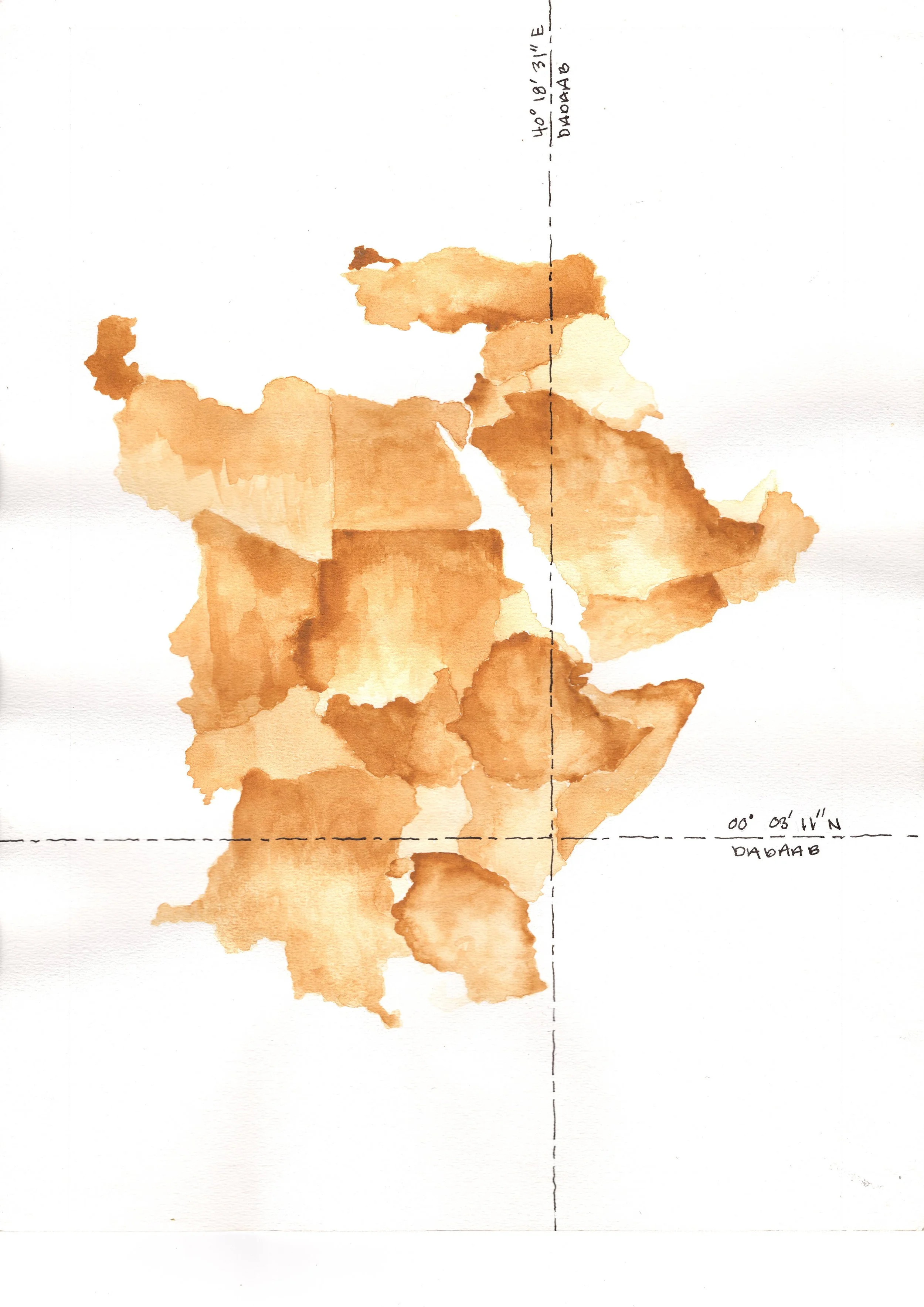
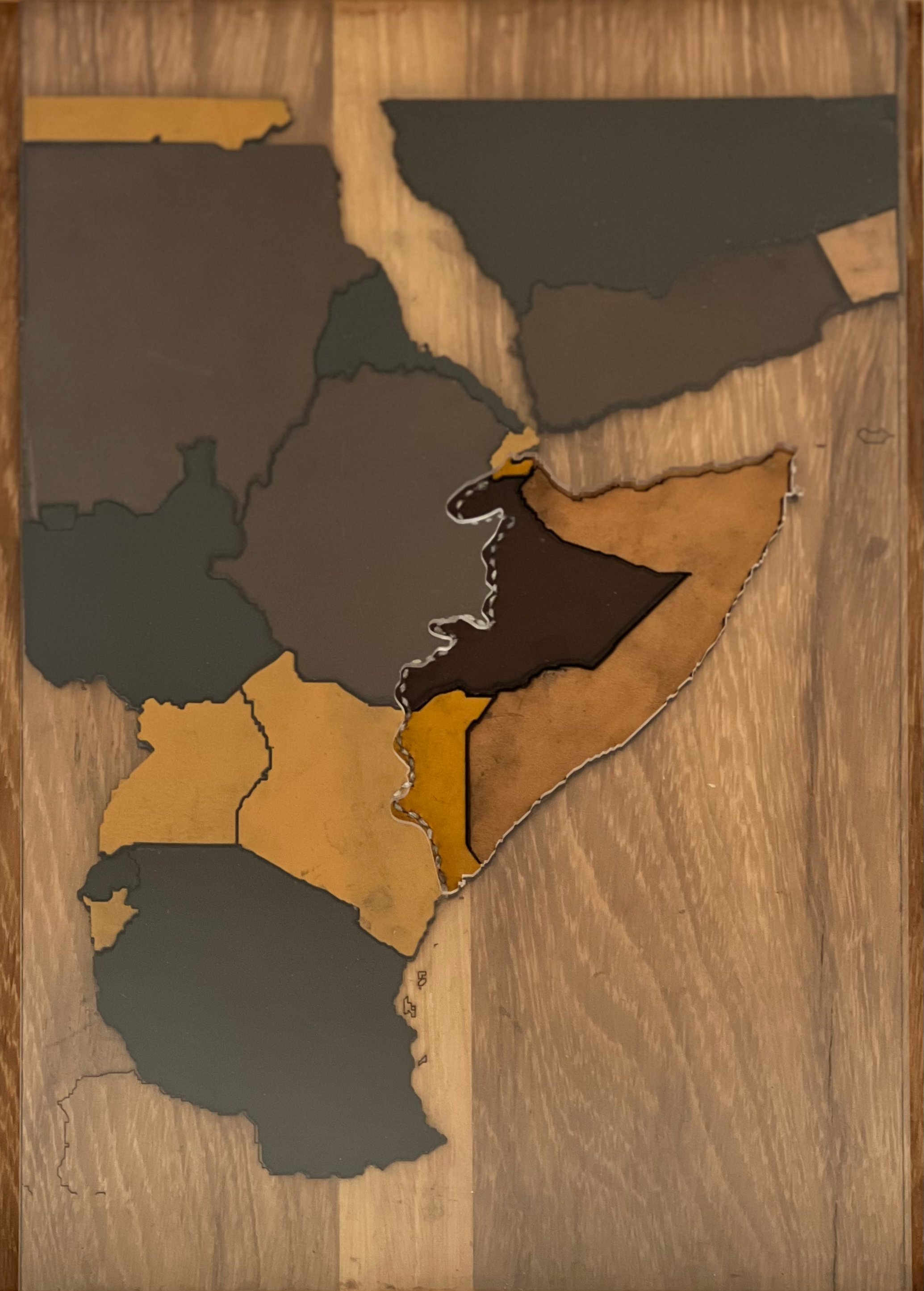
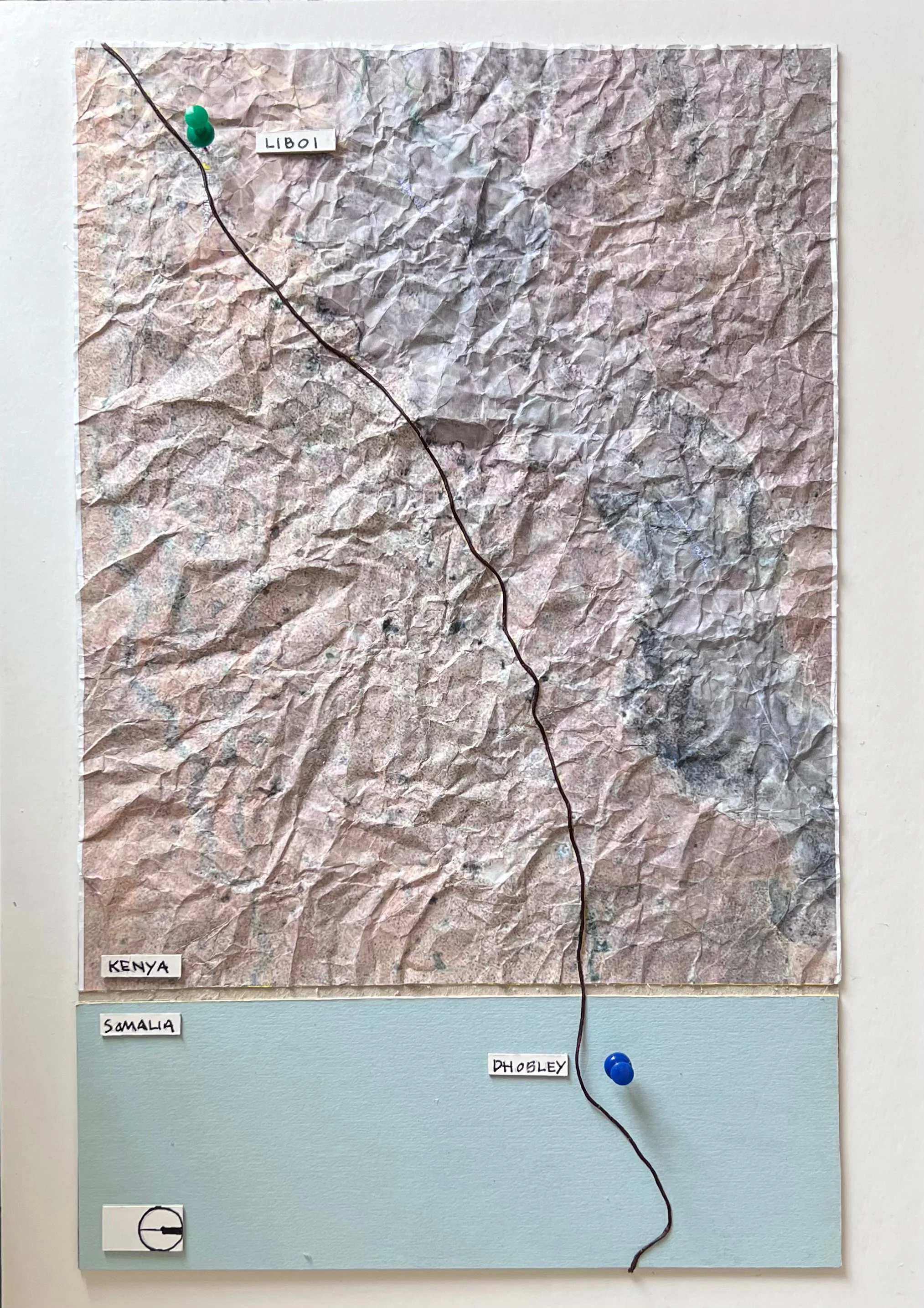
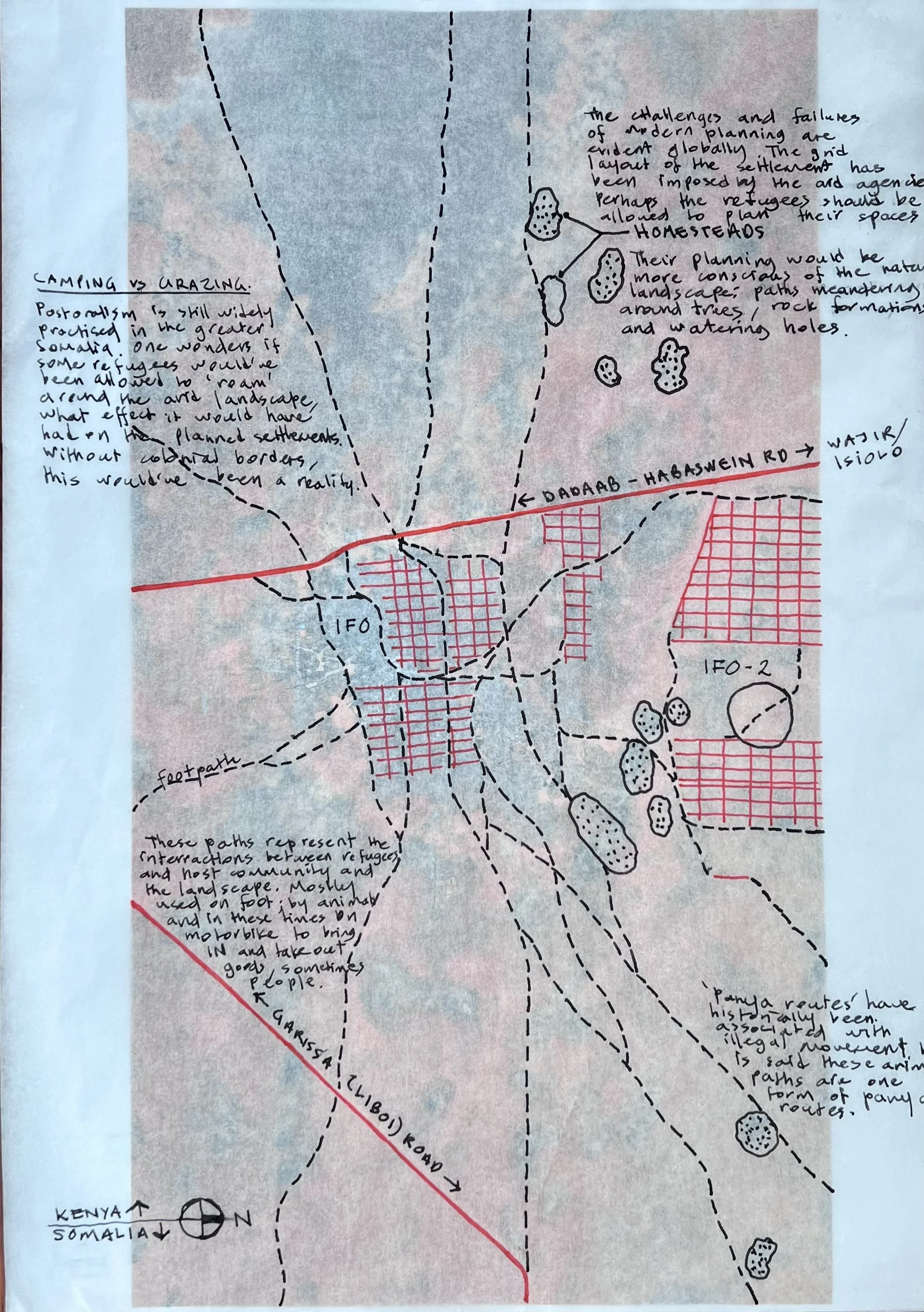
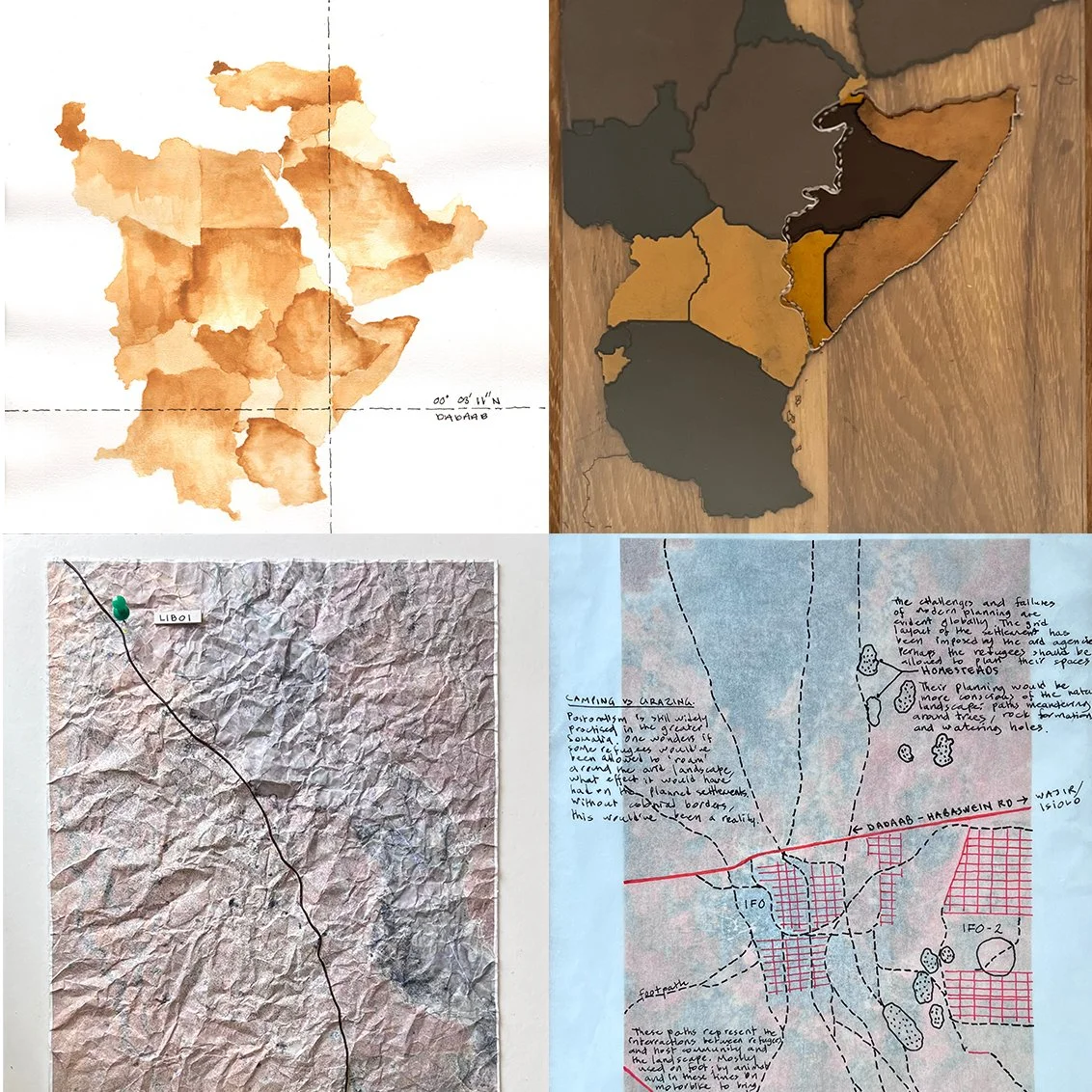
Figures 2-5. By AbdulFatah Adam, architect and principal of Studio Fourteen, Nairobi, Kenya, 420mm x 197mm, 2022. (Click on each image for more information.)
People who could not know where my questions and photographs would lead spent time in community with me—laughing, sharing—provoking my skepticism of the finality of “permissions” obtained during “research.” In response, I made decisions. I refrained from entering a mosque in a refugee camp. I did not invade anyone’s privacy with questions about the travails of flight or refuge.[6] I edited dialogues collaboratively with interlocutors, exposing our mutual flaws and contradictions. Years passed before I published photographs, of minors especially, to give people’s features time to transform and become less recognizable. Instead of populating the book with UNHCR maps, I commissioned artists to “draw Dadaab” in solidarity.[7] I did these things perhaps less as a responsible researcher, and rather more as a loving comrade, caretaker, friend, sibling.[8]
Difficulties arose as my political solidarities with migrants faced the pragmatics of negotiating scholarship within the power structures of nation-states and institutions. Transparent research in Dadaab required adhering to compromised arrangements between the UNHCR and the Kenyan government. Fieldwork by police escort and other such situations raised ethical, political, intellectual, and methodological problems at once. I mitigated them by laboring slowly and carefully over fourteen years, making a complex archive, and negotiating its fine grain. I had to work in opposition to academic production tempos. I required diverse, sometimes unanticipated skills: recalling French, Danish, and Tamil learned in childhood, acquiring Kiswahili, Italian, and Spanish, working with Somali translators, analyzing manifold visual media and ephemera, and processing high volumes of documentary data at a conceptual level.
““Naming a person honors her signature and acknowledges her authorship.””
I wished to resist an unjust system that inscribes partitions and confines people. Yet, I found myself refusing to adopt an academic method that eschews engagement, even with criminally violent state structures. I insisted on negotiating with all structures: to learn, test, and adjudicate. Such robust terms of negotiation, it must be noted, inform even the most conventional historical and art historical methodology, delimiting architectural history’s disciplinary remit.
How might we negotiate architectural histories of migration? My negotiation surprised me, ensuing from the difficult decision to publish names (even if permitted) of people at risk. “Naming a person honors her signature and acknowledges her authorship.”Migration places a historiographical strain upon the architectural object; we wish for architecture to be landed, fixed, stable. Yet, migration also creates an aesthetic burden; in the end, we know so few names, have so few signatures. Migration as a method offers a path to past and present social and political complexity. It also limns aesthetic imagination, ecological awareness, architectural knowledge. On all these counts, in the places where an architecture of migration has manifested most vibrantly, we find the avant-garde.
Citation:
Anooradha Iyer Siddiqi, “Finding the Avant-Garde: Migration as a Method,” Platform, August 24, 2026.
Notes:
[1] Siddiqi, “Land, Emergency, and Sedentarization in East Africa,” Architecture of Migration.
[2] Tania Gutiérrez-Monroy and Anselma Margarito’s occupied Otomí mountain belts, plateau, and coastal plain insist that architecture can “teach back a lesson to the legal and administrative apparatuses that essentialize and violently dissociate identity from place.”
[3] As with Amina Kaskar’s stone forms, built and rebuilt by Palestinian schoolchildren expressing fortitude against persistent Israeli attacks in the hills of south Hebron, Dadaab’s architecture results from an “intimacy with the physical act of construction” that “reflects a deeper relationship between people, place, and memory.”
[4] Detailed information on the structure of interviews and methods and ethics of citation is provided in Siddiqi, “Primary Sources,” Architecture of Migration. I organized interviews into a database, accessible at the GoDown Arts Centre; those conducted through the Women’s Refugee Commission are held by Duke University Libraries Human Rights Archive.
[5] Siddiqi, “Dadaab Is a Place on Earth: Land and the Migrant Archive,” in Writing Architectural History: Evidence and Narrative in the Twenty-First Century, ed. Aggregate (Pittsburgh: University of Pittsburgh Press, 2021), 233.
[6] I followed this practice of non-invasiveness with all people living in refugee environments, including aid workers.
[7] Siddiqi, “The Intimacies of Restitution: Reinscribing the Dadaab Refugee Camps,” Future Anterior 19:2 (Winter 2022): 74-90; Siddiqi, “I wanted this scholarly story to come to life: Interview between Anooradha Iyer Siddiqi and Omar Berrada on ,” Monsoon: Journal of the Indian Ocean Rim (Duke University Press) 3:1 (2025): 43-62.
[8] Siddiqi, “Scholarship as Mutual Aid,” in “Caregiving as Method,” gta Papers (2022): 95-99.