Conserving Reform: A Community-Led Model for Maintaining Urban Memory and Global Heritage in Shekou
Click here to read this post in Chinese.
Introduction: Critical Heritage Practice in the “Test Tube”
In the lexicon of global capitalism, few places carry the symbolic weight of Shekou, the free-trade zone located at the southern-most point of Shenzhen’s Nanshan District in Guangdong Province, China. Officially established on January 31, 1979, as China’s “test tube” for economic reform, the city was a pivotal node in the transformation of the late 20th-century world order, offering a distinctive urban model for economic liberalization that has since rippled through cities, new and old, around the world.
Shekou’s status as a reception point for global capital and technology (e.g., American glass manufacturing at the Float Glass Factory, Japanese electronics at Sanyo) made it a vital site for the transmission and experimentation of new industrial practices and economic policies that catalyzed post-Mao China’s gradual integration into the global economy. In transforming China, Shekou also changed the world, producing distinctive urban effects over the past fifty years that figure as new paradigms for potential regeneration and new ways of understanding heritage.
Shekou is now a crucible for a new kind of heritage-making that challenges traditional heritage practices, which have been enshrined in national and international institutions around the world and often privilege the ancient, the monumental, and the aesthetically unified. These practices, which often create fixed, carefully curated landscapes for tourist consumption, tend to obscure the physical scars, ongoing debates, and messy, lived-in authenticity embodied by a site such as Shekou, which arguably illustrates what scholars term a distinctive kind of “critical heritage”—a process-oriented, often contentious, and perpetually unfinished negotiation over what to remember, why, and for whom.
““In transforming China, Shekou also changed the world, producing distinctive urban effects … for … new ways of understanding heritage.””
The theoretical underpinning of this movement can be traced directly to the academic and activist work of local architectural scholars, including my own research. Drawing on theorists such as Laurajane Smith and Rodney Harrison, we can see Shekou’s heritage as a verb, not a noun—a dynamic social process rather than a static collection of objects. This framework recasts Shenzhen, of which Shekou comprises one part, as “fertile soil for heritage” precisely because of its rapid, disruptive history of construction, destruction, and reinvention.
This article traces the origins of a grassroots initiative to rethink how we understand Shekou’s history and its significance to contemporary Chinese urbanism. In 2026, the “Shekou Heritage - A New Journey” Public Welfare Fund (Shekou Heritage Fund), under the management of Shekou Community Foundation, started a WeChat public account called the “Shekou Stone Refinery” that metaphorically encapsulates an alchemical process of heritage-making: refining the raw, often dissonant, memories of industrialization into the bedrock for a shared future.
The naming itself a story of grassroots perseverance. The preferred names, “Shekou Heritage – A New Journey” or “Shekou Heritage” were not accepted through official naming channels. Undeterred, the fund committee members adopted the more poetic, potent “Stone Refinery.” This act of self-naming is a form of critical heritage practice—asserting agency and crafting a narrative that officialdom overlooked.
The group’s mission, “Refining the past stone, to build the habitats of tomorrow” (炼过往之石,筑明日之墟), speaks to a profound understanding of heritage not as nostalgia, but as raw material for future construction. The “stone” of the past is transformed into high-value cultural ore through the “refinery” of collective action. Moreover, the South China Sea is, in Chinese mythology, the very place where the goddess Nüwa smelted the stones to mend the heavens. This mythological resonance forms an intrinsic connection with the entrepreneurial spirit of Yuan Geng, the founding father of Shekou. A statue of Nüwa stands as a landmark in Shekou today, and the goddess also serves as the emblem of the Shekou Community Foundation (Figure 1).
Figure 1. Logos of Shekou Community Foundation and Shekou Heritage Fund, in reference to Nüwa Sculpture. Photograph by Ke Song.
A Chronology of Community Awakening
Figure 2. The Value Factory. Photograph by Ke Song.
The evolution of the Shekou heritage movement has not been a smooth, pre-planned campaign. It originally crystallized around an urgent, existential threat to a beloved space, namely, The Value Factory (former Guangdong Float Glass Factory). Initially renovated to host the 2013 Shenzhen-Hong Kong Bi-City Biennale of Urbanism/Architecture (UABB), the former industrial manufacturing facility became a symbolic heart for Shenzhen’s creative community, and a testament to the value of adaptive reuse (Figure 2).
In November 2024, and despite its reputation and significance, rumors swirled that another planned renovation—from a hall into a nightclub—would require the demolition of its iconic “ground pillars.” On 10th November, that night, following an on-site performance of the Shekou Theatre Festival, six residents stayed behind to protect the columns. Qu Hong, the founder of Green Mango Community (a community building organization based in Shekou), with deep ties to the Value Factory, took the lead, reaching out to her extensive network and urgently consulting with key stakeholders. A local social media account published a post on RedNote asking “whether the factory’s 89 columns would be demolished.” This ignited a convergence of grassroot action and online outcry that prompted a swift government response. Out of consideration for public sentiment and social stability, the renovation plan was immediately suspended.
In fact, the issue of heritage preservation in the Pearl River Delta or Greater Bay Area (GBA) had become a politically sensitive matter prior to this event. In 2020-2021, for example, the Guangzhou tree-felling incident fueled perceptions of the government’s inappropriate handling of community heritage concerns and resulted in the removal of local officials. Ongoing disputes, such as those surrounding Hubei Ancient Village and, more recently, the threatened demolition of the Shekou Training Center in 2021, have further heightened public awareness. Consequently, local administrative leaders now tend to adopt a more cautious and measured approach when dealing with heritage controversies, prioritizing stability and due diligence.
Figure 3. Poster of Shekou Salon #120, silhouette of columns, echoing the architectural order and civic symbolism of Classical Greece, designed by Guo Jiawei, a Shekou-based graphic designer. Source: Chronicles of Shekou Heritage: A New Journey, Nov 10, 2024 – Jan 31, 2026.
Nevertheless, public concern over the Value Factory’s fate fueled the bottom-up energy that helped to inspire Shekou Salon #120, explicitly titled “Protecting the Focal Historical Site of Reform and Opening-Up—Shekou Value Factory” (Figure 3), held in an art education institution in Shekou. The pivotal gathering assembled retired economist Chen Anjie, public art curator Liu Lei, as well as community leaders, architects, academics, and residents. More than a forum devoted to organizing an act of sentimental preservation, the event framed the factory as a “focal site” of reform-era values—efficiency, experimentation, international exchange—perceived to be under threat due to the building’s potential destruction. The hybrid nature of the salon, which balanced expert knowledge and community sentiment, was particularly important to the events that followed. I later refined and published the ideas and controversies ignited by the “pillar incident” into a reflection article, “What is the Value of the 88 Pillars of the Value Factory?”
Over the course of 2024, a series of follow-up sessions broadened the discourse beyond the preservation of the existing building into a movement to define and defend the entire cultural and economic ecosystem that Shekou’s heritage represented. A vital component of this heritage is Shekou’s people themselves. To that end, the January 3, 2025, launching of the “2025-2027 Shekou Community Memory and Ordinary People’s Oral History Co-creation Project” was a masterstroke. It formalized the task of interviewing “ordinary people”—factory managers, migrant workers, shopkeepers—who built Shekou. A key early interviewee was Yang Yongzhao, the former director of the Float Glass Factory.
This project operationalized a central tenet in critical heritage studies, namely, that heritage is carried by people, not just walls. It represented a conscious act of transforming living memory into a permanent, shared resource—a foundational stone in refining Shekou’s intangible past, and arguably a new method for engaging with contemporary China’s recent architectural past.
Subsequent events, including Shekou Salon #124 [“Discussion on the Exhibition Outline for the Industrial Civilization Museum (Shekou Chapter)”], inspired participants to consider their efforts as in building a conceptual “museum without walls,” where Shekou’s entire urban landscape might become an exhibit unto itself.
Concurrently, from September 30 to October 31, 2025, the “Shenzhen Creativity: Shekou Traces” exhibition was held at Nanhai E-Cool as part of the Shenzhen Design Week. (Figure 4). On its closing day, a formal handover ceremony transferred key historical documents—including archival maps, oral history recordings, and architectural models—to the Shekou Heritage Fund. This transfer symbolized the community’s material commitment to a form of collaborative, self-documented history, transforming curated objects into enduring assets for future advocacy and education.
Figure 4. “Shenzhen Creativity: Shekou Traces” Exhibition Opening Tour. Photograph by Ke Song.
The Birth of a Fund and a Governance Model
Figure 5. The "Shekou Community Games" Torch-Lighting Ceremony at the Column Hall of the Value Factory. Source: Chronicles of Shekou Heritage: A New Journey, Nov 10, 2024 – Jan 31, 2026.
By mid-2025, it became clear that sustained action would require sustainable resources. On June 30, 2025, economist and community pillar Chen Anjie made the first donation, symbolically planting the seed for the “Shekou Heritage - A New Journey Fund.” This landmark event officially launched the fund and initiated a public call for donations—not just of money, but of time and objects. Former workers donated old factory badges, tools, and photographs. A self-nominated preparatory group of five donors (Chen Anjie, Dai Tianchen, Guo Jiawei, Kong Yongjian, Qu Hong) was also formed and drafted initial plans for the First Donors’ Congress on January 31, 2026. A series of public events, such as the Shekou Community Sports Games and additional Shekou Salons, also helped to ensure the Value Factory remained an active part of the community (Figures 5 and 6).
Figure 6. Wang Lichen, the former engineer at Guangdong Float Glass Factory, introducing the glass manufacturing process. Photograph by Ke Song.
The First Donors’ Congress on January 31, 2026, was the movement’s crowning democratic achievement (Figure 7). With 46 donor representatives present, the congress elected an Executive Council and a Board of Supervisors, establishing a robust, transparent, and accountable governance model. This transformed “community participation” from a slogan into a working constitutional system. In early 2026, the movement accelerated its transition from academic discussion to public action. On April 18, 2026—the International Day for Monuments and Sites—the fund, in partnership with the local coffee brand The Soloist, organized a “Shekou Heritage Bike Ride.” The route traced the officially designated “Reform and Opening-Up Shekou Historical Trail,” a path connecting nine key nodes including the Value Factory (former Guangdong Float Glass Plant), Dacheng Flour Mill (now CIMC Dacheng Art Center), and Shekou Training Center (Figure 8).
Figure 7. The Inaugural Donors' Congress elected an Executive Council, Independent Directors, an Executive Board of Supervisors, and Independent Supervisors. Source: Chronicles of Shekou Heritage: A New Journey, Nov 10, 2024 – Jan 31, 2026.
Figure 8. Shekou Heritage Bike Ride, Destination: Shekou Training Center. Source: Shekou Salon (Session 139): International Monuments and Sites Day Special: Co-creating Value for the Shekou Reform & Opening-up Historic Trail.
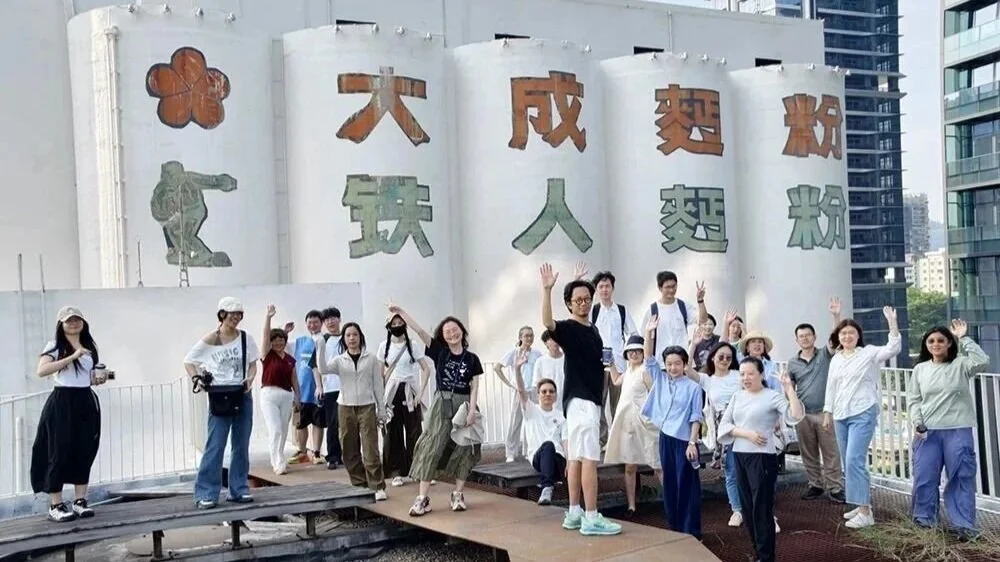
One week later, the first Shekou Heritage Community Open Day, was initiated. Inspired by the Open House Worldwide, the event attracted nearly 40 participants, including former industrial workers, students, and residents, to the CIMC Dacheng Art Center, the preserved site of the former Dacheng Flour Mill (Figure 9). Participants walked through the colossal silos and mill structures before convening for a “History-Future Dialogue” to brainstorm future uses for the site and its industrial relics. These two events—one mobile and connective, the other site-specific and immersive—transformed the area’s abstract history into tangible, participatory experience.
Figure 9. The 1st Shekou Heritage Community Open Day, visiting Dacheng Flour Mill. Source: Shekou Heritage Community Day Kicks Off with a Bang! Nearly 40 Visitors Explore Dacheng Art Center, Envisioning the Future of Industrial Heritage .
Toward World Heritage: Proposing a New Heritage Typology
Through these various activities, events, and discussions, an ambitious goal has emerged, namely, to utilize Shekou and its legacy as the basis for a redefinition of what qualifies as World Heritage in the twenty-first century. A future UNESCO nomination for Shekou, however, would have to break new ground by recognizing not only the place but also the process—the unique socio-cultural mechanism that sustains it, as exemplified by the Shekou Heritage Fund. The most radical and innovative layer is the governance model being forged in the process of understanding the site’s history. This is meta-heritage—the heritage of how to do heritage.
The Donor Convention, for example, is not just a set of rules; it is a piece of civic infrastructure, a social technology for collective stewardship. Its creation through debate and ratification by donors represents a monumental achievement in self-organization and democratic practice within a Chinese urban context. Relatedly, the “Shekou Salon” as continuous “mixed forum,” with over 141 sessions by mid-2026, is far more than a lecture series. It is a de facto “Heritage Parliament,” where values are debated, histories are contested, and consensus is built before authorities are engaged. It builds social capital and a shared narrative necessary for effective advocacy.
As a distributed network of scholars, designers, former factory workers, and residents, the Shekou Heritage Fund has effectively used salons, exhibitions, oral history projects, and digital media to turn academic research into sustained civic action. Its existence proves that in the face of bureaucratic inertia, legitimacy and authority can be built from the ground up, through diligent and persistent documentation, debate, and collective care. With the establishment of the fund, Shekou is becoming a living laboratory where community action, rather than state decree, is writing the next chapter of China’s urban and architectural narrative. The story of Shekou’s heritage-making is not one of passive preservation, but of active, contentious, and profoundly democratic creation.
Shekou Heritage remains an unfinished project, which is both the initiative’s greatest strength and its most compelling lesson. Collectively, we are building a civic habit—the habit of questioning, of debating, of stewarding, of translating memory into an act of civic responsibility.
Citation:
Song Ke, “Conserving Reform: A Community-Led Model for Maintaining Urban Memory and Global Heritage in Shekou” Platform, August 17, 2026.