Corridors of Capital: Competing Systems of Financing and Worldmaking in Eurasia
The Baku-Tbilisi-Ceyhan (BTC) and Kazakhstan-China (KzC) oil pipelines are not simply infrastructures for moving hydrocarbons across vast distances; they are worldmaking devices that inscribe political rationalities, financial architectures, and territorial regimes onto the landscapes of post-Soviet Eurasia (Figure 1). While their physical purpose is to carry crude oil, these pipelines’ political and financial logics produce and govern space in ways that shape sovereignty, labor regimes, minority relations, and geopolitical orientation. In doing so, they reactivate older imperial geographies, administering the lands they cross as peripheries—zones to be secured, bypassed, or absorbed—rather than as inhabited places with claims of their own.
Figure 1: Map depicting the BTC (left) and KzC (right) pipelines routes. The BTC pipeline traversing Azerbaijan, Georgia and Turkey as an alternative to the Bosphorus Strait. The KZC pipeline travels across Kazakhstan to the Alashankou refinery, where it is redirected mainly to Beijing.
Both pipeline proposals emerged in 1992, the first full year of post-Soviet independence, when former Soviet republics sought to assert their independence and global powers sought to shape the contours of a new Eurasian order. The BTC was championed as a way for Azerbaijan to export oil without reliance on Russian transit routes, as Georgia sought Western integration, and as Turkey aimed to position itself as a critical energy transit state linking East and West. In this year, British Petroleum (BP) opened its first offices in Azerbaijan and facilitated a visit from the then-former prime minister of the United Kingdom, Margaret Thatcher, to personally deliver the first investment cheques to the Azerbaijani President, Abulfaz Elchibey. The project consortium—led by BP and composed of eleven multinational oil companies (Figure 2)—negotiated political concessions, tax exemptions, territorial protections, and financial support by multilateral development institutions to disperse risk across political regimes, geographic regions, and financial markets. Independent observers and regional activists noted, even at the time of construction, that the pipeline’s security doctrines, environmental assessments, and community consultations were deeply uneven and biased toward protecting capital flows rather than local livelihoods.
Meanwhile, the KzC pipeline was negotiated against what Nursultan Nazarbayev, Kazakhstan’s first president, called the country’s multi-vector foreign policy, balancing diplomatic relations with Russia, China, and the West rather than aligning with one of them. Historians and political economists note that this pipeline predates but prefigures the logic of the Belt and Road Initiative (BRI)—and while existing literature treats these pipelines almost exclusively as economic exchanges, studying the space reveals how infrastructure’s lasting imprint alters the built environment and its societies. Completed between 2003 and 2009, the pipeline runs from Caspian oil fields in Atyrau, Western Kazakhstan, to Alashankou in China’s Xinjiang Uyghur Autonomous Region, forming the first major direct oil artery between Central Asia and China. By entering Xinjiang—a highly securitized and politically sensitive territory—the route intentionally embeds energy infrastructure into China's landscape of state control. While jointly owned by KazMunayGas and the China National Petroleum Corporation (CNPC), the pipeline was financed overwhelmingly by Chinese state-backed banks (Figure 2). Ultimately, this reliance on sovereign loans and integrated planning exemplifies Chinese strategic statecraft, projecting control over regional space, finance, and politics.
Figure 2: BTC and Kazakhstan-China Pipelines Capital Structure. The BTC pipeline mobilized a diverse coalition of international actors—eleven corporations as partners, two multinational corporations, and a syndicate of fifteen international banks. The Kazakhstan-China pipeline, by contrast, is nominally bilateral but overwhelmingly backed by Chinese capital: both the initial loan and the later refinanced international debt flow through Chinese state institutions. One structure sources capital from global participants; the other concentrates it through a dominant state actor. Source: Companies Reports and Infrastructure Data Aggregators
The BTC pipeline’s globalized financing and extraterritorial legal frameworks produce a corridor that transfers economic and political liabilities away; in contrast, the KzC pipeline’s state-centric financing embeds oil flows into China’s continental order. The following sections explore how these infrastructures materialize in inhabited landscapes—particularly around Kurdish and Uyghur populations whose lived geographies have been shaped by these pipelines’ divergent operational logics. Read against the grain, these corridors disclose less of what they are built to carry than what they are built to hide. This capacity of infrastructure to operate as a mode of governance alongside—and often outside—the formal state is what Keller Easterling calls extrastatecraft: a power that resides less in legislation than in the dispositions of space itself.
““While their physical purpose is to carry crude oil, these pipelines’ political and financial logics produce and govern space in ways that shape sovereignty, labor regimes, minority relations, and geopolitical orientation.””
Our inquiry emerges from a conversation between two disciplines that cite one another more often than they meet. One of us is trained to read space, the other to read capital—combining an understanding of how corridors, easements, and setbacks organize inhabitation with a knowledge of how syndication, sovereign guarantees, and risk organize obligation. Pipelines demand both, as a corridor is simultaneously a place and a balance sheet. While the analytic vocabularies for these two conditions have developed largely in isolation, what follows is an attempt to hold them in the same frame.
Contracts and Rhetoric
The Public Money behind the Free-Market Façade
Figure 3: Pipeline marker in Georgia, showing warnings and BP Georgia contact in case of emergency. Photo: Alp Demiroglu
While the BTC pipeline is officially owned by the consortium, public communication remains monopolized by BP. In corporate reports, BP frames the pipeline as the “first great engineering project of the 21st century.” This polished narrative of commercial viability contradicts the real financial assessment by BP’s own chief executive, John Browne, who conceded in 1998 that the pipeline could not proceed without billions of “free public money.” These statements had to be explained by the International Finance Corporation (IFC) in its social and environmental assessment of the project. However, despite securing these government transfers, BP reports emphasize “improving people’s lives,” explicitly steering the narrative toward community development. BP has been able to craft a singular corporate voice that presents the pipeline as a private venture insulated from state politics (Figure 3).
In contrast to the corporate narrative, the host governments framed the BTC explicitly as a tool of statecraft. The Georgian President hailed the pipeline as a geopolitical victory for the Caspian Basin countries. Meanwhile, the Azerbaijani President linked the pipeline’s completion directly to the preservation of national sovereignty. This creates a striking rupture: while BP’s press releases used technocratic and financial language, the host governments stressed the project’s strategic core, celebrating the pipeline as an instrument of independence. However, this triumphant rhetoric omitted the legal concessions, obscuring the fact that sovereignty had been contractually surrendered to private capital.
On the other hand, the corporate discourse surrounding the KzC pipeline is indistinguishable from state policy. KazMunayGas does not frame the pipeline as a mere commercial asset in its annual reports; rather, it describes its initial operations as the “efficient execution of the instructions of the Head of State” to ensure export security, accompanied with futuristic imagery. KazMunayGas’s reporting emphasizes its role in “maintaining social stability” in the regions it operates, positioning the company as an arm of domestic governance rather than a profit-maximizing entity. Similarly, CNPC utilizes language that mirrors Beijing’s diplomatic lexicon, describing the relationship as “a strategic partnership on economic, trade, energy, technological, cultural and educational cooperation.” Unlike the BP-led model, where the corporation highlights its technocratic independence from the state, KazMunayGas and CNPC announcements openly conflate their corporate goals with joint national interests of development and expansion. By replacing external investors, the financing reshaped the pipeline into a tool of direct intergovernmental collaboration rather than market abstraction. These distinct conception contexts ultimately force the physical environment into two contrasting configurations: the Western-consortium extractive approach leaves a fractured territory where “security” alienates communities from their own land, while the state-directed KzC pipeline actively amplifies the Chinese state’s military and surveillance presence into the Uyghur region.
Sovereignty: The Price of “Security”
The specific legal terms accepted by the host governments reveal the extent to which sovereignty was ceded to secure the project. The Host Government Agreements (HGAs) granted the consortium a legal status that superseded national laws, utilizing “freezing clauses” to exempt the project from any future legislative changes (including environmental or human rights laws) that could affect profitability for forty years. On the ground, the project executed a massive land acquisition program, requisitioning land from over 35,000 individual owners. An eight-meter Right-of-Way (ROW) was established along the pipeline's entire length (Figure 4). While landowners in these predominantly rural zones retain surface access, they are subject to permanent legal restrictions: the corridor permits only shallow-rooted crops and strictly prohibits trees, deep ploughing, and any new structures. Complaints received by the European Bank for Reconstruction and Development (EBRD) include security guards restricting access to the ROW and damages to water sources and crops in adjacent lands. In Easterling’s terms, the HGA converts the corridor into a “zone”—a carved-out jurisdiction where the ordinary law of the state is suspended in favor of a bespoke legal order written for capital. In the economic aspect, other concessions were made, such as below-market transit fees and guaranteed construction costs overruns. Ultimately, the contract architecture allowed the sponsors to extract cash flow to repay the debt, earn a guaranteed return and after 20 years offload the operational responsibility to the host nations, while retaining ongoing economic interest. The governments argued that the value of bypassing the Bosphorus Strait, Western political protection and independence from Moscow outweighed the costs. Crucially, the participation of the IFC and the EBRD functioned as political insurance. These mechanisms discipline the host states, creating financial (and spatial) supranational layers of governance that freeze the regulatory power of the state and aim solely to reduce the risk for investors.
Figure 4: Pipeline marker in Azerbaijan showing warnings and prohibitions against unauthorized works. Photo: Alp Demiroglu
Government communications regarding the KzC pipeline are routinely bundled with broader geopolitical commitments, specifically regarding China’s security concerns. Joint statements released during pipeline milestones frequently reaffirm Kazakhstan’s support for the “One-China principle” and opposition to Taiwan’s independence. This mutual understanding was set immediately upon establishing diplomatic relations in 1992 and allowed the two nations to resolve their shared 1,700km border disputes. The political baseline paved the way for the 1997 oil and gas cooperation agreement, which proposed the pipeline as the first major break from Russia’s export monopoly for Kazakhstan. Consequently, when the first section of the pipeline was completed in 2005, it coincided with the signing of a “Strategic Partnership” agreement centered around the suppression of the “three evil forces” (terrorism, separatism, and extremism) and the defense of China’s core interests in the Xinjiang Uyghur Autonomous region. In this equation, China extracts a geopolitical profit that transcends energy security and reinforces its international standing.
Spatial Management: Avoidance vs. Incorporation
To understand how financial and geopolitical architectures manifest territorially, it is necessary to examine how these pipelines engage with landscapes already inhabited by people with histories, cultures, and political identities (Figure 5). Yet the ways the BTC and KzC pipelines encounter these populated spaces differ dramatically—and these differences reveal how these infrastructures configure social orders through the strategies of avoidance or incorporation.
Figure 5: Heydar Aliyev Marine Terminal (also known as Ceyhan Terminal) near Adana, Turkey. Operated by BOTAŞ, the Turkish National Petroleum Corporation, it is the Mediterranean endpoint of the BTC pipeline and is surrounded by farms growing sunflowers, cotton, and corn. Photo: Alp Demiroglu
BTC and Armenia
The spatial logic of the BTC pipeline is often described in terms of its geopolitical bypass of Russia and Iran, yet its route also materializes a quieter but equally consequential exclusion: Armenia. Following the First Nagorno-Karabakh War in the early 1990s, all transport links between Armenia and Azerbaijan were severed.
Prior to the conflict, oil, rail, and road networks connected the Caspian basin to Eastern Anatolia through Armenian territory, passing through Gyumri toward Kars (Figure 6). With Armenia rendered inaccessible, Azerbaijan and Turkey—frequently described as “one nation, two states”—found themselves territorially proximate but infrastructurally disconnected. Rather than reopening or renegotiating these inherited routes, BTC planners turned north to Georgia, whose southern provinces offered a politically aligned and uninterrupted passage to the Mediterranean. As with the later Baku-Tbilisi-Kars (BTK) railway, this alignment allowed Azerbaijani exports to move westward without passing through Armenian territory. This severed line is still legible in the landscape: the Soviet-era railway through Gyumri toward Kars sits intact but deliberately cold, bypassed by the parallel BTK route built expressly to avoid Armenian soil.
Figure 6: This 1963 map illustrates the Soviet-era economic landscape and trade links among Azerbaijan, Armenia, and Georgia. Color-coded regions and symbols represent the flow of oil, gas, metals, and textiles—highlighting Azerbaijan's central role in the regional trade networks. The dotted green line denotes gas pipeline connections between the three capitals of Baku, Tbilisi, and Yerevan. The solid red lines show rail connections within the USSR and out into Turkey and Iran. Title: Ekonomicheskiye svyazi Azerbaydzhana s Armeniyey i Gruziyey. Author: I. K. Abdullaev and the Institute of Geography of the Academy of Sciences of the Azerbaijan SSR for the Atlas Azerbaidzhanskoi Sovetskoi Sotsialisticheskoi Respubliki. Source: David Rumsey Map Collection, David Rumsey Map Center, Stanford University Libraries (Licensed under Creative Commons)
Armenia’s exclusion became a structuring condition of the corridor itself. Though referring to railways, Manu Karuka’s description of “infrastructures of reaction” is embodied in the BTC pipeline—a project that perpetuates political uncertainty by hardening it into material form. Rather than resolving regional conflict, the pipeline routes around it, freezing antagonisms into steel. What the pipeline refuses to touch is as politically significant as what it connects. In this sense, the BTC operates as a self-contained infrastructural system, with its own legal, security, and operational regimes—what Tekla Aslanishvili describes as “a state within the state.” This logic of managing political difference through avoidance rather than engagement sets the precedent for how the pipeline later encounters other populations along its route, most notably Kurdish communities in southeastern Turkey.
BTC and the Kurdish Question
In Turkey, the BTC pipeline’s route intersects with Kurdish majority regions in the southeastern provinces. Yet rather than engaging these populations as stakeholders, the project circumvents Kurdish regions wherever possible, routing the pipeline through more politically secure terrain (Figure 7). Though official justifications have framed these decisions as necessary to avoid potential ethnically charged acts of aggression, the pattern of routing reflects a deeper logic of state avoidance of ethno-political conflict. Kurdish territories have been treated as zones to avoid rather than spaces with rights and claims to inclusion in development benefits. This has facilitated the uninterrupted transit of crude while minimizing the pipeline’s exposure to insurgent activity and thereby protecting investor interests. Observers have noted that the pipeline’s sponsors made minimal efforts to negotiate route alternatives with Kurdish communities or to ensure meaningful consultation and consent. Fact-finding missions in the early 2000s found no substantive development plan negotiated with Kurdish or Circassian minorities and reported violations of international consultation and resettlement standards.
Figure 7: Map depicting the BTC’s route avoiding Turkey’s predominantly Kurdish area.
When the pipeline did enter regions where Kurdish communities reside, it did so under a heavily securitized regime. Turkish state security forces—including gendarmerie (jandarma in Turkish) units and specially designated security zones—were deployed to guard pipeline infrastructures. This securitization occurred amidst an already entrenched state framework treating Kurdish political expression and organization as threats to national unity, resulting in a reinforced militarization of everyday space. The pipeline’s presence in these areas thus became another justification for intensified state security apparatuses rather than a vehicle for economic inclusion. That such dynamics were absent from BP’s corporate and investor communications underscores a broader corporate erasure of conflict—a silence that transforms complex socio-political contexts into depoliticized success stories of development. Reports from human rights coalitions have highlighted that community consultation was inadequate or nonexistent, particularly in Kurdish regions, and that intimidation and repression deterred meaningful local participation.
““Both corridors promise trapdoors out of familiar geopolitical entanglements—Russian transit monopolies, Middle Eastern supply dependencies, the web of Pax Americana security arrangements.””
What this avoidance meant on the ground can be read in the geometry of the line and in the lives pressed against it. BP’s own project management acknowledged that the route swings wide of the Kurdish-majority southeast to reduce the risk of sabotage—an admission that the bend in the pipe is a political feature as much as an engineering one. Where the corridor did touch these landscapes, its arrival was mediated by the gendarmerie and designated security zones rather than consultation; villagers who tried to protect or bargain over their land faced intimidation, and in some cases were beaten and hospitalized by riot police. Compensation was itself spatially uneven—landowners in Turkey received markedly lower settlements than their counterparts in Georgia and Azerbaijan, with disputes over crops and plots unresolved years later, and no development plan was ever negotiated with the Kurdish or Circassian communities the World Bank’s safeguards were meant to protect. Nor did avoidance hold: in August 2008 an explosion at Refahiye, in the Erzincan province, shut the line for several weeks, with the PKK claiming responsibility—the frozen antagonism the route was built to bypass returning, briefly, as fire.
KzC and the Uyghur Landscape
By contrast, the KzC pipeline does not avoid minority territory; instead, it runs straight through the Uyghur Autonomous Region of Xinjiang, a region where the Chinese state has instituted some of its most intensive forms of social and security governance. Rather than routing around Uyghur communities, the pipeline is woven into a larger constellation of transport, industry, and territorial integration projects—including railways, highways, and development zones—that serve as instruments of state presence. This pattern reflects a logic of incorporation, where infrastructure functions to anchor state power into a politically sensitive region. The pipeline becomes part of a broader strategy of connective governance, designed to shift the region from peripheral to central in China’s continental economic and security architecture.
The repercussions for local Uyghur populations are profound. While official development narratives emphasize modernization and poverty alleviation, independent research and human rights reporting indicate that these processes have coincided with land requisitions, relocations, and economic pressures that disproportionately affect Uyghur herders and farmers. Seasonal grazing lands have been repurposed for industrial zones or transport corridors; rural communities have faced pressure to relocate into standardized housing or industrial precincts under the banner of economic uplift; and economic integration has often been accompanied by policies that constrain traditional water management practices. These dynamics bring to light a form of territorial incorporation that does not simply generate benefits but reconfigures traditional ways of life under the rubric of state-led development. Independent human rights analyses of the broader governance regime in Xinjiang document patterns of surveillance, restrictions on mobility and cultural expression, and state intervention in social and economic life—presenting a backdrop against which infrastructure projects like the KzC pipeline are implemented. That regime has hardened into the mass extrajudicial detention of an estimated one million or more Uyghurs and other Turkic Muslims in a network of internment and so-called “re-education” camps—the most severe expression of the security order into which the pipeline’s connective infrastructure is woven.
Figure 8: Militarization and Security in Kazakhstani Infrastructure. Photo: Alp Demiroglu
For those who live beside it, this incorporation is legible less as a pipeline than as a saturation of daily space with omnipresent new state politics. The pipeline is bundled with rail lines, highways, development zones that have remade Uyghur mobility, and it shares its ground with one of the most granular apparatuses of control anywhere in the region: facial recognition checkpoints at jurisdictional boundaries, mosque entrances, and transport hubs, and “convenience police stations” spaced every few hundred meters.
Where the BTC’s security regime is latent—present as an absence, activated only by incident—the KzC’s is ambient and constant, a field of checks through which belonging is continuously re-adjudicated (Figure 8). Here, infrastructure does not marginalize difference by sidestepping it; rather, it incorporates difference into a tightly controlled, state-defined developmental logic.
Comparative Implications
Both corridors promise trapdoors out of familiar geopolitical entanglements—Russian transit monopolies, Middle Eastern supply dependencies, the web of Pax Americana security arrangements. Set side by side on the ground, the two corridors produce almost inverse spatialities. The BTC is a buried line—steel laid a meter or more beneath a cleared servitude (Figure 9). punctuated by block-valve stations and marked by little more than posts and the occasional patrol; its security is episodic, and its dominant spatial gesture is disappearance. It manages difference by withdrawing from view, dispersing its frictions into a slow archive of individual land claims litigated one plot at a time. The KzC, by contrast, is a line that announces itself: knit into a visible lattice of rail, road, development zones, checkpoints, and camps, its dominant gesture is saturation. It manages difference not by avoiding it but by absorbing it into a continuously surveilled frontier. One corridor produces a landscape of provisional, compensated absence; the other, a landscape of total, administered presence—two opposite spatial orders for holding a population beside a pipe.
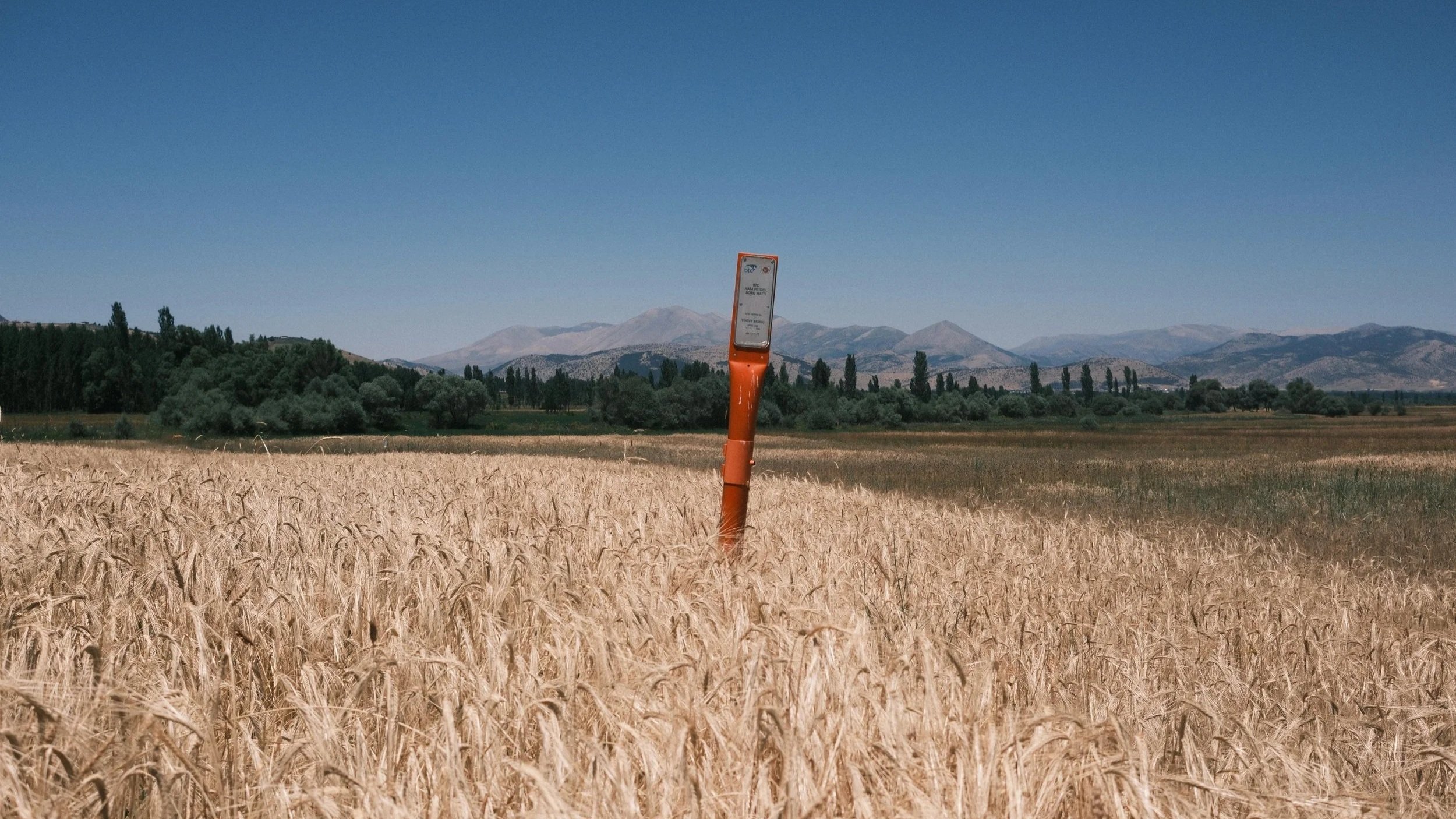
Figure 9: BTC Pipeline marker in Turkey above a wheat field, as only shallow rooted crops are allowed in the pipeline exclusive zone. Photo: Alp Demiroglu
Conclusion
The Baku-Tbilisi-Ceyhan and Kazakhstan-China oil pipelines reveal that capital-backed infrastructure is always political, inscribing patterns of visibility, control, and marginalization onto the landscapes they traverse. Built through a dispersed Western consortium, the BTC manages minority presence through avoidance, routing itself around Armenia and Kurdish regions to secure an uninterrupted investment corridor while relegating minority communities to the margins of its corporate capital narrative. In contrast, the KzC pipeline, funded through Chinese sovereign finance and near-complete state control, manages minority presence through incorporation, knitting the infrastructure directly into Xinjiang’s territorially integrated economic and security apparatus. The pipeline thus operates as a dual-extraction machine: pumping oil east to China while pumping capital service payments back to Beijing, reinforcing a cycle of financial obligation.
““To live beside these corridors is to have one’s belonging rendered provisional according to a logic authored elsewhere and pressed into the surrounding architecture of checkpoints, security zones, and camps.””
These different modes of engagement—avoidance versus incorporation—arise not from neutral engineering decisions but from competing economic and geopolitical rationalities. Neoliberal multilateral finance fosters a corridor that avoids potentially contentious political subjects; state-centric sovereign investment absorbs territory into a centralized developmental regime. Yet both logics share a fundamental orientation: infrastructure redraws who is visible, who is marginal, and whose landscapes are remade in the name of energy circulation. Nor is oil the end of the story. In each corridor the pipeline functions as a pretext: the first, most financeable incision through which a wider extractive and logistical apparatus—reaching toward rare earth and other critical minerals—is subsequently installed. What is redrawn, finally, is not only territory but identity. To live beside these corridors is to have one’s belonging rendered provisional according to a logic authored elsewhere and pressed into the surrounding architecture of checkpoints, security zones, and camps. These are not just instruments of control, but engines of documentation, with the corridor being sustained as much by the data they generate as by the lands they occupy (Figure 10). As Andrew Barry observes, “if the pipeline corridors were defined as much by the production of information as the occupation of land, then the borders of these corridors needed to be progressively refined, adjusted, and defended through the production of more information.”
In doing so, pipelines like the BTC and KzC do more than move oil; they produce political geographies. They define regions as secure or risky, populations as partners or obstacles, and territories as integrated or avoidable. As corridors of capital and power, they exemplify how infrastructure shapes not only material flows but the social and political contours of post-Soviet Eurasia.
Figure 10: Sangachal Terminal in Baku, Azerbaijan. Still operated by BP after the transfer of the pipeline to SOCAR. It is the start, and main pumping station, of the BTC pipeline. Photo: Alp Demiroglu
Citation:
Alp Demiroglu and Mauricio Meza, “Corridors of Capital: Competing Systems of Financing and Worldmaking in Eurasia,” Platform, August 10, 2026.