Snakes and the City: What Venomous Snakes Reveal about who the Australian Suburb is Built for
A member of the public rings. They have just seen what they think is an eastern brown snake in their yard and they want it gone, now. The snake handler asks the usual questions. Is it still visible? Has it been seen before? How close is the house to bushland or a reserve? The answers are reassuring. The yard backs onto a nature reserve, and a snake not seen before is probably one that is just temporarily and opportunistically passing through. Left alone it will move on, and removing it may open a niche for another snake, perhaps one less habituated to and tolerant of people. None of this lands. “I don’t care, I just want it gone,” says the resident. “It doesn’t belong in my backyard. It might bite one of my kids. If you won’t do it, I’ll do it myself, so it never comes back.”
One of us has taken some seven thousand calls like this over a decade as a licensed snake handler in Canberra, Australia’s aptly named “Bush Capital.” The other is an urbanist who has spent a career on housing, property and the ordering of cities. What strikes us both about the exchange is how little it has to do with risk as the handler assesses it. The fear is real, but it is not simply the resident’s own. It draws on stories, images and expectations that circulate beyond any one yard, and it is underpinned by an apparatus of hotlines, removal services, licenses and online community noticeboards that treat the snake’s presence as a problem to be resolved. We might call this arrangement an affective architecture: a fairly durable organization of emotions, symbolic classifications and material systems through which some forms of life are felt to belong in and at the edges of the city, while others are perceived as threats. Like any architecture, it is assembled, it endures and it can be mapped. This piece sketches that map for readers who design, plan and build the places where encounters like the one described above happen.
Why snakes? Over the past two decades urban studies has built a substantial account of cities as multispecies places, from urban wild things to possums crossing the threshold of suburban Australian homes, flying foxes in Melbourne and bats in the house. Nigel Thrift’s Killer Cities (2021), the book that prompted this essay, audits the harm cities do to animals on a planetary scale and calls for “metrofitting” the city so that it actively accommodates other species. Yet snakes barely appear in any of this, Thrift’s metrofitting included. Where they do appear it is mostly in herpetology, which focuses on their evolutionary biology, their spatial and behavioral ecology and the pressures they face, including their part in conflict, translocation and displacement.
We think snakes, and venomous species in particular, are worth attention precisely because they fit so poorly. They are what we call diagnostic figures: animals whose treatment makes a wider system of inclusion and exclusion legible. Kittiwakes on Tyneside do similar work, provoking anxieties about the vulnerabilities of the ordered city, concerns which are disproportionate to the trouble these birds cause. Commonly encountered native snakes like the eastern brown (Pseudonaja textilis) are protected in law yet routinely harmed, ecologically vital yet almost never welcomed, and they cut across the categories urbanists use to group urban animals. They are at once commensals that feed on the rodents our waste practices support, adapters to the fragmented edges between bushland and suburb, adopters of stormwater drains and warm concrete, and instinctive avoiders of people and their companion animals.
The snake’s relation to the city is ambivalent (Figure 1). The mundane resources and infrastructures that make the suburb habitable for snakes, the rodents, the warmth and the water, also expose them to harm: fruit nets, traps, rodenticide, cars, pets, swimming pools, removal and relocation and, of course, the long-handled shovel. A snake can flourish and perish in the same yard, even on the same day.
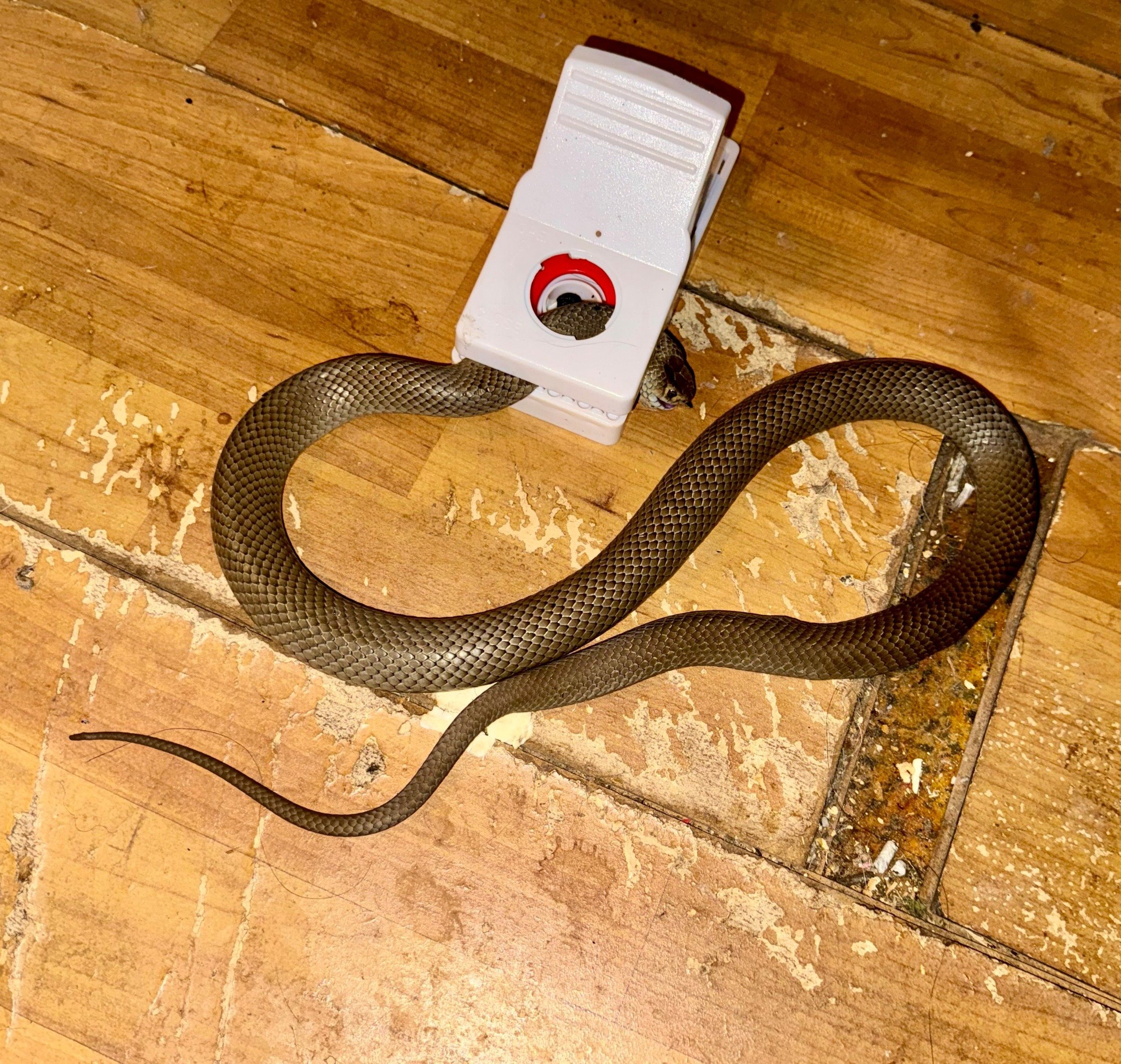
Figure 1. A brown snake caught in a rodent trap indoors. Following the rats and mice into the house exposes snakes to the same devices set for their prey. Photograph by Gavin J.D. Smith.
The eastern brown has a popularized reputation for being hostile, bold and deadly, and countless stories circulate online of these snakes “chasing” people. Like other Australian snakes, brown snakes are shy, sensitive and cryptic behaviorally. They bite people, dogs and cats in self-defense, and most bites follow a deliberate provocation, or someone inadvertently stepping on or close to one. None of this is to deny that brown snakes can be dangerous. They cause the majority of snakebite deaths in Australia, partly because their urban-adapted behavior brings them into contact with people, pets and properties. Our point is that the fear they elicit is out of proportion to the risk they present, because it is organized by relations that extend well beyond the snake.
Those relations center on property. The urban geographer Dallas Rogers has described what he calls “venomous property” in the settler colonial city. From the outset of colonization, the continent was framed as hostile, and colonial writing is awash with references to snakes interrupting surveys, frightening settlers and obstructing the conversion of wilderness into property. Today, a snake in a backyard unsettles the promise of enclosure – the fence, the title and the sense of dominion – and it symbolically devalues the asset by showing that nature persists in a space that was supposed to have been cleansed and domesticated. One of us recalls instances of agitated real estate agents conveying how “catastrophic” it would be if prospective buyers learned that snakes sometimes utilize the yards of listed properties. In some cases, viewings were canceled, less from snakebite risk than from the optics of a potential snake sighting. We know of no systematic research on snakes and house prices, although there is evidence that wild animals near housing can depress values even where proximity to nature otherwise raises them.
““...a snake in a backyard unsettles the promise of enclosure... it symbolically devalues the asset by showing that nature persists in a space that was supposed to have been cleansed and domesticated.””
The setting matters as much as the animal. Recent experimental work finds that the same snakes are rated more threatening and more disgusting when pictured in urban rather than natural settings, and that in urban settings individual differences in snake fear largely stop predicting the response. It is arguably the place, and the way it is coded, as much as the actual snake itself that generates the fear. And snakes are very good at turning up in the wrong place: garden beds, swimming pools, garages, school playgrounds and, sometimes, bathrooms and bedrooms. Nor do these organisms distinguish between rich and poor: habit and opportunity decide which side of the fence they occupy.
The questions residents ask after an encounter are revealing (Figure 2). How did it get in? Will there be more? How can the house be snake-proofed so that another is never seen again? These are questions about sovereignty over territory. They treat the land as fully domesticated and controllable, and they sort all other life along a spectrum from welcome visitor to unwelcome intruder. This is a form of ecological bordering. Settler urbanism has long depended on spatial separation, between Indigenous and non-Indigenous people, urban and rural, nature and infrastructure, and it extends the same logic to species. Yet this architecture, though pervasive and obdurate, is neither natural nor universal. Across Aboriginal traditions, snakes figure in diverse ways: as kin, as protectors, as lore and law, and as information about the state of Country, read for what their movement, abundance or absence says about water, fire and the balance of other species. A different arrangement of knowledge about, and forms of connection with, snakes has been practiced on the same ground for a long time. We do not speak from within those traditions, but their existence reveals that the ophidiophobic suburb is a product of colonial, religious and economic histories, and powerful cultural forces, rather than a fact of nature.
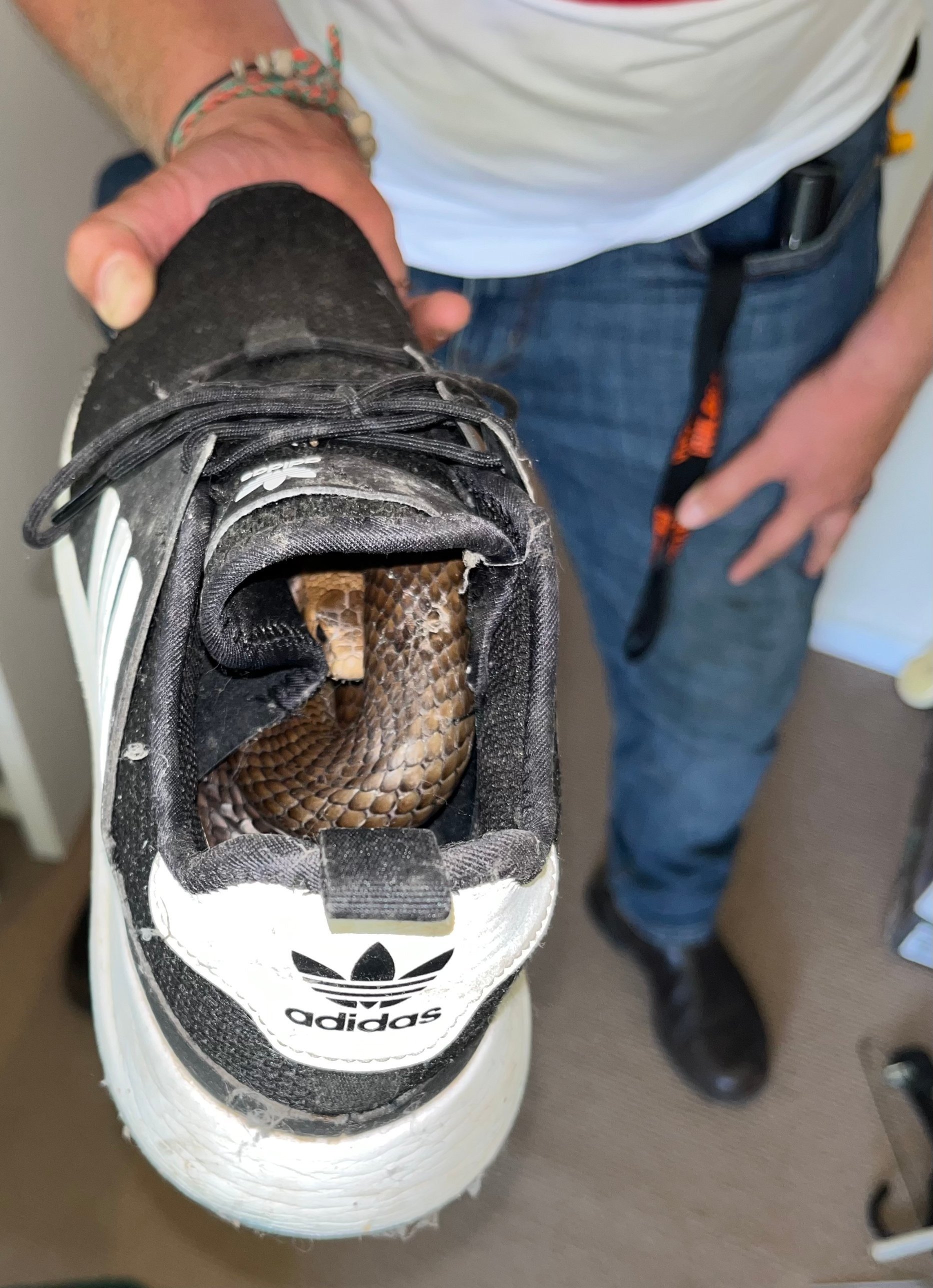
Figure 2. A snake found inside a shoe during a house call. Encounters in the most intimate spaces of the home prompt questions about how it got in and whether there will be more. Photograph by Gavin J.D. Smith.
If the snake marks one pole of the suburb’s affective spectrum, the pet dog marks the other. Companion animals sit at the center of what we might call the suburb’s infrastructures of care. They are insured, microchipped, vaccinated, legislated for, loved and mourned. Whole segments of the built environment, from yards, parks and pavements to cafés and pubs, have been recalibrated to accommodate them, and pet-friendly planning is now an ordinary item on a council agenda. The snake triggers a biopolitics of removal; the dog by contrast triggers empathy, policy reform and consumer innovation.
This asymmetry is not simply a cultural preference that argument could reverse. Dogs and humans have co-evolved over many thousands of years, and the dog returns the gaze, reads the face and can be named, trained and grieved. The snake, as popularly depicted, offers nothing comparable, so any attempt to make room for it has to work without obvious reciprocity. But the asymmetry is also out of line with the risks. Between 2001 and 2021 the National Coronial Information System recorded 50 deaths in Australia involving snakes, less than three a year. Horses were involved in 222, cattle in 92, dogs in 82 and kangaroos in 53 (road collisions). The hospital data tell the same story: in 2021–22, dogs put roughly eighteen times as many Australians in hospital as venomous snakes did (9,542 against 539). Yet dog bites rarely trigger media and moral panic. They are framed as individual aberrations, manageable through responsible ownership, training and containment. The snake, by contrast, is treated as inherently untrustworthy: its danger assumed, its presence exceptional, its removal usually non-negotiable.
Snake fear is also often routed through the figure of the vulnerable pet. News stories and community noticeboards cast snakes as opportunistic visitors poised to strike a beloved cat or “curious” dog. In these accounts, the snake’s danger lies not only in its venom but in its capacity to violate the bonds of the multispecies household. The pet, in this sense, is the inverse of the snake: not a breach in suburban order but its embodiment. Suburban pets show what is already thinkable within ecological urbanism; the treatment of snakes shows what remains unthinkable.
What happens after the call is where the architecture becomes most visible to a planner’s eye. The hotlines, apps, community noticeboards, mapping tools, licensing and insurance protocols that respond to snake encounters form a distributed, reactive and partly commercialized mode of governance. They operationalize fear, converting discomfort into intervention and, in Kai Bosworth’s phrase, affect into infrastructure. Their logic is exclusion rather than containment. Where pets are integrated into urban space through leash laws, dog parks and pet memorials, snakes are expelled, treated not as animals but as events: breakdowns in domestic order to be resolved as quickly as possible.
The snake handler is a vital component of this apparatus. Some snake catchers have become media creators and influencers, staging in their posts (often unintentionally) both the errancy of snakes in urban environments and human mastery over them; while also being key conduits for the flow of information about snakes, accounting for their complex biology, in-situ behaviors and why they matter. And yet, the mass intermediation of snakes in urban places, and their ensuing removal by those paid to wrangle them, becomes a cultural performance, a risk event or spectacle that prompts clicks and wider circulation. In this regard, a supposedly unruly animal is made hypervisible precisely at the moment of its displacement to an anonymous bushland site on the urban edge, where these tainted creatures are deemed to belong. In instances where the expanding snake catching apparatus is too slow or costs too much, residents may sometimes take matters into their own hands, as the caller we began with threatened to do (Figure 3).
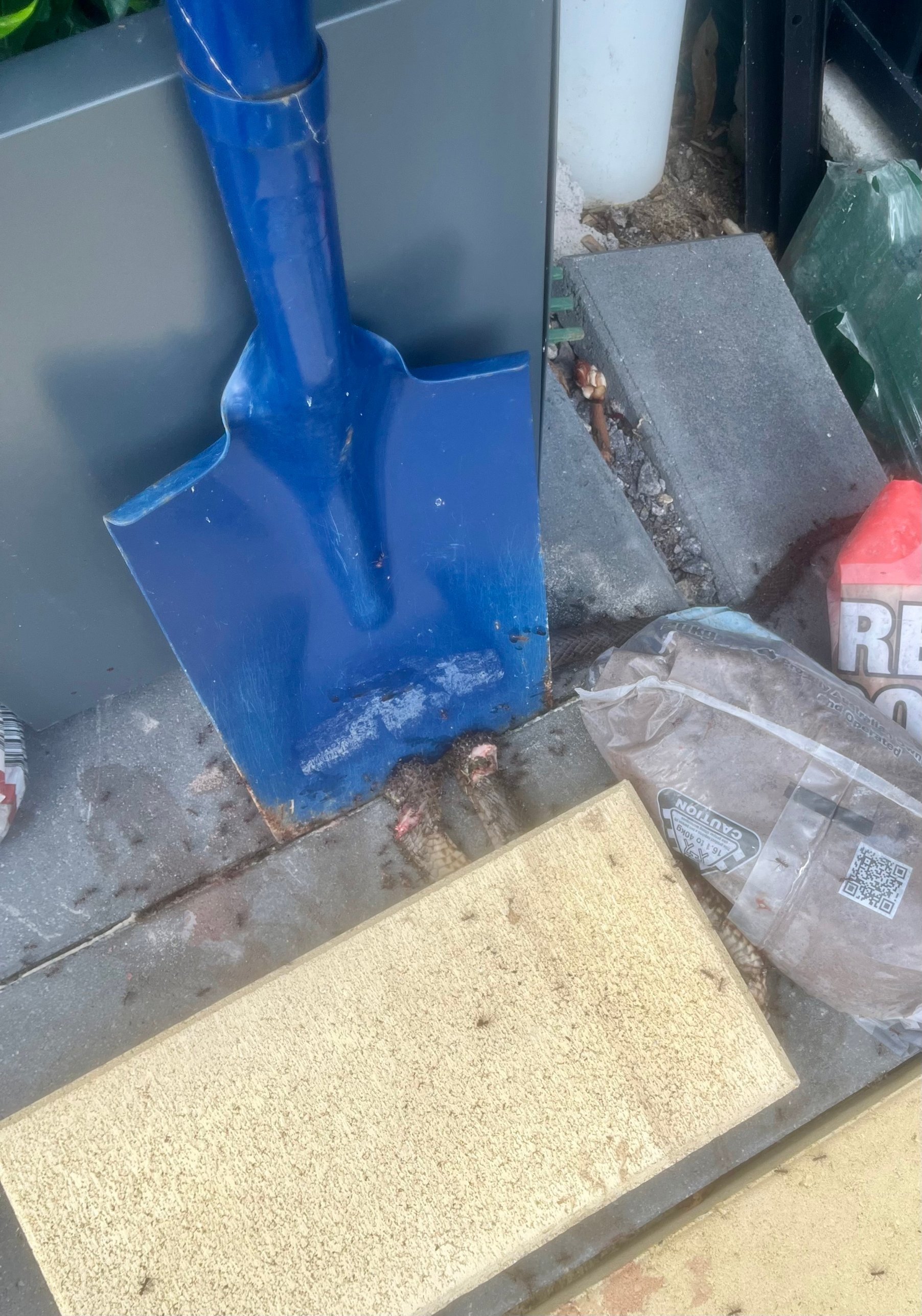
Figure 3. A snake killed with a garden spade beside a suburban planter. Where removal services are too slow, some residents act for themselves. Photograph by Gavin J.D. Smith.
These systems present themselves as apolitical, but they do significant cultural work, defining which species warrant concern and “absenting”, and why this is. The snake does not fit neatly into wildlife corridors, green infrastructure models or biodiversity plans, and so it is managed reactively, after suburbs have been designed, built and occupied. What emerges is something like a settler ecology of fear: a governance logic in which affectively charged species are targeted because they violate the idea of the city, and by proxy the yard, as a pacified and curated place. Cities meanwhile often brand themselves with charismatic native species. Ironically, Canberra’s own emblem in the Parks and Conservation Directorate, the Gang-gang cockatoo, is now listed as endangered as both fire and development destroy the woodland (and tree types) it needs to breed. Greening of this kind is curation rather than restoration, and it limits which organisms are allowed to flourish under its banner.
As an urban presence, the snake is unusual in another way. It makes no demands, attends no protests and seeks no recognition. It inhabits a spacetime of its own: not the clock time of the commute or the working week, but a snake time set by season, temperature and a home range its ancestors have used for millennia. Thrift borrows the term “enjambment” from poetry, where a line breaks but the sentence runs on, to describe the small interruptions that halt the flow of urban life and that open a space in which habituated feelings become available for reflection and perhaps revision. A snake sunning itself on a suburban path is just such an interruption. Its rumored presence works at a distance, too: in spring a bush track or cycle path becomes a potential basking site, routes change and alertness rises. Snakes do not merely inhabit the suburb; they alter its atmosphere, and atmosphere is something designers work with.
What might this mean for those who plan, design and build the suburban edge? A few things follow.
The first is that the snake is not going anywhere. Eastern browns flourish in ecotones where the built environment meets bushland or “wasteland,” the kind of space that new developments pressing against reserves keep producing. As climate change potentially shifts the ranges and distributions of some venomous species toward the poles, which in Australia means toward the more densely populated south and east coasts, encounters are likely to become more common, not less. Call records show requests for removal rising year on year over the past decade, while snakebite hospitalizations nationally have stayed low and stable. Population growth and new estates at the bushland edge account for some of that rise, but perhaps not all of it.
The snake’s adaptation is made of the ordinary details of the built environment. The biologist Jakob von Uexküll called the perceptual world of a species its Umwelt: the world as that creature senses and uses it. In the snake’s Umwelt, a water-meter box is a burrow, a gap in cladding is a refuge, a concrete slab is a place to warm up, a stormwater drain is a corridor, a backyard pond is a source of water and food and dense garden planting provides requisite cover, shade and cooling. None of these was designed with a snake in mind. All of them are snake architecture, nonetheless. The suburb is already a multispecies infrastructure; the question is how to design and share it in more convivial ways. A snake-literate reading of a standard detail, the habitat features and thermal sources snakes prefer, would tell a designer a good deal about where encounters are most likely, which materials and designs might reduce human–snake and pet–snake conflict, and perhaps where snakes could be steered rather than simply prohibited.
The second is that exclusion is not the only response. A minority of the handler’s calls come from people who want advice on coexistence rather than removal: from those who have observed a resident snake over several seasons and who opt to live safely alongside it. For instance, staff at a botanic gardens café on the New South Wales coast tolerate a red-bellied black snake that regularly basks near the tables; they have named it Big Bertha, erected signs and let customers decide where to sit. Practices like these are local, private and rarely visible in media or policy. They are more common at the long-settled bushland edge, where encounters are routine, than in newer estates, where a snake is an event and incoming residents have little experience of living beside bush. They suggest that the affective architecture we describe is dominant rather than total, and that institutions reproduce it more reliably than every resident holds it.
The third is that there are precedents for accommodating unloved species rather than excluding them. In northern Norway and on Tyneside, planners have begun to design nesting sites for kittiwakes around where the birds themselves choose to settle. Of course, while loud, Kittiwakes are harmless, so the potentially lethal snake is a harder case, and there is as yet nothing comparable for it. The question is not how to keep snakes out, which is impossible, but how a suburb might be designed, signed, landscaped and governed so that a snake’s appearance is read as information about a functioning ecology rather than as a breach of the peace. That would mean treating the ecotonal edge as multispecies habitat rather than as a buffer. It would also mean investing in snake education for incoming residents of edge estates, and perhaps inserting a module in the national school curriculum, taking snake awareness as seriously as bushfire preparedness.
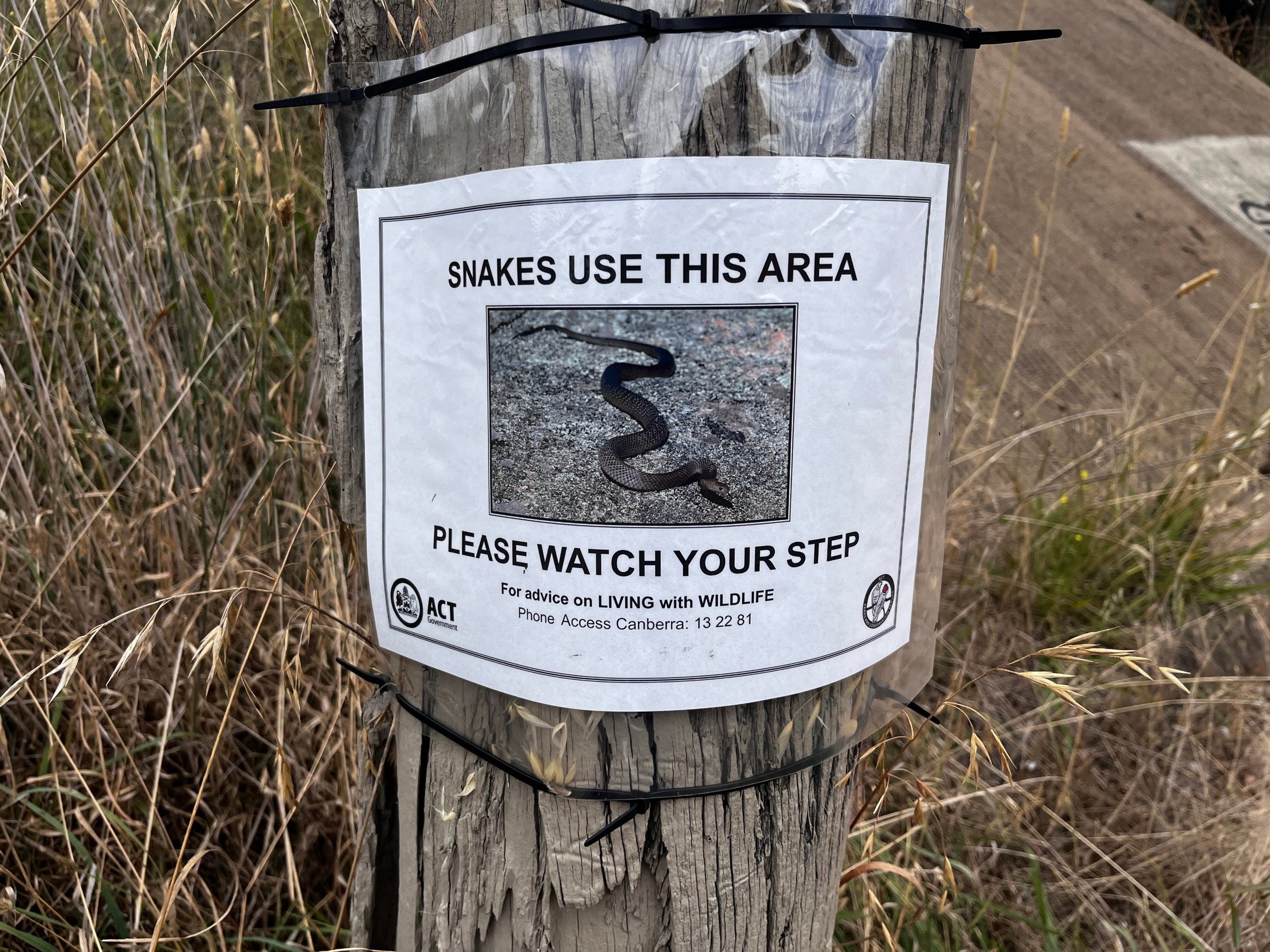
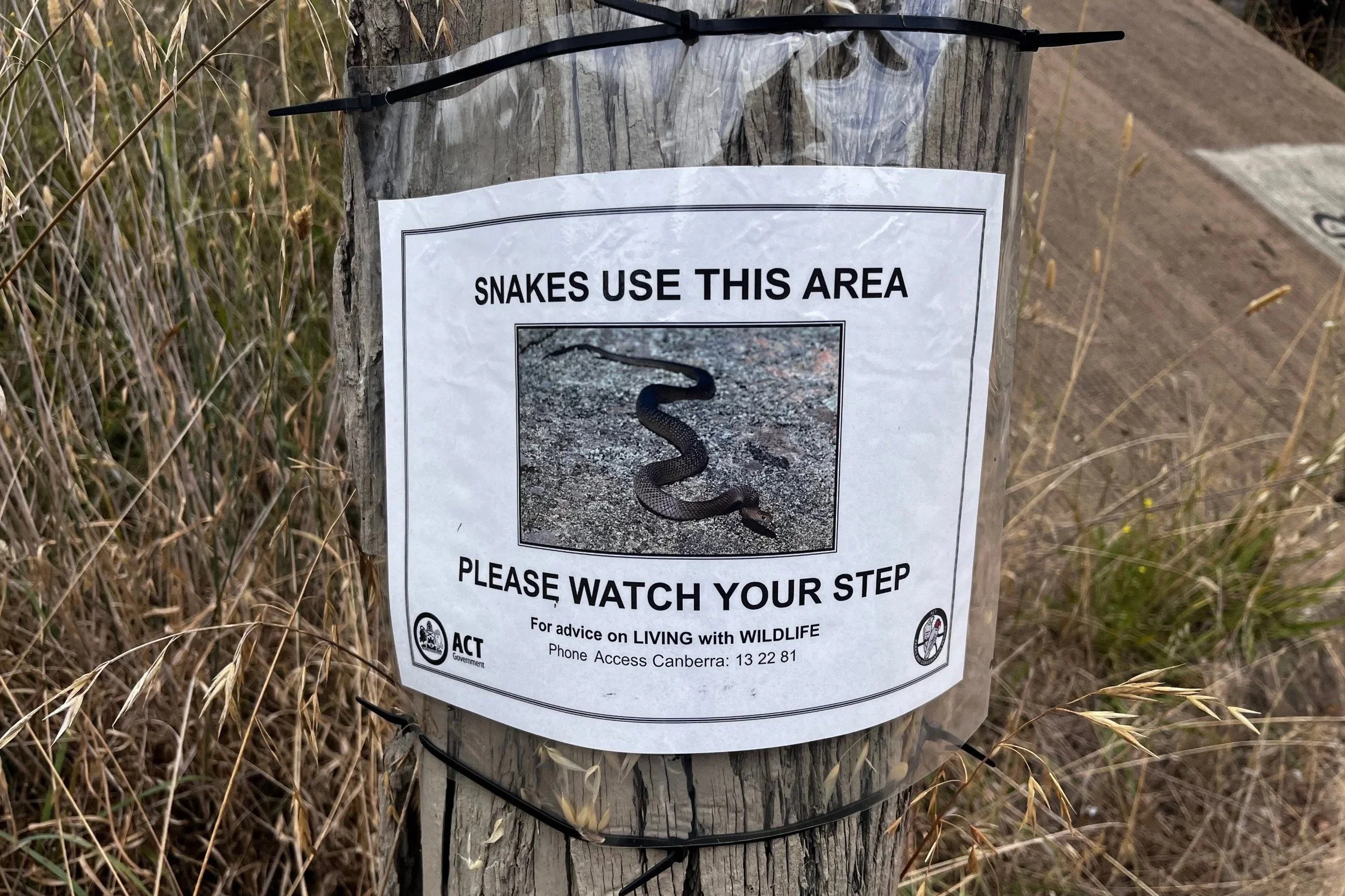
Figure 4. An ACT Government sign at the bushland edge: “Snakes use this area. Please watch your step.” Signage of this kind treats snakes as co-users of shared space rather than intruders. Photograph by Gavin J.D. Smith.
None of this asks the snake to change. It has long since adapted to the affordances of the suburb, with an embodied competence that the removal app and the hotline fail to register. It is not snakes that have failed to adapt to humans and their companion animals; it is the affective cultures of the city that have not reciprocated. Making room for snakes would require, first, greater respect for urban otherness: learning to see urban spaces as inhabited by diverse forms of life, each with its own unique requirements and contribution. It would mean becoming more attuned to snake behavioral rhythms, as various First Nations communities have long been. For pet owners, it might simply entail keeping a closer eye on dogs and cats in the warmer months when snakes are most active, and perhaps walking dogs on leads or elsewhere where signs say snakes use an area (Figure 4). It might also mean setting aside parts of yards and reserves where snakes are tolerated, separated from the areas people use most or buffered by materials that limit contact. Whether the settler suburb can learn that kind of attention, tolerance and space-making is an open question. The snake, which already does its best to avoid us, remains the more accommodating party.
Citation:
Gavin J.D. Smith and Roger Burrows, “Snakes and the City: What Venomous Snakes Reveal about who the Australian Suburb is Built for,” Platform, November 23, 2026.