Sabogal's Architectural Depictions and Other Visions of the Andes
In the early twentieth century, artists, politicians, and writers based in the coastal city of Lima began to consider Peru’s mountainous interior. Under the umbrella of indigenismo, this loose network framed Peru’s indigenous population as the bedrock of national identity. Taking off between 1910 and 1920, amid increased peasant insurgency protesting the neo-colonial land tenure system, the indigenistas often saw their enterprises as key to ending national policies and cultural norms that subjugated native populations in the central Sierra. However, according to Alberto Flores Galindo in his classic In Search of an Inca, the politics of indigenismo were ambivalent. Fearing the spread of Marxism or the specter of an Indigenous invasion of Lima, the indigenistas did not empower Indigenous communities or directly support their struggle. Rather, they framed the “Indian” population as “people on the margins of history, static, inward-looking, necessarily sheltered from modernity, immobile and passive, singular and abstract” in both representational artworks and political advocacy.
Peruvian architectural historian Elio Martuccelli argues that although architectural motifs occupied a secondary position relative to portraiture and landscape, they nonetheless featured prominently within Peruvian pictorial indigenismo. Scholarly attention to indigenista architectural representation, however, remains sparse, appearing in passages in Natalia Majluf and Eduardo Wuffarden's 2013 exhibition catalog on José Sabogal, and art historian Horacio Cerna Ramos's article examining painter Enrique Camino Brent's engagement with neo-colonial Andean architecture. Part of what makes indigenista architectural representations difficult to navigate is architecture's entanglement with land. From the colonial era through the 1969 agarian reform, much of the Indigenous highland population worked under semi-feudal conditions on large estates owned by descendants of Spanish colonizers or in mines owned by foreign corporations, while steadily losing their communal land. In recent years, scholars of the built environment, such as Lucia Allais, Sheila Crane, Gabriel Cuéllar, Andrew Herscher, Catherine Ingraham, and Reinhold Martin, have foregrounded land as architecture's precondition, attending to how architectural and planning practices have participated in the transformation of land into private property and real estate. Architecture's dependence on land suggests that indigenista representations of buildings were never politically neutral. Both Indigenous and colonial architecture emerged from land subject to hierarchies that indigenismo only equivocally challenged and mostly passed over when architecture became its subject. The question, then, is what Indigenous architectural imagery signified within the specific conjuncture of mid-century Peru — a moment in which semi-feudal land relations remained structurally entrenched.
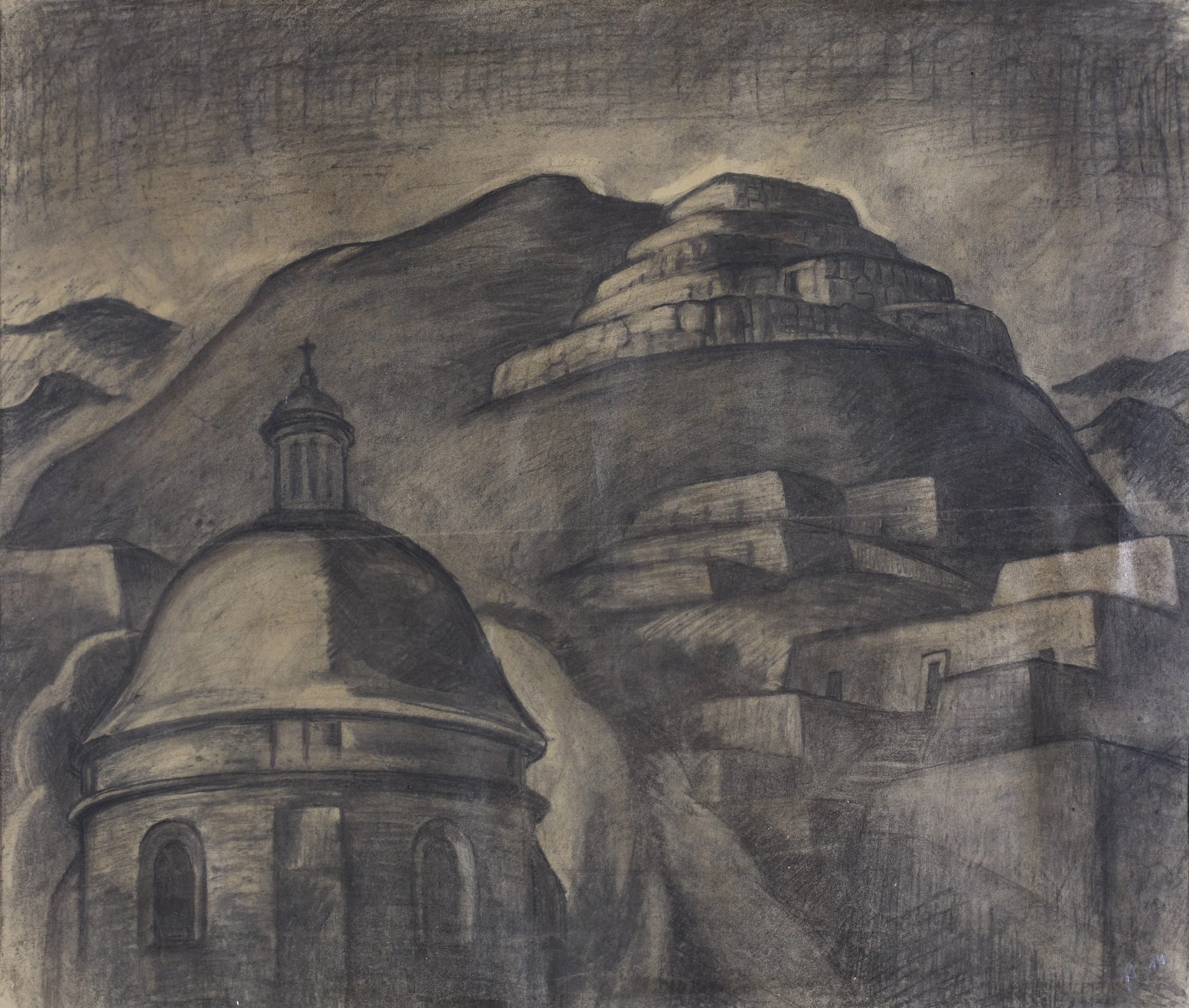
Figure 1: José Sabogal, Vista del Cuzco y Sacsahuamán. 1945. Charcoal on paper, 55 x 64 cm. Collection of Isabel María Sabogal Dunin Borkowski.
One way indigenistas navigated this fraught entanglement was through abstraction, a pictorial strategy that let architecture stand in for the nation. After leaving his post at the Escuela Nacional de Bellas Artes, the founder of Peruvian indigenismo, José Sabogal, made Vista del Cuzco y Sacsahuamán in 1945. (Figure 1) Created during the second of his two longer stays in Cuzco, while he painted a series of murals at the Hotel de Turistas, the iconizing mode offers the ultimate expression of Sabogal's approach to Andean architecture. In this charcoal drawing, Sabogal suspends the viewer at eye level with the church’s cupola, enabling a direct gaze up at the Inka site. Rendered in sensuous shadow, Sabogal treats the dome, the citadel, and the cityscape with the same smooth tonality and pared-down block forms. By treating these built forms as largely formally equivalent, save the pronounced articulation of the citadel's stonework, Sabogal suggests an equivalence between Indigenous and Spanish heritage. In doing so, he projects the architecture of Cuzco as a manifestation of a resolved, hybrid national identity, a notion that overlooks colonial violence, which Bolivian activist and sociologist Silvia Rivera Cusicanqui has deemed sterile and politically inert.
““By treating these built forms as largely formally equivalent, Sabogal suggests an equivalence between Indigenous and Spanish heritage.””
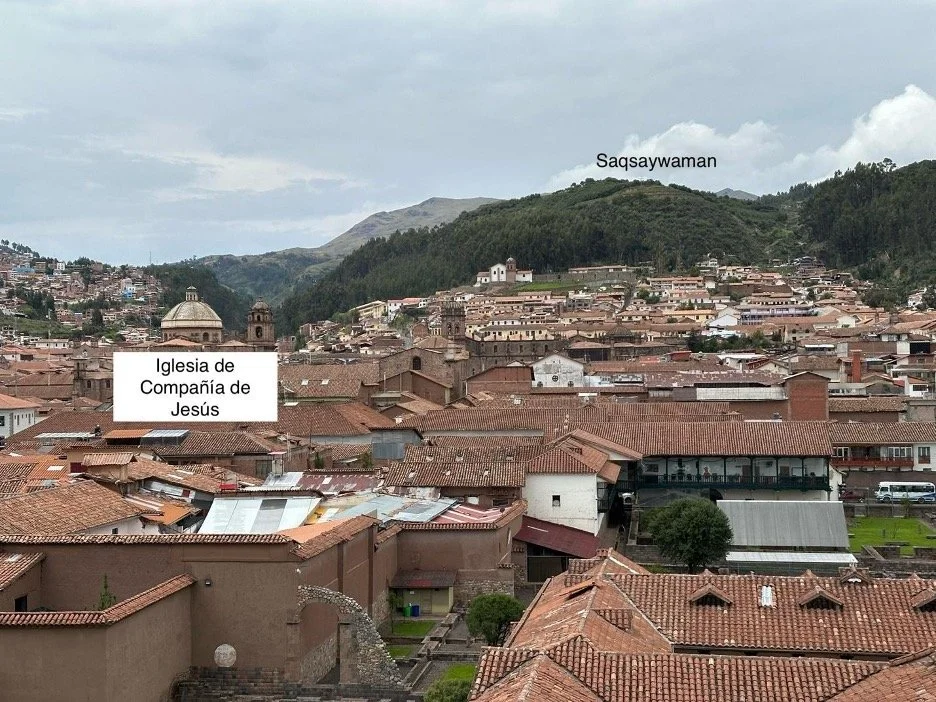
Figure 2: View of Iglesia de Compañía de Jesús and Saqsaywaman, photograph by Reed Miller, used with permission, taken December 2024.
Visitors to Cuzco can profit from a view of the city that includes the dome and the citadel from the bell tower of Iglesia de Santo Domingo. (Figure 2) From here, a viewer can observe what Sabogal left out of the frame or reduced to basic geometries. In the drawing, Sabogal abstracts the built environment and land between Iglesia de la Compañía de Jesús and Saqsaywaman— the tower of Iglesia de la Compañía de Jesús, a sea of tile roofs, the hillside, and another hilltop church— into orthogonal forms that serve as a shorthand for the stone blocks characteristic of Inka architecture.
““An apologia for colonial history and an enforcer of coloniality on ideological terms, Vista del Cuzco y Sacsahuamán spatially abstracts Cuzco by extracting aesthetic value from Inka architecture.””
As architectural theorist Fernando Luiz Lara sees it, abstraction promotes a surface understanding of space that negates relational spatial understanding. Lara roots spatial abstraction in a deep history with present-day political resonance, claiming that abstraction serves as a tool of coloniality and that architecture relies on it to operate. An apologia for colonial history and an enforcer of coloniality on ideological terms, Vista del Cuzco y Sacsahuamán spatially abstracts Cuzco by extracting aesthetic value from Inka architecture.
For Sabogal, abstraction enabled artistic engagement with Indigenous architectural heritage on formalist terms, displacing the relations of the land on which that architecture materially depended. In Vista del Cuzco y Sacsahuamán, Sabogal heralded the convergence of Spanish and Inka forms in Cuzco, saying little about the violence of colonization that made this convergence possible and how such violence persisted throughout the twentieth century in the arrangement of land. Sabogal's abstraction functioned as a means to represent the postcolonial nation as conflict-free, thus transforming longer histories of abstraction in what is now Peru, such as those practiced by the Inka. Carolyn Dean describes these as primarily a means of communicating the values of the state and managing relationships between the state and its subjects. As Dean writes in Inside Abstraction, the Inka used abstraction to "affect attitudes and influence behavior; 'aesthetic appearance' was a desirable byproduct but was not the primary objective." With Dean's reading of Inka modes of abstraction in mind, it becomes clear that Sabogal did not simply impose abstraction on the Inka forms he captured, but instead put abstraction to work for the needs of a modern nation-state seeking a stable cultural identity amid political instability rooted in the violence of colonial expropriation and militant movements for land sovereignty.
As part of indigenismo and even as it waned in prominence as younger generations of artists embraced abstraction and viewed Sabogal as dogmatic, art made in the Andes gained prestige in Lima’s art spaces. In the 1940s, Andean and Amazonian craft that melded Indigenous and colonial traditions, known as arte popular, increasingly entered Lima markets and galleries. Prominent forms of arte popular include mates, carved gourds, and retablos, portable altar pieces made from potato-based pulp that combine a Baroque form and Indigenous content. Any tourist visiting an artisan craft market, or even the departures terminal at Jorge Chavez in Lima, can purchase a miniature retablo or mate for a modest price. While arte popular entered the privileged spaces of high art in the second half of the twentieth century, today, arte popular, or its mass-produced iterations, often functions as cheap tourist goods. Both in the gallery and the market, arte popular aligns with Eurocentric expectations of artistic non-utility, reduced to either an individual artistic signature or exchange value, and alienated from its cultural context and ritual function.
““Sabogal did not simply impose abstraction on the Inka forms he captured, but instead put abstraction to work for the needs of a modern nation-state seeking a stable cultural identity amid political instability rooted in the violence of colonial expropriation.””
Although displaying Andean and Amazonian crafts in cosmopolitan spaces supported an indigenista agenda for constructing a national identity, artisans depicted Andean architecture in ways that challenged the genre's established conventions. In Critica De La Artesanía, Peruvian poet and critic Mirko Lauer theorized that traditional art history and production privileges representation over what he calls the “support,” or the material structure of the art object. Lauer concludes, then, that traditional craft objects overcome the division between representation and support that more often dictates artistic production found in galleries and museums. Megan Sullivan and Mijail Mitrovic have recently interpreted Lauer's famously dense texts and argued for his importance to Marxist art history. Lauer's recently revisited legacy aside, a closer look at an example of non-commodified arte popular illuminates Lauer's theorization and offers an alternative representation of Andean architecture to the one proffered by Sabogal.
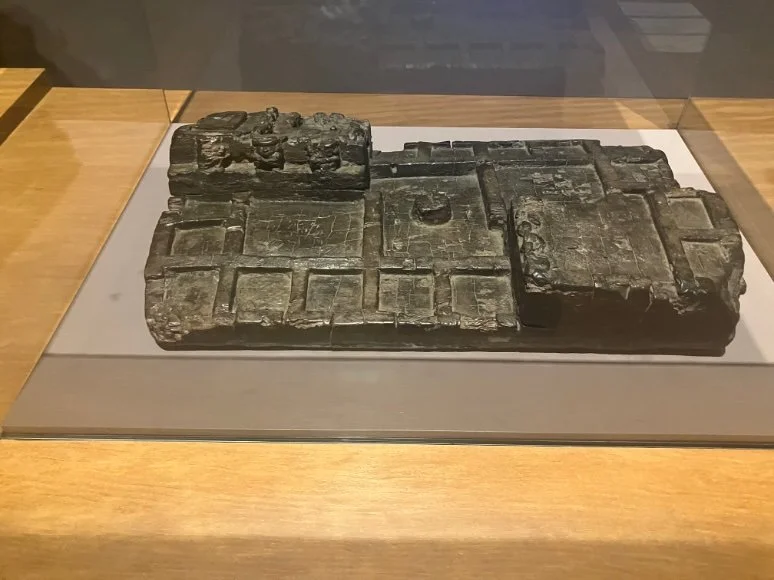
Figure 3: Yupana, Inka architectural model, 1400-1532 AD piedra tallada y pulida (carved and polished stone), MALI.
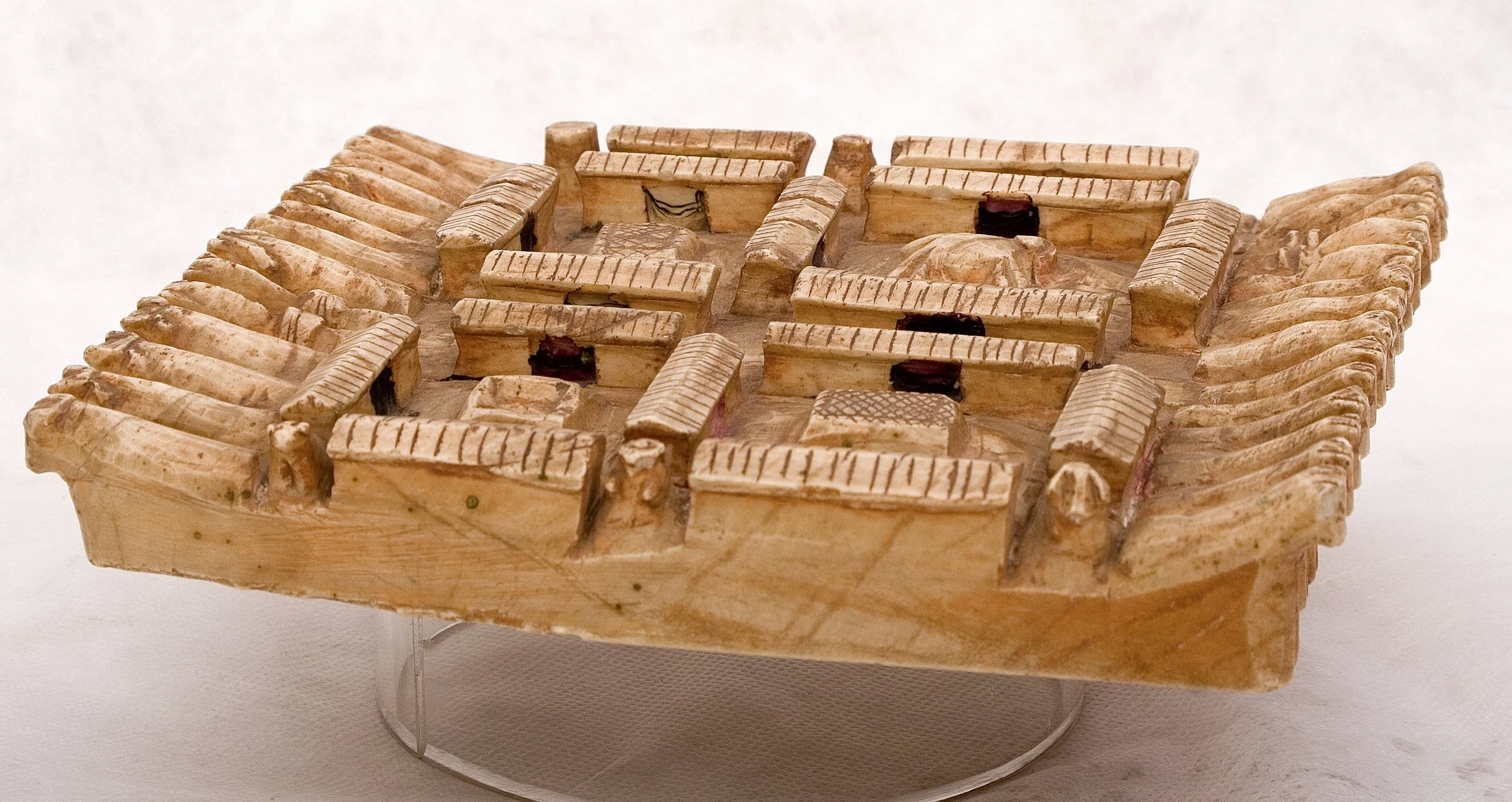
Illas, made in regions with alabaster deposits, such as Ayacucho or Puno, are portable sculptures dating to the mid-twentieth century. Arguably drawing on the Inka precedent of yupana, carved stone objects thought to be counting devices or potentially architectural models, many illas depict courtyards or village squares. (Figure 3) Sometimes sized to fit in the palm of a hand, many illas are meant to be carried, to protect their owner, to link her to her home, or to serve as a portal to the spiritual realm. Illas thus continue what Andrew James Hamilton classifies as pan-Andean practices of miniaturization, pointing to diverse practices such as Chimú architectural maquetas and Inka conopas. In Scale and the Incas, Hamilton argues that while Indigenous societies across the Andes made scaled-down objects, the word miniature carries Western baggage — it assumes a small object is a detailed representation of something larger, standing in for it symbolically. Hamilton argues that there is a lack of evidence that the Inka conceived their small-scale objects in this manner. Rather, the Inka thought of these objects as functional items that assured social benefit through ritual offerings. Illas, too, are used in ceremonies to Pachamama, the Quechua term for Mother Earth. Illas thus show how makers of arte popular consider Andean architecture highly situated and specific, not something to broadcast to audiences dispersed across space, coalesced under the unstable sign of the nation, as in Sabogal's frames. (Figure 4)
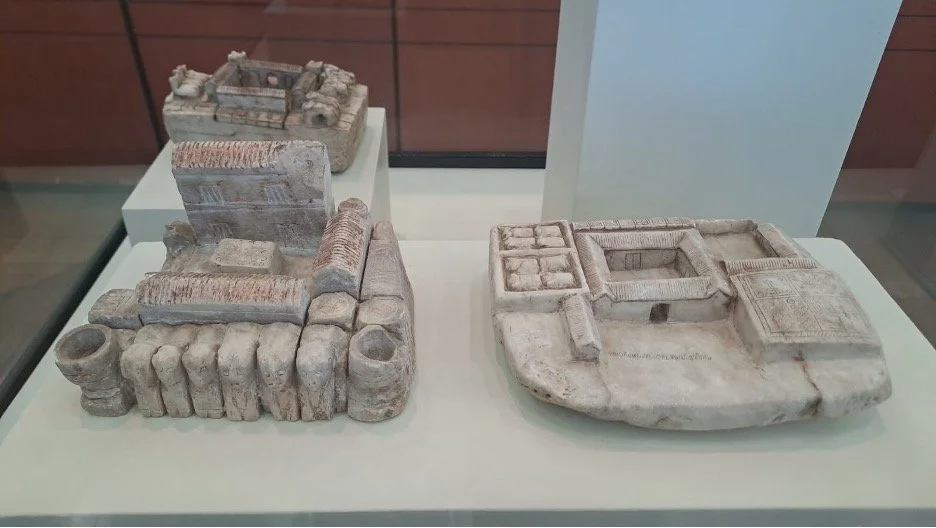
Figure 4: Various illas from MUCEN collection, Lima. Exact date unknown but likely mid-20th century.
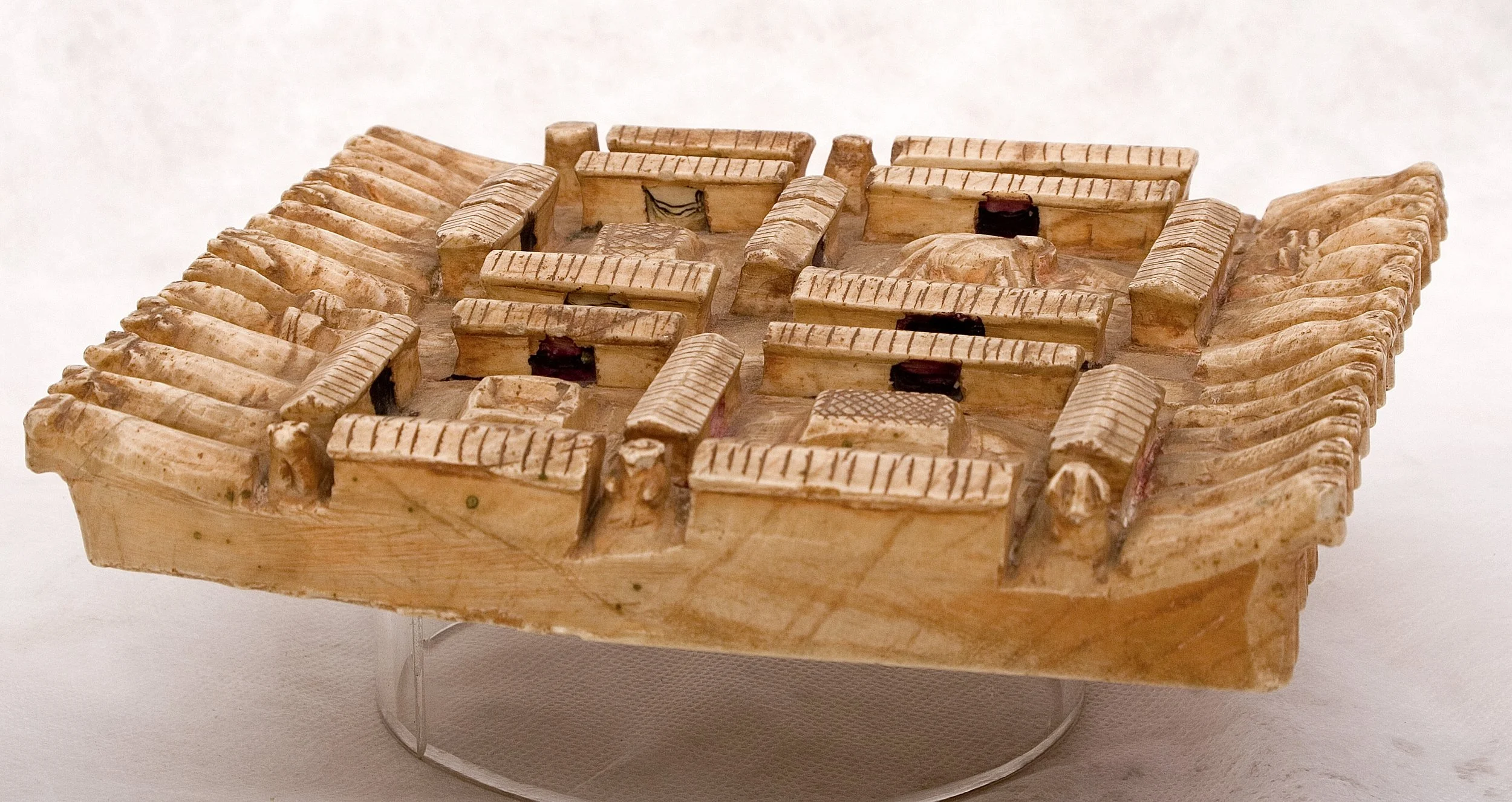
Figure 5: Unknown maker, Illa chacra, stone, twentieth century. Collection of the Museo de Arte de San Marcos, Lima, Peru.
More research is needed to unpack the illas, their representational strategies, and to understand how they are made, used, and circulated. A group of illas in the Museo de Banca de la Reserva collection in Lima shows a common motif of the genre. According to archivist at Museo de Arte de San Marcos Ivet Carrión Milla, this illa shows cattle protecting the farm as a "form of communal life" in which dwellings and bounty are shared, an alternate mode of land tenure that differed from the dominant one in the Andes at the time. While indigenista representations of Andean architecture gloss over the relations that shape the land on which it stands, illas foreground land as the basis of collective sustenance and social reproduction. Made from the situated tectonic resources they represent, illas link the carrier back to a specific place. As a form of architectural representation and a useful spiritual totem, illas thus transcend the gap between representation and the material support on which traditional notions of art depend, as Lauer theorized. Illas, draw on Andean techniques of the miniature and abstraction, to ultimately suggest new ways of understanding the politics of architectural indigenismo and architectural representation beyond Sabogal's vision.
Citation:
Madeleine Aquilina, “Sabogal's Architectural Depictions and Other Visions of the Andes,” Platform, November 16, 2026.