On Transhistorical Continuities and the (After)life of a Colonial Clocktower
As a scholar of colonial and postcolonial architecture with a background in archaeology, I am constantly on the lookout for surviving traces of the colonial past in our built environments. A true Mediterranean crossroads once governed by France as a protectorate (1881–1956), Tunisia is full of them—minor details, big buildings, and street patterns. Here the colonial past remains vivid in the language, law, architecture, and habits of the postcolonial present. While countless nineteenth- and twentieth-century buildings survive, keen observers will find more subtle historic continuities within contemporary spaces and structures. Recognizing and understanding those references enriches one’s knowledge of the spaces in which we live in both professional and personal ways. Appreciating them from a transhistorical perspective does so even more, often revealing critical connections that undermine the strict divisions between the colonial and postcolonial still too often taken to be impermeable. Such links furthermore demonstrate that the past lives not only through physical endurance, but also in architectural appropriation and reinterpretation.
A relatively simple clocktower, which I first encountered in faded archival images and then several times in brilliant color as I spent time in Tunisia, illustrates precisely this type of meaningful continuity. The clocktower is an apt item to use in advocating for consideration of the long(er) durée, as it is more than just a scaffold for a public clock. It is an archetypal apparatus of empire, and as such, this particular case—a life and an afterlife—stitches together the colonial past and postcolonial present in one corner of North Africa.
The political nature of timekeeping has been understood for a while. Indeed, as Joe Zadeh notes in “The Tyranny of Time,” “we discipline our lives by the time on the clock,” but people have of course also used the clock to discipline others. This practice is clearly evident in the placement of prominent timepieces on buildings throughout the European empires of the nineteenth and twentieth centuries. In Kolkata, Cairo, Hong Kong, Cape Town, Mombasa, and Mumbai, and beyond, clocks communicated the time, but also the horologic of Western “civilization” in territories far from Greenwich’s Royal Observatory.[1] The most astonishing example of what Zulfikar Hirji calls “chronometric colonialism” in the architecture of French-occupied North Africa may be the addition of a modern clock to the Mosque el Djedid (New Mosque) in Algiers by French officials in 1852 (Figure 1).[2] Where once the passing of time had been marked by the muezzin’s prayer call five times daily as determined by the lunar cycle, with the clock’s introduction one’s life took place in twenty-four systematized hours on repeat. The “blatant act of secularization” at the Mosque el Djedid was a somewhat rare occurrence though, and in most cases colonial authorities simply raised purpose-built towers for their clocks, rather than installing them on existing minarets.[3]
Figure 1. The Mosque el-Djedid (1660) and the equestrian statue of the Duc d’Orléans (Marochetti, 1845), Place d’Armes, Algiers. Photograph, ca. 1910. Author’s collection.
Public clocks as tools for social ordering were also erected in neighboring Tunisia, where administrators oversaw the destruction of Tunis’s historic walls during the final decades of the nineteenth century. There, Raphaël Guy (1869–1918) designed a post office (another quintessentially colonial institution) in the busy Bab Souika neighborhood within the medina. Guy was a major figure in the dissemination of Arabizing architecture in Tunisia, where he served as the principal architect of the colonial Civil Buildings Service, and in his many public buildings he fueled a revival in traditional decorative arts, recounts Fabienne Crouzet. Guy drew from existing architectural models like many of his Orientalist peers, but the curious minaret-like clocktower he created at the Bab Souika post office stood out both structurally and symbolically.[4]
Figure 2. Bab Souika Street and Post Office (Guy, 1906), Tunis. Photograph, ca. 1920. Author’s collection.
Guy’s post office was a picturesque punctuation mark that reflected the ambitions of an administration increasingly keen to adopt indigenous aesthetics while maintaining strict control (Figure 2). Over the otherwise symmetrical reinforced concrete building, the tower’s square base resolved into an octagonal tower, while an arcade of horseshoe arches held aloft its pyramidal roof.[5] Its crenellation recalled the medina’s razed walls, so in a way it filled a void; it fit in (Figure 3). While the architect’s explicit intent remains unknown, his design decisions made the post office seem like a natural component of the wider historic streetscape, and thus by extension, the French a logical presence too. This was something of a specialty for Guy, who had successfully adapted the minaret form to a clocktower at the city hall he created for Tunisia’s second city, Sfax, outside its historic core (Figure 4). There, as in Tunis and so many other occupied territories, the European administration draped itself in a cloak of appropriated cultural imagery meant to soften the intrusiveness of colonial regulation and control.
Figure 3. Bab Souika Post Office (Guy, 1906), Tunis. Plans, 1906. © Fonds Bétons armés Hennebique. CNAM/SIAF/Cité de l’architecture et du patrimoine/Archives d’architecture contemporaine.
““The enduring presence of objects referencing colonial hegemony is far from trivial, and … the secular “minaret” tower speaks volumes about consumerism, contemporary tourism, and intersections between heritage and identity in the postcolony.””
Figure 4. City Hall (Guy, 1905), Sfax. Photograph, 2024, by author.
Three decades after Tunisia’s independence, the modernizing government of Habib Bourguiba sought to expand the roadway through the traffic-choked medina and ultimately constructed a tunnel beneath the reorganized and rebuilt Bab Souika square.[6] With that, in 1986, Guy’s eighty-year-old post office and clock tower were razed, as one form of modernity yielded to another.[7]
I first visited the coastal town of Hammamet, fifty miles south of Tunis, in 2004. Exploring its flashy, faux old city enclave, the Médina Mediterranea, I found buildings constructed using wood, stone, terracotta, and traditional methods—a point of pride for the complex’s architect, Tarek Ben Miled, who at the time emphasized the importance of revitalizing local approaches that counter the ubiquitous “misunderstood modernity” (a colonialist construct) so “ill-suited to our climatic and sociological environment.”[8] I was surprised thus to come across a bright blue minaret-like tower over the entrance to a tourist restaurant and nightclub in the Medina’s main square. Its somewhat cartoonish appearance was a shocking juxtaposition with the carefully studied (loose) recreations of Mediterranean landmarks (e.g., Sidi Bou Saïd’s iconic Café des Nattes, Seville’s Torre del Oro, and Mahdia’s Skifa Kahla gateway) designed to lure visitors away from the far smaller, cramped historic center across town. [9] Only later, while reviewing historic images for a grad school research paper, did I make the connection between touristy Hammamet and Guy’s post office tower.
Careful inspection reveals some differences, but the correspondence is unmistakable. The new iteration at the Médina Mediterranea is a bit squatter than the original by Guy. Its merlons have been rounded out, no longer coming to the model’s points. Having lost its clock, the tower here gained a Palladian window of sorts; I suppose time is less relevant to partying tourists who might appreciate a view onto the square below. This also reflects the fact that the “tower” here is more of an articulated building façade capped with a rooftop cupola than a freestanding slender structure.
Two decades later, I returned to Hammamet and found that the tower remained in place, still chroma key blue, framing the entrance to the Shéhérazade Restaurant. Crossing its threshold, one now enters the realm of dinner show spectacle and “1,001 Nights” (Figure 5). The recreation of historic colonial-era structures in later eras is unusual,[10] so this one seems special, though as it turns out, not unique.
Figure 5. Shéhérazade Restaurant, Médina Mediterranea (Ben Miled, 2001), Hammamet. Photograph, 2024, by author.
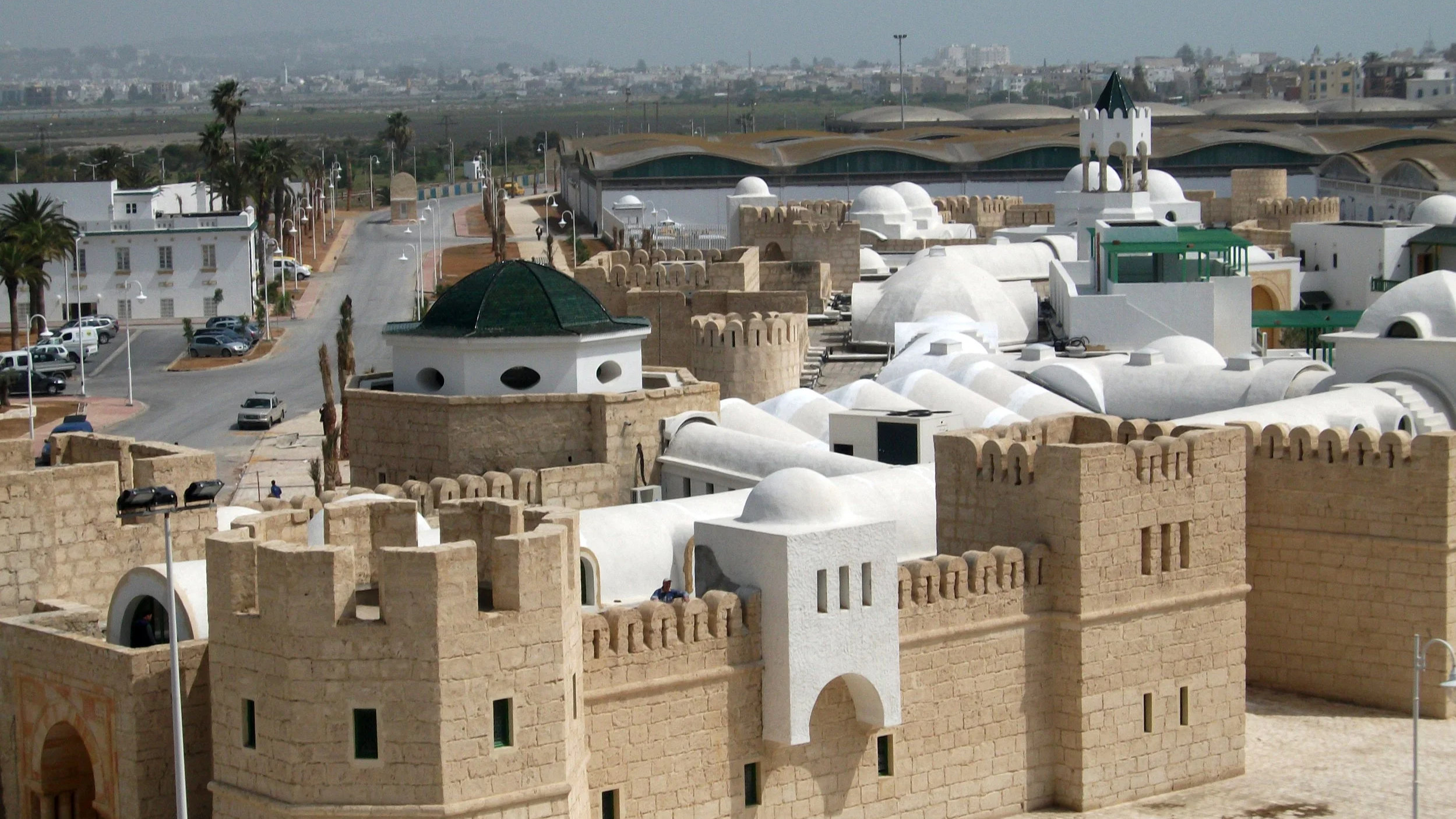
Those traveling the roads linking downtown Tunis to the cruise ship port at La Goulette back up north will spot a very similar, green-tiled pyramidal roof on horseshoe arches rising above another set of imitation medina walls, as I did a few years ago. This third version of the tower, however, is dwarfed by docked ships hailing from France, Italy, Spain, and elsewhere. Echoing some of the language used to describe Hammamet’s Médina Mediterranea, the Goulette Cruise Port offers visitors another curated taste of Tunisian authenticity, its managers say, in what they bill as the Goulette Village Harbor, the “Pearl of the Mediterranean,” and “a Medina with Tunisian architectural styling.” In this restricted setting open only to cruise passengers, one finds the Hammamet tower whitewashed, with merlons pointed, again a lean spire projecting above the vaulted shopping street, restaurant, and open-air amphitheatre below. This version therefore more closely resembles Guy’s 1906 original. Inset stone panels frame photogenic nail-studded wooden doorways modeled on those of historic buildings and mosques (and referenced by Guy in his post office), though they appear to be merely ornamental here. Again, the tower complemented the assemblage of souks and domes, not unlike it had in both Bab Souika and Hammamet (Figure 6). [11]
Figure 6. Goulette Village Harbor at the Tunisia Cruise Port, La Goulette (Tunis). Photograph, 2010. Wikimedia Commons/ Vaguerrero.
Exactly how this all came to be remains unclear, but it is obvious that the fabricated image of the colonialist mind slipped from French occupation into postcolonial consumerist spectacle. Its function—as a clocktower—was discarded, conceding to its visual role as spatial marker and rather superficial “urban” decoration in Hammamet. At La Goulette, the tower was appropriated again, still without its clock, and set within in a zone nonetheless controlled by the precise timetable of departures and arrivals. Through this usage, it theoretically became distinctively Tunisian (if the advertising description is to be taken at face value), a representative reincarnation liberated from the baggage of the French Empire and formal colonialism’s horologic objectives.
It would seem that “chronometric colonialism” yielded to consumer capitalism and a form of auto-Orientalist Disneyfication designed to court tourists. But many questions about the individual structures and their significance remain. The present case clearly confirms, however, that the past is relevant in contemporary built environments, even if influential models have long since been lost. To trace the circuitous (after)life of Guy’s tower is to follow along “diachronic lines of continuity,” and thus to mitigate the effects of the “optical illusions caused by a narrow focus” in the study of colonial-era architecture, as was encouraged by the late Jean-Louis Cohen.[12] When observed with the wider perspective, what does the removal of the clock and restoration of Guy’s tower to a more medina-like context suggest about the Tunisia today? What may be overlooked by a visiting tourist or a scholar with too “narrow [a] focus”? How does the fact that this tower in La Goulette, which is presented as if to be of indigenous origin, is based on a colonial construct, complicate the notions of origin, authenticity, and hybridity?'[13] How is this more than just a superficial reflection of the past into the present? Is it?
Tunisian culture, politics, and built environments, remain complexly bound to its past. The enduring presence of objects referencing colonial hegemony is far from trivial, and I would argue that this muted, secular “minaret” tower speaks volumes about consumerism, contemporary tourism, and intersections between heritage and identity in the postcolony. Contemporary Tunisianité, a unique and definitive blend of historic and modern influences, and a tendency to adapt and incorporate, manifests itself in a variety of socio-cultural ways, and—as demonstrated here—architecturally.[14] At times very actively cultivated by a stability-seeking state, and in places directed more towards promoting tourism, this hybridity has resulted in aesthetic pastiche. The Médina Mediterranea, with its blue tower, is a prime example of this. Guy’s post office and its amalgam of Western symmetry and frontality, with its Arabizing trim and minaret-like timepiece is another example from the Protectorate. The sum of the transhistorical whole here, would thus seem to be much more meaningful than its isolated parts; the enigmatic tower inviting expanded views and open minds.
Citation:
Daniel E. Coslett, “On Transhistorical Continuities and the (After)life of a Colonial Clocktower,” Platform, January 19, 2026.
Notes:
[1] Colonized populations also used clocks and clocktowers, as did the Ottoman Empire during the Tanzimat era. See Zeynep Çelik, Empire, Architecture, and the City: French-Ottoman Encounters, 1830–1914 (Seattle: University of Washington Press, 2008), 146–53.
[2] Zulfikar Hirji, “Architects of Time: Colonialism, Calendars, and Clocktowers on the East African Coast,” in Architectures of Colonialism: Constructed Histories, Conflicting Memories, ed. Vera Egbers, Christa Kamleithner, Özge Sezer, and Alexandra Skedzuhn-Safir (Berlin: Birkhäuser, 2024), 59–75; Çelik, Empire, 146.
[3] Çelik, Empire, 146.
[4] The minaret form was of interest to many French colonial architects. Such towers were frequently incorporated into Maghribi world’s fair pavilions during the nineteenth and twentieth centuries and featured prominently in the era’s art.
[5] The most iconic of Tunisia’s minarets are square in plan with pyramidal roofs, though octagonal plans do exist. See, for example, the minaret of the seventeenth-century Youseff Dey Mosque in Tunis. On French involvement in the reconstruction of the Zitouna Mosque minaret in Tunis, see Sihem Lamine, “Colonial Zaytuna: The Making of a Minaret in French-Occupied Tunisia,” Muqarnas 38 no. 1 (2021): 185–221.
[6] Jellal Abdelkafi, La médina de Tunis: Espace historique (Paris: Alif, 1989), 203–23.
[7] Serge Santelli, Tunis: Le Creuset Méditerranéen (Paris[?]: Demi-Cercle/CNRS Editions, 1995), 77.
[8] Tarek Ben Miled, “Médina Mediterranea, Yasmine Hammamet,” Architecture Méditerranéenne (2007), 205.
[9] References to Isfahan’s Maidan in the site’s primary hotel complicate the project’s intended “Mediterranean” identity, while the appended Carthageland themepark warrants a study of its own. Hammamet’s historic medina is about half the size of the Médina Mediterranea.
[10] The 1993 reconstruction of the French-colonial clock tower (erected 1910) in Casablanca, following the original’s destruction decades earlier, is an ironic exception. See Jean-Louis Cohen and Monique Eleb, Casablanca: Colonial Myths and Architectural Ventures (New York: Monacelli, 2002), 43; Daniel E. Coslett, “Broadening the Study of North Africa’s Planning History: Urban Development and Heritage Preservation in Protectorate-era and Postcolonial Tunis,” in Urban Planning in North Africa, ed. Carlos Nunes Silva (New York: Ashgate, 2016), 117–18.
[11] The resemblance of both the Goulette Village Harbor and Médina Mediterranea to the many nineteenth-century world’s fair pavilions built by French officials is a phenomenon to be unpacked elsewhere.
[12] Jean-Louis Cohen, “Architectural History and the Colonial Question: Casablanca, Algiers and Beyond,” Architectural History 49 (2006): 255.
[13] Here, I think as well of the craft industries in Morocco and Tunisia that were in many cases subsidized and cultivated in service of the tourism by colonial administrators.
[14] Safwan M. Masri, Tunisia: An Arab Anomaly (New York: Columbia University Press, 2017), xxvii; Leïla Ammar, Histoire de l’Architecture en Tunisie de l’Antiquité à nos Jours (Tunis: Agence MIM, 2005), 252.