On the Reshaping of Space: Venezuela and the United States in Realignment
In January 2026, Venezuela suddenly became the focus of the world’s attention—and not for good reason. Only fifty hours into the new year, before dawn on January 3, the second Trump administration carried out an illegal (and deadly) seize-and-capture military operation in Caracas. Bombing several strategic sites such as the Meseta de Mamo naval base and La Guaira Port, U.S. forces ultimately captured Venezuelan President Nicolás Maduro and First Lady Cilia Florez at Fuerte Tiuna. Maduro and Flores are currently held at the Metropolitan Detention Center in Brooklyn, where they are awaiting trial on charges of narcoterrorism.
The spectacular removal of Maduro has stirred a cauldron of emotions among Venezuelans both in the country and abroad, with many expressing a mix of optimism at the prospect of a democratic Venezuela and horror at the possibility of the country becoming a neocolonial vassal state of the U.S. The preservation of the entire Maduro regime, as well as Trump’s sidelining of opposition leader María Corina Machado—despite her efforts to ingratiate herself to his caprices—has suggested that regime change in Venezuela may be primarily cosmetic in nature, with different players in the same roles. The installation of Vice President Delcy González as acting President would all but confirm this: though Chavista to the core, González is apparently more pliable to U.S. interests than either Maduro or Machado.
““Fernando Coronil theorized that the subsoil constituted the “natural body” of modern Venezuela, no longer does it belong exclusively to the collective “social body” composed of its citizens. Today, it belongs to the highest bidder.””
The shape of the new/old order in Venezuela finally became clearer at the end of the month, with two striking developments. On January 29, the National Assembly, led by Delcy Rodríguez’s brother Jorge Rodríguez, passed sweeping changes to the Organic Hydrocarbons Law, opening oil investment and production to the private sector. It is the first major restructuring of the Hydrocarbons Law in twenty years, and was passed simultaneously with the U.S. Department of the Treasury’s authorization of Venezuela General License 46, which greenlights the sale and export of Venezuelan oil by U.S. companies. With the door open to privatization, the status of Venezuelan crude has been categorically redefined in the most radical terms since the industry was nationalized half a century ago. If the anthropologist Fernando Coronil theorized that the subsoil constituted the “natural body” of modern Venezuela, no longer does it belong exclusively to the collective “social body” composed of its citizens. Today, it belongs to the highest bidder.
In these first weeks of 2026, then, we are witnessing the reorganization of Venezuelan life in definition if not exactly in physical makeup. A much more powerful example is the second development that closed the month. On January 31, Rodríguez announced a new amnesty law that, in her words, “covers the whole period of political violence from 1999 to the present day.” It promises the release of political prisoners—long a goal of opposition leaders and activists who have decried the Maduro regime’s crackdowns on political dissent with detainment, torture, and death—as well as the closure of El Helicoide, the notorious prison in Caracas where political prisoners have been subject to documented human rights abuses (Figure 1). As of this writing, 383 of 687 political prisoners have been released, according to legal rights group Foro Penal.
Figure 1. El Helicoide, designed by Jorge Romero Gutiérrez, Dirk Bornhorst, and Pedro Neuberger, Caracas. Source: Wikimedia Commons. Photo: Damián D. Fossi Salas. https://www.flickr.com/photos/damianfossi/2764909786.
Figure 2. Promotional brochure “Helicoide de la Roca Tarpeya: Centro Comercial y Exposición de Industrias,” later included in Integral 5 (December 1956). Photograph: Archivo Fotografía Urbana / Proyecto Helicoide
If there is a symbol for Venezuela’s twentieth-century dream of economic prosperity and its twenty-first-century collapse into authoritarian repression, it is El Helicoide. A brutalist spiral winding its way around the Roca Tarpeya in southwest Caracas, and capped with a luminous geodesic dome, El Helicoide was famously intended to be a drive-through commercial center when it was designed by architects Jorge Romero Gutiérrez, Dirk Bornhorst, and Pedro Neuberger in 1955 (Figure 2). As Celeste Olalquiaga writes in her history of the building, the distinctive spiral design is reminiscent of everything from Frank Lloyd Wright’s Gordon Strong Automobile Objective to, more portentously, the doomed Tower of Babel. And true to its Babelesque form, the project seems to be cursed by chaos and confusion. Construction was delayed by financial and political instability, triggered by the deposition of the Marcos Pérez Jiménez dictatorship in 1958 and the uncertain return to democracy, and a series of lawsuits and bankruptcies that froze progress. Over the next two decades, perched on the top of the hill, El Helicoide became home to squatters, then to families displaced by mudslides, and finally in 1984 the DISIP (General Directorate of Intelligence and Prevention Services). When Hugo Chávez came to power, it became the detention center for the SEBEN (Bolivarian National Intelligence Service), where as architect Pedro Torrijos writes, “offices were converted into cells, bathrooms sealed off for confinement, and curved corridors integrated into a monitored circuit that erased any stable spatial reference.”
For decades, El Helicoide loomed large both in the physical urban landscape of Caracas and in the Venezuelan imaginary, a symbol of past exuberance warped into something monstrous. The popular story of Venezuelan modernity is frequently one of failure—of a delirious oil boom that soured into a dependency on “the devil’s excrement,” to quote diplomat and OPEC founder Juan Pablo Pérez Alfonzo; of democratic liberty (more or less) hemmed in by authoritarianism; of cultural patrimony neglected and twisted into icons of diaspora. Nowhere is the latter most apparent than in the slow, public defacement of the mosaic Additive Color in the Simón Bolívar International Airport in Maiquetía (Figures 3–4). Originally designed by kinetic champion Carlos Cruz-Diez as a public installation in the late 1970s, it is now the final point of physical contact with the country for migrants fleeing Venezuela. The resulting damage to the work materializes the often invisible formation—and deformation—of national collective memory, in this case the diaspora of nearly eight million Venezuelans across the globe.
Figure 3. Carlos Cruz-Diez, Ambientación de Color Aditivo (Environment of Additive Color), 1974–1978, sialex tiles, Simón Bolívar International Airport, Maiquetía, Caracas. © Atelier Cruz-Diez
““Mineral and crude deposits redefined as profit margins; a shopping mall converted into a prison; a kinetic mosaic unwittingly transformed into a site of collective grief.””
Figure 4. Detail of damage to Ambientación de Color Aditivo (Environment of Additive Color), December 2017. Diagnostic inspection carried out by In Situ Art Projects.
Mineral and crude deposits redefined as profit margins; a shopping mall converted into a prison; a kinetic mosaic unwittingly transformed into a site of collective grief. The Venezuela of yesterday is still very much with us, and not even in altogether unrecognizable form. One of the most uncanny aspects of this shift is precisely its material if not definitional continuity with the past. If the Pérez Jiménez regime of the 1950s asserted its authority through grandiose architectural spectacles such as hotels, universities, and highways; and if the Chávez period of the 2000s–2010s was defined by massive housing projects and the proliferation of the Comandante’s , then the current shift has entailed the reorganization of preexisting spaces. Perhaps it is too early to tell what the urban impact of Maduro’s ouster will yield, but the release of political prisoners as well as the possible return of exiled Venezuelans, via the restoration of direct flights between the U.S. and Venezuela, suggest that space will be reorganized in bodily terms. Space is, in pure Lefebvrian terms, being socially reconstructed along different ideological vectors.
That molecular transformation, of a new/old order that may superficially resemble the past but which behaves entirely differently in rhetorical and infrastructural terms—like, say, a commercial-turned-carceral complex—is a phenomenon that is also being experienced by the U.S. as it is reassembling into an authoritarian military state. While there are tangible architectural interventions such as the paving of the White House Rose Garden and the demolition of the East Wing to make way for Trump’s vision of a nationalist White Architecture, as Kristina Borrman writes for , more subtle but no less potent transformations are afoot. The renaming of the Kennedy Center, for example, entailed no physical alterations to the building itself, but the purging of staff, censoring of programming, and cancellation of performances have degraded the establishment to the extent that the Center has been shuttered for two years.
Even more alarming is the weaponization of public space and visibility in Minneapolis, Minnesota, which has been under occupation by ICE (Immigration and Customs Enforcement) agents since the beginning of the year. The killings of Renée Good and Alex Pretti have jolted residents of the city into action both visible and invisible to protect their neighbors in the face of masked paramilitary forces operating with impunity, while communities across the country have organized to reclaim spaces such as school zones, parking lots, and hotel branches—the latter often housing ICE agents who are conducting raids and detentions (Figure 5). With $75 billion in additional funding granted by the U.S. Congress in 2025, ICE has also begun purchasing industrial warehouses with the intention of storing not goods, but people. The fate of El Helicoide, it seems, is not entirely unique to Venezuela.
Figure 5. A federal agent pointing a weapon at protestors outside Home2Suites by Hilton, Minneapolis, January 26, 2026. © AP/Adam Gray
In both the U.S. and Venezuela, the reshaping of space is ultimately a question of sovereignty, echoed in the twin rallying cries “Whose streets? Our streets” and “El petróleo es nuestro” (the oil is ours). More so than the material changes being wrought by administrations that would either erect monumental edifices or defiantly tear down existing ones, it is the semantic rewiring of quotidian space that defines the consolidation of what historian Nikhil Pal Singh has astutely dubbed the “Homeland Empire”—that is, the transnational expansion of U.S. power into a “single domain of impunity” defined by extrajudicial removals, territorial expansion, and above all the use of violence to impose and enforce free-floating, often ad hoc categories such as “alien,” “patriot,” or “terrorist.” Venezuela is a test case for this theory of Homeland Empire, with a government that is at once unchanged and radically realigned, and with spaces transformed beyond—or back to—their original uses.
““We are in the midst of a recalibration of space and of the world, in which all that is familiar is no longer quite so reliable, or quite so straightforward.””
Case in point: with the amnesty bill, González has stated that she plans to convert El Helicoide into a “sports, cultural, and commercial center for police families and neighboring communities.” At long last, the complex can serve its original purpose, and yet the question remains whether it will ever be able to scrub the residue of political violence, or even if that is the ethical option. A more fitting solution, according to human rights groups, would be to turn the site into a Museum of Memory, as has been done in Argentina, Chile, Mexico, and Paraguay, among others. But to do so would be to honor the palimpsest of uses and abuses that define El Helicoide, not as a symbol of a future that never arrived, but as a real site where real individuals suffered gravely. Very little in the amnesty bill, to say nothing of recent history in either Venezuela or the U.S., indicates an appetite for that kind of historical reckoning.
Figure 6. Alexander Apóstol, El Helicoide, from the series Caracas Suite, 2003, video stills. © Alexander Apóstol
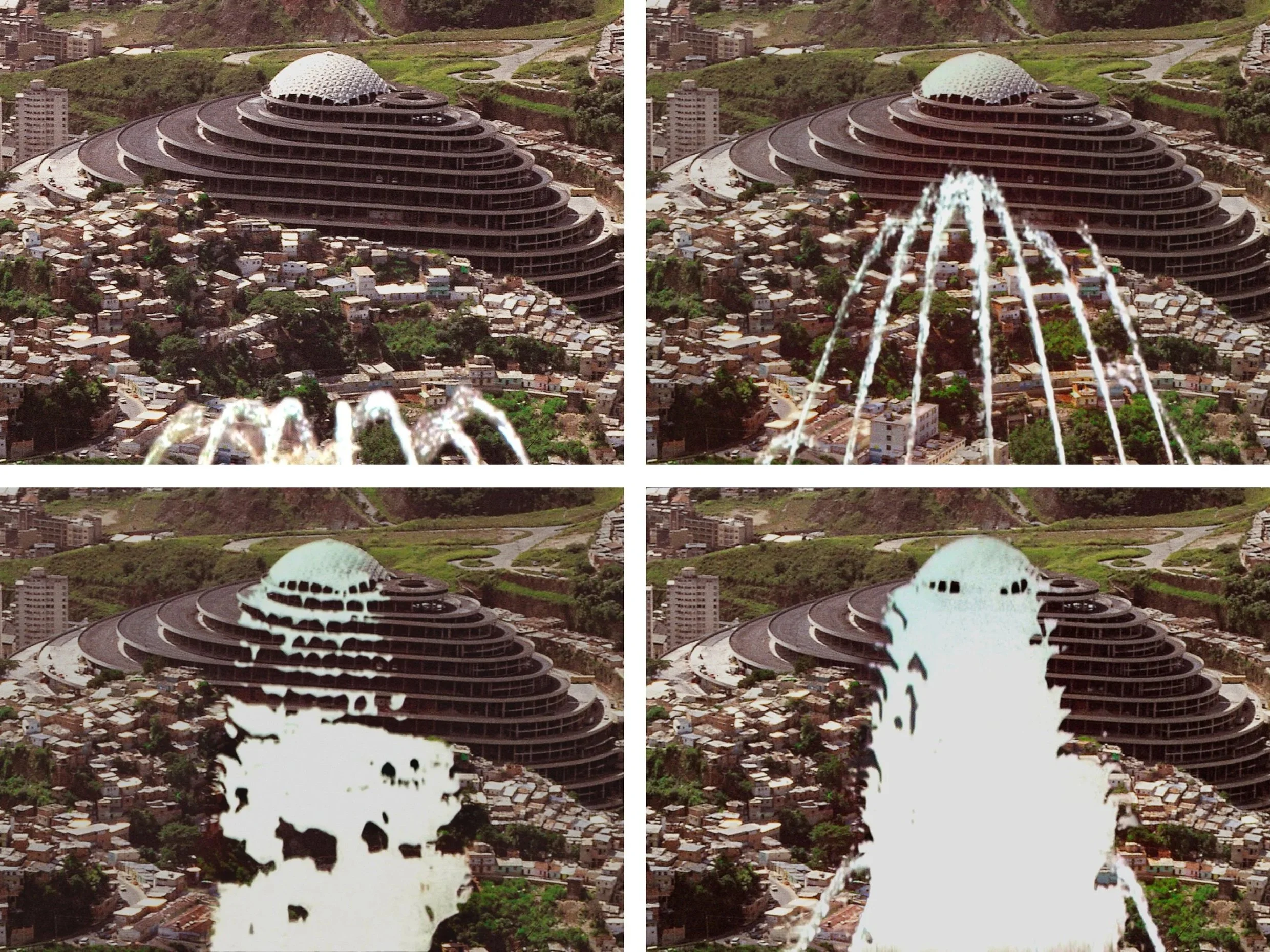
In 2003, the Venezuelan artist Alexander Apóstol created a series of videos titled Caracas Suite, in which familiar sites of the Venezuelan capital are metaphorically washed away by a fountain of water. One of the icons is El Helicoide, which is drained of meaning by the jets that visually flatten its ziggurat-like form into a field of white (Figure 6). The water stains the image while simultaneously evoking purification, of a kind that any future conversion into a cultural center will never fully be able to achieve. But a site like El Helicoide can never be emptied of significance; on the contrary, it is overburdened by its history. As Apóstol says, El Helicoide is “an enduring reminder of the inefficiency of our system and our immense capacity to imagine and to desire.”
We are in the midst of a recalibration of space and of the world, in which all that is familiar is no longer quite so reliable, or quite so straightforward. Our everyday spaces take on new meanings, issue new threats and offer new possibilities even as they remain, on the surface, unchanged. Perhaps, then, it is that contingency of social space that can be harnessed and rerouted, for it is precisely our capacity to imagine new arrangements of space, power, and society that can move us through and beyond this fearsome moment.
Citation:
Sean Nesselrode Moncada, “On the Reshaping of Space: Venezuela and the United States in Realignment,” Platform, March 2, 2026.