Resettler Nationalism Makes Rental Babies
The following is an excerpt from a chapter in Esra Akcan’s book Architecture and the Right to Heal: Resettler Nationalism in the Aftermath of Conflict and Disaster (Duke University Press, 2025, Figure 1). This book calls for architecture to take an active role in healing communities affected by socioeconomic, political and environmental disasters. It highlights the ongoing struggle to heal (conceived as a layered concept that encompasses but differs from repair, restoration, reparation, or restitution) after internal social, state and business-led violence ranging from enforced disappearance to mass extinction. Putting forth the concept of resettler nationalism as a source of partition and displacement, and concentrating on Ottoman successor states in the late nineteenth and throughout the twentieth century, the book argues that while architecture and urban planning have been weaponized to segregate and subjugate people, they could instead confront systemic violence and make accountability and reparations possible. Healing is argued as a matter of rights as well as a holistic notion of justice that can be achieved through architecture. By locating spaces of political and ecological harm, the book advocates for healing on individual, communal and planetary levels.
Figure 1. Esra Akcan, Architecture and the Right to Heal: Resettler Nationalism in the Aftermath of Conflict and Disaster (Duke University Press, 2025). Cover of the book.
Established scholarship attributes gecekondu development [literally means “landed at night,” usually translated as “slums,” “squatter settlements,” “shantytowns,” or “informal settlements”] to rural-to-urban migration following the mechanization of agriculture and industrialization. However, I infer from the evidence in this book that the cross-border population movements during and after the dissolution of the Ottoman Empire constituted the primary reason for the emergence of these settlements. Slum development, in other words, is a debris of resettler nationalism.
Memoirs and family photographs of early gecekondu residents who moved to the Zeytinburnu district of Istanbul from Greece, Bulgaria, Yugoslavia, Soviet Union, China, and other cities of Turkey reveal a textured architectural and urban history of this district in the second half of the twentieth century (Figure 2).[1] Many dramatically mention the muddy ground, which was so thick and prone to suctioning that they lost their boots in it. You could not walk on Zeytinburnu’s unpaved paths without changing your shoes at the border where the planned formal city ended and the informal one started. Once you entered the district, you would see that the gecekondu houses were placed in gardens, two or three of which sometimes shared a courtyard. Upon first arrival in Istanbul, many migrants stayed with relatives for the first days, but soon “encircled an area” (çevirmek) on an unbuilt land with stones to construct their own houses. The more friends arrived from hometowns, the more clusters densified. Hatullah Yeniyol remembers how his family’s house number kept changing as new houses were added between the existing ones on the same street.[2]
Figure 2. Family photograph of Besim Sadıker in Zeytinburnu, ca. 1950. Zeytinburnu Oral History Project.
Collapse took the form of state demolition in the mid-twentieth century, rather than the civil war that the victims had escaped from. The locals used the pseudonym “the greens” (yeşiller) for the state’s gendarme forces who frequently pulled their houses down. Almost all residents failed in their first attempts, and either watched the municipal officers demolish their houses or came back from work to a pile of debris. Consequently, they designed architectural and social tactics to prevent state demolition. Sometimes they secretly gathered at night in groups of hundred and built ample houses on an empty flat land they had selected before.[3] Other times, they made sure to use lime as mortar rather than cement in between briquettes, because it was hard for officers to break the briquettes that way.[4] Mehmet Ali Vatansever describes the construction of his and others’ gecekondu houses upon their arrival in Zeytinburnu from Yugoslavia.
Everyone used to encircle an area to their liking; it did not matter if it belonged to a foundation or not. Three to five families used to get together. The operation did not take place in daylight due to the gendarme forces. We used to hide the construction materials in the [Armenian and Greek] Kazlıçeşme cemeteries, as these cemeteries had tall grass. After five o’clock, we carried the briquettes, bricks, sand, and wood to build the houses. It was important to finish the roof and to put a cradle with a baby inside the house, because the gendarme forces could not demolish houses that had babies in them. But where would you find that many babies? There were babies for rent. For instance, my sibling was a rental baby.[5]
““You could not walk on Zeytinburnu’s unpaved paths without changing your shoes at the border where the planned formal city ended and the informal one started.””
This single memory-image demonstrates the impact of resettler nationalism on an entire lifespan: the dead in unattended non-Muslim cemeteries whose relatives could no longer visit their graves are accompanied by the babies of conflict refugees who had to be rented out as a tactic to prevent state demolition (Figure 3). Despite the alleged illegality of gecekondu settlements, the government and its arms-controlled home construction for their own benefit. Ahmet Dildar mentions that it was impossible to sustain a gecekondu house unless one bribed the gendarme forces.[6] Cemal Aslan remembers that their house was demolished nineteen times, before his father quickly finished construction during a weekend and paid a fee to the municipality as if the house had always been there.[7] Houses did not collapse during the days of election campaigns, making it easier to build and move in at that time, because the government did not dare to lose votes.[8]
Figure 3. Armenian Cemetery in Zeytinburnu. Photo: Esra Akcan, 2019.
Contrary to the common perception, it was not amateurs but building masters (usta) who oversaw the construction with the request and help of residents.[9] Some residents paid a fee to the masters, others benefited from the gift economy. Enver Sertel exchanged the radio that he had brought from Macedonia for the construction fee of his house,[10] while Mehmet Zeynel gave the refrigerator he had carried from Skopje in exchange of a gecekondu.[11] These transactions are reminiscent of the Greek-Turkish Exchange of Populations Treaty (1923) that had made a distinction between movables and immovables to be recognized by international law. Leaving immovables behind caused unquantifiable harm to the memories and economic status of exchanged migrants, while movables became reminders of old life and museum objects. The distinction between movables and immovables reappeared in other operations of resettler nationalism. The movable artifacts that migrants carried while crossing national borders turned into exchangeable possessions to acquire immovable real estate in places of arrival. Circulating between hands, these movable artifacts continued to connect Rumelia and Anatolia despite the official border that had been drawn between them.
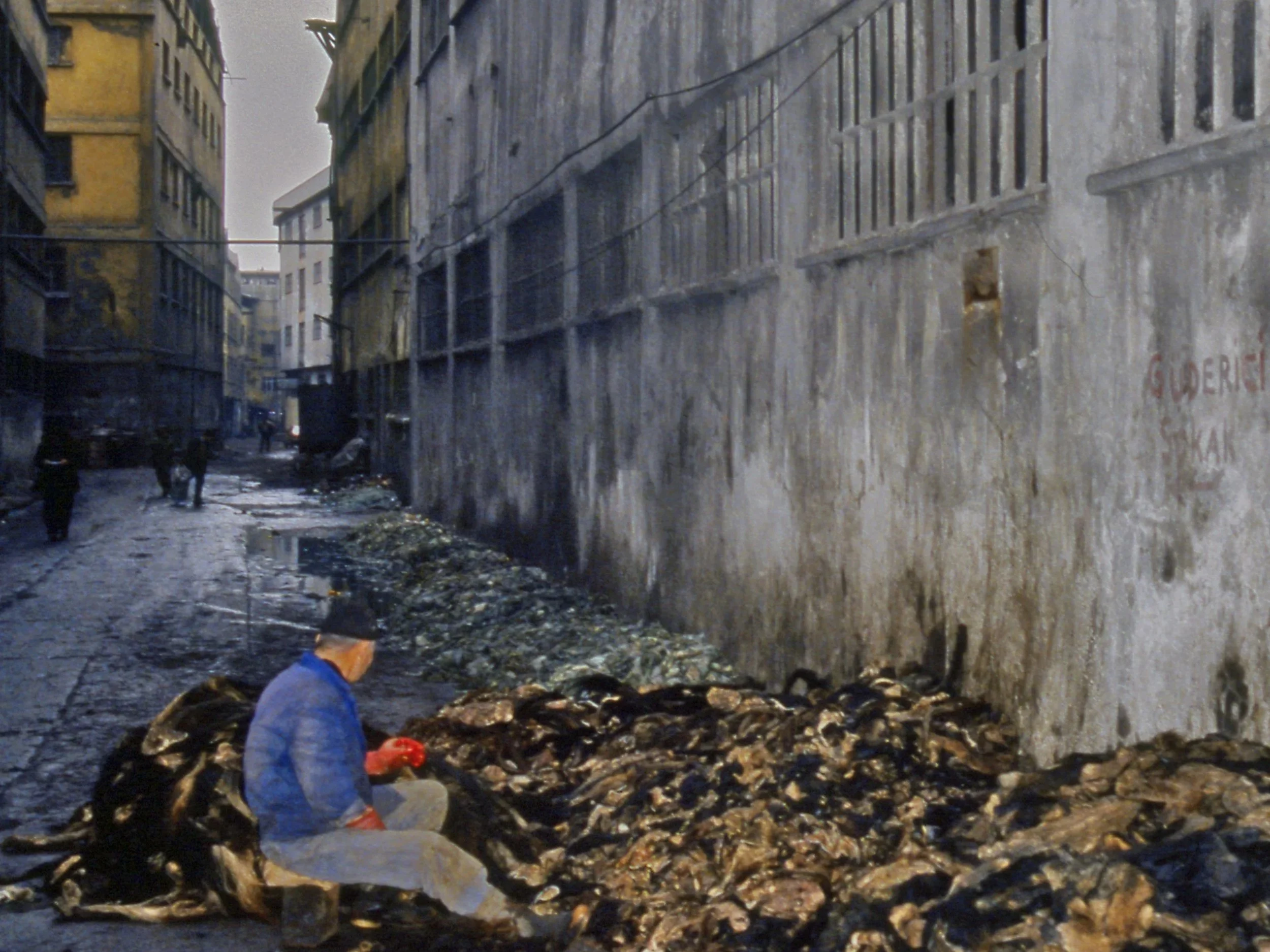
Figure 4. İzzet Keribar (photographer). Tanneries in the industrial zone of Zeytinburnu, 1986. Courtesy of the artist.
Resettler Nationalism Is Pollution
The movie Çark (Wheel) directed by Muzaffer Hiçdurmaz and shot on location provides a stark depiction of buildings in Zeytinburnu’s industrial zone in 1987, before the tanneries and factories gradually moved out of the area due to the workers’ strikes that started days after the movie (Figure 4).[12] Hordes of men, women, children, and disabled workers (many actors were chosen from real-life workers) arrive at the Kazlıçeşme train station in the morning. The day is dark, and the air is covered with smoke coming out of the factory chimneys. Buildings are high, and streets are narrow and blocked with piles of animal remains and unused skins. Arriving at the zone for the first time and obviously disturbed by the sight and smell, a worker asks: “What kind of a place is this? This is worse than a slaughterhouse.” It is like a “graveyard of the living,” one comments, but all commercial shoes, belts, and coats are produced here, the other reminds.[13] The workers in leather workshops are employed without insurance in unkept buildings with low ceilings, exposed pipes, and peeling wallpaints. They work in crowded conditions, squeezed in between old machines, and subject to the punishing watchful eye of the midlevel boss. Leather production on an industrial scale is a smelly, muddy, and polluted business without necessary sanitary regulations. The industrial zone is just next to the sea, but the workers can hardly see even a glimpse of the blue waters. A child worker dies after being caught up in one of the machines. As the workers try to carry the blood-covered corpse of the child on their shoulders out of the industrial zone, they are blocked with police forces at every exit and threatened with being charged with illegally organizing a march and unauthorized absenteeism if they do not go back to their factories immediately. For about eight minutes, the camera follows the group as they try to find a way out of the narrow, labyrinthine, muddy, decaying, and blocked streets of Zeytinburnu’s industrial zone. Finding no exit, the group lays the child’s dead body on the ground of an urban square and puts their clothes on the deceased in a symbolic attempt to organize his funeral.
Zeytinburnu residents remember their hybrid life with industrial and agricultural activities fondly today with a hint of nostalgia. However, long-term infrastructural, economic, and sanitation problems hardly made this district a better alternative to formalized housing. In addition to low wages and lack of formal housing, the industrial economy in Zeytinburnu caused high levels of pollution with no accountability for residents’ health. In a questionnaire in 1974, 89 percent of residents said their health conditions were poor due to the insufficiency of their houses.[14] Ali Yerli remembers that roofs were covered with white dust coming out of the cement factory’s chimney, and that it was impossible to wear a white shirt as it would have been covered with black coal dust when one walked by the train station near the factories.[15] Fahriye Efeoğlu remembers that flat meadows became the city’s waste dumping area, where residents collected scraps of wool, thread, and fabric “like ants in the trash.”[16] There was no water or electricity in the houses till the 1970s, and residents carried polluted limy water from the eight artesian wells and 174 fountains nearby.[17] This created yet another symbolic border between “uncivilized” Zeytinburnu and “civilized” Istanbul. […]
““The definition of pollution as a threshold beyond which the environment is considered harmed creates the misconception of nature as resilient and self-healing.””
In her book Pollution Is Colonialism, Max Liboiron resists the definition of pollution as a healable environmental damage or a side effect, but exposes its root cause as settler-colonial mentality and extractive relation to land, which disregarded the indigenous wisdom in North America. Modern science calculates pollution with measures such as critical load, tolerance dose, carrying capacity, or assimilative capacity that denotes the amount of permissible contaminant. However, the definition of pollution as a threshold beyond which the environment is considered harmed creates the misconception of nature as resilient and self-healing. It allows settler colonialists and industrialists to pollute the land until its maximum permissible level.[18] Similarly, pollution conceived as a side effect of industrial progress obscures and perpetuates the inequalities and harms caused by capitalist urbanization. In Zeytinburnu, the dual ideologies of resettler nationalism and capitalist urbanization turned migrants into industrial workers who breathed polluted air and drank contaminated water as if this was the price nations were willing to pay to heal from underdevelopment. While pollution is caused by settler colonialism in the context of post-Columbian Americas, as Liboiron convincingly argues, it is caused by resettler nationalism in the context of post-Ottoman Afro-Euro-Asia.
Resettler Nationalism Is Dispossession
The state policy for gecekondu areas swung between demolition and legalization between 1953 and 1980 in Turkey (Figure 5). Assuming that illegal construction would be superseded, the amnesty law of 1953 legalized previously built houses all over the country. As a result, the land in Zeytinburnu was sold to gecekondu residents between 1954 and 1959.[19] And yet, gecekondu construction did not come to an end either here or the rest of Turkey. Those who arrived in Zeytinburnu after the 1960s bought the official title deed of the land, but still built illegal houses on these properties. Amnesty laws kept coming in 1963, 1966, and 1976 that legalized previously built houses. It did not escape the public that these amnesty laws were granted especially before elections, and that the political parties used gecekondu legalization as a campaign tool.[20]
Figure 5. Esra Akcan and Farzana Hossain. Maps showing the evolution of Zeytinburnu, Istanbul, during the twentieth century: top row: ca. 1919, ca. 1969, bottom row: ca. 1999, and 2019. Abstracted maps based on earlier maps, historical information, and some level of speculation where precise documents could not be found.
Who really owned the land that the migrants had unofficially settled on? In other words, whose land was the state selling to the migrants of resettler nationalism? The answer is complicated due to the residues of the Ottoman Empire’s property regimes, its late integration into capitalism, and the dispossessions due to its dissolution. Following Robert Nichols, I do not use the word dispossession here with “first occupancy” claims or to validate the idea of possession, but as a process that shows the transformation of land into property and the disenfranchisements that take place during the institutionalization of a property regime.[21] During the Ottoman Empire’s classical period, farmers cultivated the agricultural land and paid taxes, but they could not claim this land as their private property. All land except those affiliated with a Muslim vaqf (foundation) or a non-Muslim foundation belonged to the state.[22] This started changing in the nineteenth century, and the Ottoman land regime had six categories that did not concurrently fit the European ones. State property increased after the dissolution of the Ottoman Empire when non-Muslim populations were exterminated or expelled, resulting, at many instances, in the de facto transfer of their land to the state. Two-thirds of Turkey’s territory still belonged to the state at the end of the twentieth century, a situation that changed with the rise of neoliberalism.[23]
There were unresolved accounts about the previous owners and stewards of land in Zeytinburnu, before the state sold them to gecekondu residents as property. Writing in 1974, Faik Akçay speculated that three-quaters of the land belonged to the Greek community.[24] Other historians argue that most of the area had belonged to Bezm-i Alem Valide Sultan and Sultan Beyazit-ı Veli Khan Endowments. In 1880, the Armenian community applied to design an Armenian neighborhood in this area, and their request was granted even though the construction never materialized. The land was registered in the name of Priest Agop from the Armenian Church, who sold some of the property to Armenian, Greek, and German individuals after the cancellation of the construction plans before 1914.[25] After Priest Agop’s death, the rest of the land was eventually considered state property in an act of dispossession that was quite common for this period.
““Land was turned into a mechanism of capitalization and dispossession within the ideology of resettler nationalism.””
The Greek Patriarch and community had also received titles for land since the times of Beyazit II. The Balıklı Greek Hospital secured the large area on which it stands as the property of the Greek Patriarch and community with a title deed of 1837. After the Law on Foundations of 1936, when the Turkish state got a hold of much land from Ottoman vaqfs with the aim of dispossessing Islamic religious foundations and secularizing Turkey, the Greek Hospital’s land was also expropriated. When the foundation took the decision to court, the Supreme Court of Appeals found the expropriation legitimate in 1971, claiming that it was not legal for non-Turkish persons to purchase land. This decision violated minority rights, as Istanbul Greeks were indeed citizens of Turkey. In 1975, the court admitted the mistake but held on to the position.[26]
After the amnesty law of 1953, the state sold one square meter for three liras to the gecekondu residents. Private owners sold it for 75–80 kuruş (cents) after realizing the existence of houses on their property whose dwellers would have been difficult to evict. There were countless confusions during the process, as the same house could be located on a land whose parts belonged to an individual, a vaqf, and the municipality simultaneously.[27] This is to be expected due to the unresolved histories of property regimes and dispossession during the dissolution of the Ottoman Empire, and lawless decisions thereafter. In any event, starting in 1954, the Turkish state sold Zeytinburnu’s lots to migrant settlers, some of which had been dispossessed or taken by deceit from the Islamic and Greek foundations, as well as exiled or murdered Armenian landowners. While refugees and rural migrants legitimately tried to make a life for themselves in arrival cities after being dispossessed themselves, land was turned into a mechanism of capitalization and dispossession within the ideology of resettler nationalism.
Citation:
Esra Akca, “Resettler Nationalism Makes Rental Babies,” Platform, March 9, 2026.
Notes:
[1] Oral History Project of Zeytinburnu Municipality Archives (hereafter ZAD)
[2] Hatullah Yeniyol, zad 204.
[3] Ismet Aydın, zad 255.
[4] Hasan Yılmaz, zad 198–99.
[5] Mehmet Ali Vatansever, zad 280–81.
[6] “We built it three times, they destroyed it three times. . . . One week later we gave money to a gendarme, and they did not demolish that house.” Ahmet Dildar, zad 39.
[7] Cemal Aslan, zad 133.
[8] Muzaffer Çavuşoğlu, zad 352.
[9] One of the earliest settlers, Nurten Yenal, describes how she and her father dug the ground, laid the foundation, after which the father could not trust his construction ability and hired a master. Another Balkan migrant, Enver Nehir, says: “There were famous masters who built the houses. . . . They had reputations such as this master would finish the house in two days, that master would have such and such qualities.” Nurten Yenal, zad 385–6; Enver Nehir, zad 163.
[10] Enver Sertel, zad 164.
[11] Mehmet Zeynel, zad 299.
[12] Muzaffer Hiçdurmaz, dir. Çark.. Istanbul, Turkey: Burak Film, 1987
[13] Hiçdurmaz, Çark, 54’35’’—54’46’’ MINUTES
[14] Faik Akçay, Zeytinburnu Gerçek Yönleriyle Bir Gecekondu Kenti. Istanbul: Çelikcilt Matbaası, 1974.
[15] Ali Yerli, zad 69, 83.
[16] Fahriye Efeoğlu, zad 167
[17] Akçay, Zeytinburnu. Oral histories confirm that carrying water to the house was one of the major challenges for everyone. ZAD
[18] Max Liboiron, Pollution Is Colonialism. Durham, NC: Duke University Press, 2021.
[19] Turgay Gökçen, “Zeytinburnu Gecekonduları.” In Surların Öte Yanı—The Other Side of the City Walls: Zeytinburnu, 3rd ed.¸edited by Burçak Evren, 366–73. Istanbul: Zeytinburnu Belediyesi Kültür Yayınları, 2006. Rıfat Akbulut emphasizes February 26, 1957, when sixty-two families were granted the title of their properties in Zeytinburnu. Rıfat Akbulut, “Mekansal Dönüşüm.” In Surların Öte Yanı—The Other Side of the City Walls: Zeytinburnu, 3rd ed., edited by Burçak Evren, 376–413. Istanbul: Zeytinburnu Belediyesi Kültür Yayınları, 2006.
[20] Ruşen Keleş, Kentleşme Politikası. 10th ed. Istanbul: İmge Yayınları, 2006; Sibel Bozdoğan, and Esra Akcan. Turkey: Modern Architectures in History. London: Reaktion, 2012.
[21] Robert Nichols. Theft Is Property: Dispossession and Critical Theory. Durham, NC: Duke University Press, 2020.
[22] Halil Inancık, The Ottoman Empire: The Classical Age. New York: Phoenix Press 1973.
[23] Çağlar Keyder, “The Housing Market from Informal to Global.” In Istanbul: Between the Global and the Local, edited by Çağlar Keyder, 143–59.Lanham, MD: Rowman and Littlefield, 1999.
[24] Akçay, Zeytinburnu.
[25] Gökçen “Zeytinburnu Gecekonduları,” 372.
[26] Baskın Onan, “The Minority Concept and Rights in Turkey: The Lausanne Peace Treaty and Current Issues.” In Human Rights in Turkey, edited by Zehra Kabasakal Arat, 35–56. Philadelphia: University of Pennsylvania Press, 2007.
[27] Gökçen, “Zeytinburnu Gecekonduları.”