Emergent Lessons from the Mangrove Thicket: Reading Landscape and Architecture
The mangrove forests lining the serpentine channels of the Cross River estuary are difficult terrain (Figure 1). They are also, it turns out, instructive. When you make your way through these tangled thickets, you begin to see how resilience and memory take root right there in the landscape. You see how buildings and ways of living have held on, adapted, or quietly vanished under the pressures of slavery, the palm oil trade, and imperial dispossession. In my recent book The Architecture of the Bight of Biafra: Spatial Entanglements, I argue that these landscapes, often considered marginal to architectural history, are central to understanding how built environments emerge, survive, and transform across time. The book traces how race, landscape, and built form were co-produced in southeastern Nigeria from the early modern period to the present. Port cities, trade networks, and everyday spatial practices generated entangled landscapes that challenge conventional narratives in architectural, urban, and planning history. This article reflects on methodological and landscape insights shaped by the material realities and metaphors of the mangrove while proposing a mode of architectural history attentive to entanglement, absence, and ecological ground.
Figure 1. Map of Biafran region and Cross River Estuary. Source: Map by Joseph Godlewski and Allison Howard, 2026.
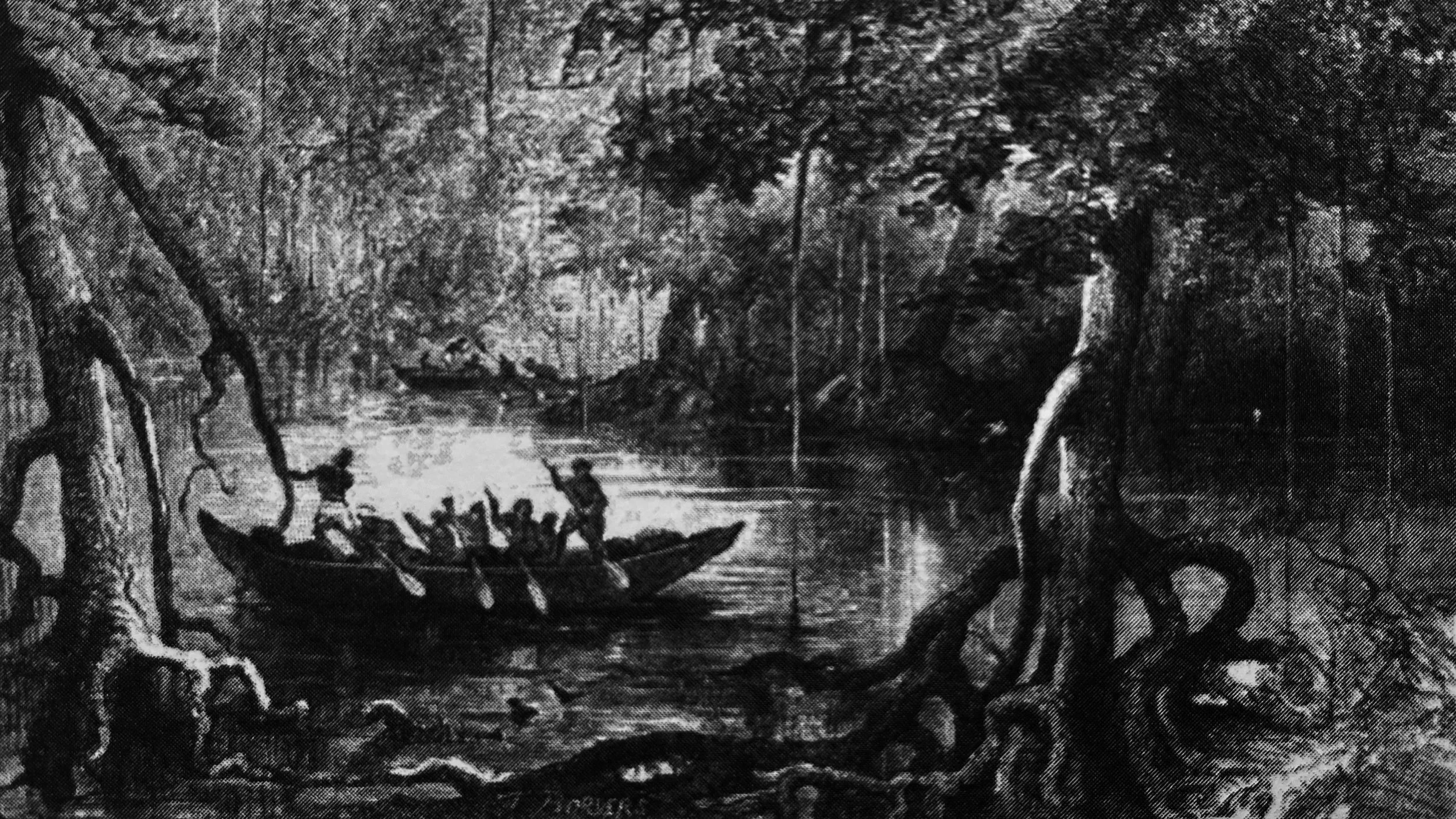
The mangrove is an environment of radical interdependence. Its tangled roots, simultaneously submerged and exposed, offer both protection and permeability. Standing in a mangrove thicket, it becomes difficult to say where land ends and water begins, or where the built environment gives way to the natural one. The landscape refuses these neat divisions (Figure 2). In my research, the mangrove served as more than a scenographic backdrop; it became a methodological model and a material leitmotif. Literary scholar Ainehi Edoro has shown that forests in African fiction function not as settings but as living structures where politics, history, myth, and creativity animate new worlds. A similar logic guided me. Whether sustaining early fishing communities, supplying insect– and rot-resistant posts for domestic compounds and Ékpè lodges, or grounding prefabricated merchant houses and missionary buildings shipped from Europe, mangrove forests materially shaped the region’s architecture across centuries. Difficult to navigate and rife with malaria-carrying mosquitoes, these thickets shielded communities from slave traders and colonial agents, just as mission houses, schoolhouses, and churches at the forest edge served as spaces of asylum and protest in the mid-nineteenth century. Beyond utility, mangroves were spaces of folkloric imagination, home to water deities and preternatural forest spirits, and connected to wider diasporic worlds.
Figure 2. Hope Masterton Waddell’s “Mangrove Forest” and canoes along the Calabar River, 1863. Source: Hope Masterson Waddell, Twenty‑Nine Years in the West Indies and Central Africa 1829–1858 (Frank Cass and Company, 1863), facing 324.
Looking closely at the root structure, half in water and half in soil, one begins to see a kind of diagram of how space works in this tropical ecosystem (Figure 3). The roots move horizontally, evading linear tree models and singular origins. Palm oil plantations supplied the raw materials that sustained Victorian hygiene regimes. Neo-Palladian English country houses were entangled with the barracoons and obsequies of Old Calabar's slave-trading world. The performed space of Ékpè masquerade at once enabled the slave trade and furnished the counter-image necessary to construct Enlightenment notions of order. These spaces were simultaneously rooted and open, entwined in local ecological and cultural contexts and in global circuits of power.
Figure 3. Mangrove swamp roots, 2006. Source: Creative Commons 4.0 https://commons.wikimedia.org/wiki/File:Mangroves.jpg
J.B. Jackson argued that history is made visible in the landscape, but the urban history of this region is in some sense doubly peripheral: marginalized within architectural historiography and constituted by built forms that are themselves impermanent, mobile, and performed. Conventional architectural historiography, privileging monuments and documented authorship, cannot grasp these fluid and fugitive architectures. What is needed is diagrammatic reconstruction: a speculative and provisional practice that assembles fragments of material, archival, and oral evidence into visual and narrative wholes that suggest pathways for understanding without claiming finality. The method treats absence not as a limit to historical knowledge but as a condition that structures how built environments can be reconstructed. In this sense, diagrammatic reconstruction is less an act of architectural recovery than of landscape reading: an attempt to make legible the histories that persist in terrain long after the buildings that shaped it have disappeared.
“The urban history of this region is in some sense doubly peripheral: marginalized within architectural historiography and constituted by built forms that are themselves impermanent, mobile, and performed.”
A central methodological challenge was writing history from an archive shaped by violence, absence, and displacement. Swati Chattopadhyay's reading of Nii Kwate Owoo's film You Hide Me (1970) in PLATFORM is instructive here. Owoo documented the British Museum's African collection not through its display cases but through the boxes, crates, and storage stacks that held the vast majority of objects out of sight. Chattopadhyay argues that this spatial apparatus of containment is itself the site of colonial power: it is not the object but the structures that enclose and withhold it that produce meaning and deny African ontology. “Unarchiving,” in her formulation, means attending to what those structures refuse, displace, or leave unrecorded. The archives of the Bight of Biafra operate by a similar logic, disclosing their politics as much through omission as through content. Faced with this, I worked across archives rather than within any single one. Oral histories, colonial maps, missionary letters, slave ship logs, and diaries, each partial and each carrying its own kind of authority, were brought into dialogue. The circulation of sources, not their stabilization, animated the historical reconstruction, highlighting processes of building, exchange, adaptation, and forgetting rather than producing definitive answers about origin or influence.
Old Calabar's Iron Palace of King Eyamba V survives only in engravings, plans, and scattered textual references. Demolished within two decades of its construction, the surviving depictions, produced by foreign observers, often obscure the building's actual use and meaning. This challenge led me to adopt speculative reconstruction: a disciplined practice that assembles what is known while making explicit what remains conjectural. Contrary to foreign depictions, the imported house was not an isolated structure but was integrated into Eyamba V's compound, daily rituals, and the local urban fabric, showing how European architectural elements were appropriated and adapted within indigenous practices rather than imposed upon them (Figure 4).
Figure 4. The Iron Palace of King Eyamba, Axonometric Diagram Reconstruction. Source: Diagram by Joseph Godlewski and Scott Krabath, 2022.
Rather than presenting the Iron Palace as a fixed object, I treated it as a creatively adapted node in a network of trade, diplomacy, and cosmology. This move from monument to entanglement allows architectural history to speak to broader Atlantic-world histories and makes visible relationships no longer extant in the city's built environment. Sujin Eom's work on the vanished shophouses of Incheon’s Chinatown in Korea, also on PLATFORM, pushes this further. Working from police photographs taken for unrelated purposes, hand-drawn floor plans, and the rumors that circulate in diasporic communities across generations, Eom demonstrates that architecture is not a passive backdrop to colonial violence but an active participant in it. The ransacked shophouse, the hidden passageway between neighboring buildings, the pair of Chinese shoes left at the door to mislead colonial police are spatial artifacts that register both the operations of power and the intimacies of resistance that formed beneath it. Archival gaps, in both cases, are generative rather than obstructive. The built environment of the Bight of Biafra is embedded in waterways, compounds, masquerade spaces, and market enclaves, functioning as an active repository of memory and meaning that no single archived object can fully capture.
“Architectural history must expand beyond monuments and archives to include the ephemeral, the erased, and the ecological conditions that sustain them.”
Resilience and ruin are not opposites but coexisting states. Many built forms I studied were ephemeral by design: wooden trade houses, mud and thatch compounds, Ékpè lodges. Others bore the marks of destruction or slow environmental attrition. In these cases, what mattered was not permanence but the ability to respond to tides, conflict, and the shifting rhythms of trade. What looks like impermanence in these compounds and trade houses, mud walls that wash away, wooden posts that rot and are replaced, is really a form of landscape maintenance. It is the way people here have always shaped their places to fit the tides, the seasons, and the shifts in power around them.
A final methodological takeaway is ethical. Working within histories shaped by slavery, extraction, and colonialism risks reproducing the epistemic violence one seeks to critique. There is no neutral ground from which to tell these stories. Every act of archival recovery and every diagrammatic reconstruction is entangled with the legacies of dispossession. In The Architecture of the Bight of Biafra, I sought to make the reconstruction process visible: to show the seams, absences, and choices. Rather than presenting the past as fully knowable, the work dwells within its uncertainties, making them productive rather than paralyzing.
Figure 5. Mangrove Forest, Kwa Falls, Great Kwa River near Calabar, Nigeria, 2024. Source: Creative Commons 4.0 https://commons.wikimedia.org/wiki/File:Kwa_waterfall_14.jpg
The thicket offers no easy passage. It requires patience, attentiveness, and a willingness to become disoriented. Yet it also teaches resilience, adaptability, and relationality. What emerged from this research is the conviction that architectural history must expand beyond monuments and archives to include the ephemeral, the erased, and the ecological conditions that sustain them. Reckoning with these troubled histories requires attending to their spatial dimensions: reconstructing built environments conscientiously, acknowledging their particularities, and connecting them to the broader forces that shaped and continue to shape the worlds we inhabit. Moving through these swamps, sometimes haltingly and sometimes intuitively, reveals that what is hidden, submerged, or fragmented still shapes present landscapes. (Figure 5). A broader spatio-historical imagination is not merely scholarly; it is the precondition for reading inherited landscapes with care and projecting more just and sustainable futures from the ground up.
Citation:
Joseph Godlewski, “Emergent Lessons from the Mangrove Thicket: Reflections on Method, Landscape, and the Architecture of the Bight of Biafra,” Platform, April 6, 2026.