Invented Food Identities: Entangled Migrations and Representations of the Chianti Landscape
Xenophobic sentiments have intensified in current US political rhetoric, arguing that manufactured products should be solely homegrown. The Trump administration has made the Made in America Agenda central to its policies, in the name of national security, economic growth, and symbolic representation. And with these increasing political pressures, many industrial food producers have claimed (falsely) that their food products are made in the United States. Even though the companies source their ingredients from all over the world, they aim to represent their food products as American. These jingoistic impulses by food companies converge with the positions of MAHA movement that capitalize on long-held attitudes that local foods are better for our health, environment and society. The homegrown is prized as a critical value in the political matrix of food, culture, aesthetics, and land. But, what exactly is understood as local? The ingredients, the land, the farmer, the worker, the consumer—what defines a food’s identity as American?
These political values and preferences for the “local” are linked to claims of authenticity, based on a desire to fix a stable and immutable identity, or what Dell Upton has called “invented traditions.” Referencing an earlier concept of “invented communities,” the argument is that nations are socially constructed, and people construct shared practices and symbols to be the basis for social cohesion. The notion of “invented traditions” builds on Benedict Anderson’s concept to account for the instability of the objects and dynamic practices that develop into that shared and ever-changing culture, and moreover, to claim that people have agency to make material their identities. As Upton writes, “The connection [between identity and material sign] is arbitrary rather than ‘authentic’…”
Figure 1. Advertisement of the Black Rooster brand at the Vinitaly 2026 fair, with imagery meant to link the present to a long and continuous history of wine cultivation. https://www.chianticlassico.com/news/il-gallo-nero-a-vinitaly-2026/
The cultivation of wine and wine itself has a mythological presence in Italy, as well as many other European countries. It serves as a symbol that connects an ancient culture to contemporary society with a territory, whose associated values of pleasure, conviviality and hospitality are considered sacred and natural to la bella vita, or a good life. Many wine producers cultivate this narrative, but the complex processes and various materials that compose this particular commodity of fermented liquid, from the producers, laborers, plants, trees, animals, microbes, buildings, barrels, equipment, consumers, and land reveal histories that run counter to that mythology of nature. They show the careful and intentional construction of an idea of landscape and food identity.
Studying the case of Chianti wine, a luxury food export, we can see how the desire to represent an idea of “Italy” is complicated by migrations of humans and non-humans, the expanding tourism industry, rural development policies, and finance capitalism. The Chianti Classico Consortium, established in 1924, controls and protects the Black Rooster brand which includes 480 producers in Italy, with about 70% of all bottles exported, mostly to United States by a wide margin. With the majority of its production going abroad, the recent centennial celebration included an exhibition to showcase its influential producers to the world. Selective narratives of place and its producers obscured the complex practices of wine production and cultivation—none of the branded profiles including any discussion of the human and non-human migrations central to the making of the wine—for the global marketplace of wine consumption.
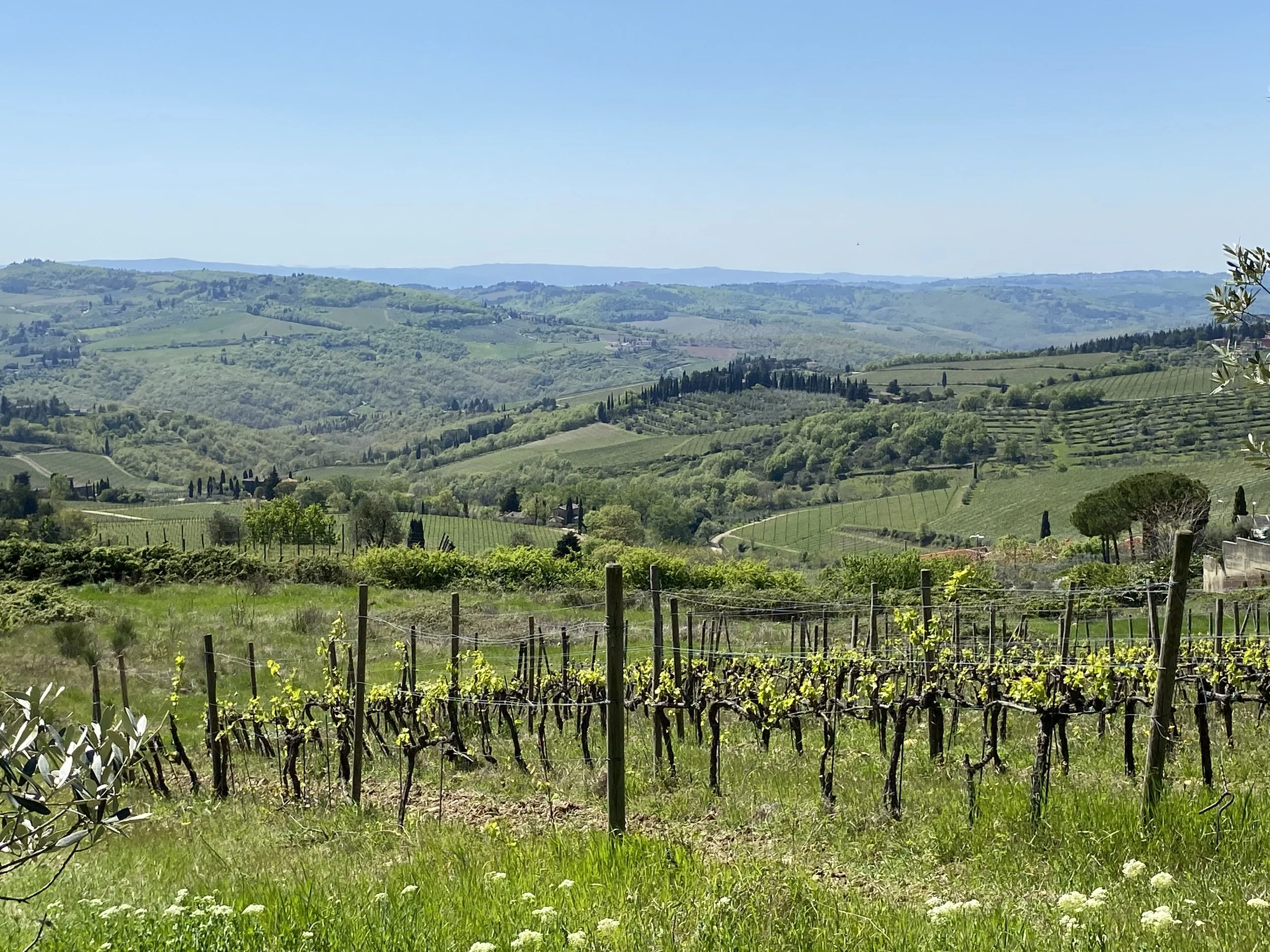
Figure 2. Vineyards in Greve in Chianti, April 2022. The landscape in the spring months, when grass grows in alternating lines between the vines, surrounded by olive trees and wildflowers. Photograph by author.
Chianti is located in the area between Florence and Siena, bounded by the Val di Pesa, Elsa river, and includes the Chianti hillsides and mountains. I started visiting the region in 2017 and discovered a curious environment. I found myself in the most perfectly exquisite and picturesque landscape with its verdant rolling hills of grapevines and cypress trees. What I wasn’t prepared for was that in these tiny rural villages that dot the hills were American, British, Swiss, German, French and Swedish owners, with Albanian, Macedonian, and Kosovari workers tending to the land and its fruits, Japanese chefs training in Tuscan cooking, English-speaking hoteliers and hospitality workers, and everyone all together working to produce this perfect image of Italy. It was as global as Milan or Rome. Even the Italians were not necessarily or only “local.” Many were born, grew up, studied, trained, worked, and lived elsewhere, bringing their perspectives and knowledge of far-off places to cultivate this Chianti landscape and its wine.
““For scholars of landscape and built environments, a product like wine...offers an opportunity to reconsider how the very idea of a local place is inextricably tied to the global, to mobilities, and to migrations, human and non-human.””
Getting to know the people and visiting the various towns over the years revealed that the history of this wine landscape was based in overlapping stories of migration, tourism and land speculation. For scholars of landscape and built environments, a product like wine—so closely linked and fetishized for its “terroir,” with certain microbes, bacteria, insects and flora, particular cultural practices of cultivation all tied to a specific site—offers an opportunity to reconsider how the very idea of a local place is inextricably tied to the global, to mobilities, and to migrations, human and non-human. Dario Cecchini, whose family has been practicing butchery in Panzano di Chianti for eight generations, provides one possible answer when asked how his products can be Italian when his cows come from Catalonia. He states that it is the wrong question: it doesn’t matter the nationality of the animal and the political identity of the land on which it feeds. Dario is concerned with the life of the animal and how it was raised before it comes to him to be transformed through his artisanal skills. He emphasizes practices, not fixed but dynamic to the cultural, temporal and situational conditions as the basis of collective identity.
The cultivation of wine in this region— mostly Sangiovese—is relatively recent and connected to the massive demographic shift from the countryside to cities after the Risorgimento through the post-war period. There was some wine cultivation dating at least to the 15th century but many of the hills are called golden because they grew grain and mostly wheat, for humans and for their animals. Those small wine producing efforts were largely decimated with the phylloxera epidemic during the 19th century that famously ravaged many other wine regions including those in France. This blight was caused by an invasive aphid from North America that arrived in Continental Europe—many believe through greater trade through the development of the steam engine between Europe and the Americas. One of the main solutions to this massive blight was grafting American vines resistant to the insect onto the varieties growing in Europe.
Figure 3. View towards Lamole from Panzano in Chianti, November 2021. The landscape in autumn with the leaves turning golden and the fields between, green from the rains. The different directions of the rows signal the variability of sun and climate on the same hill. Photograph by author.
This created a hybrid plant and the condition of a phenomenon that Anna Lowenhaupt Tsing refers to as salvage accumulation. Here was an instance of an entanglement that was more than natural but social, cultural, political and economic: massive agricultural devastation because of the development of industrial capitalism, and a solution also derived from industrialization, which provided the capacity for greater communication and collaboration between different agricultural and scientific communities. This enabled the creation of a new hybrid plant, such as a Bordeau or a Chianti wine, that would then eventually be used by different regions and countries to promote national identities and capitalist ambitions.
The region has a few spots where pre-phylloxera vines are tended, and cultivation techniques come from various traditions, experiences, as well as improvised solutions to create an ecologically and culturally complex landscape. For example, each vineyard manages frost in their own manner, sometimes with wax candles, some with oil heaters, others straw fires, or a combination. These kinds of practices from diverse origins are then integrated into the very particular and always changing environmental and climatic context of the hillside. One hillside estate receives sun differently than its neighbor, and others have winds that create a different micro-climate on their terrain. And each estate employs a different team of workers and sets unique priorities, such that there is no clear and straightforward conformity to the wine. The Chianti Consortium aims to regulate some standards to the label, but there are many estates in the region that do not participate. In this sense, the “Italian” and even the “Chianti” descriptor flattens and reduces the diversity of the lands, techniques, and people as well as the geographic scales and timeframes from which this grape is produced.
The agricultural land in Chianti region was mostly depopulated in the post WWII period. Because of the poverty experienced by many farmers due to the depressed prices of grains, there was no option to continue. Villages were largely abandoned for the city or peasants took on other available jobs in relatively larger towns. It was a period of mass internal migrations. Upward mobility or even survival was not possible in the countryside, and these ills of modernization were well represented in the Neorealism period of the Italian filmmaking. The once golden fields became fallow, and the forests slowly reclaimed the Tuscan hills and mountains. Léon Femfert whose family owns and runs the Nittardi Estate explains that in 1981, when their family acquired the property that once belonged to Michelangelo Buonarroti, the hillside had to be cleared of thickets of trees and the soil transformed for viticulture.
By the 1980s, successive waves of European foreigners were traveling to the region, and many began to buy up properties. The area had for some time acquired a nickname of “Chiantishire” among the upper-class British and first coined in a 1988 novel, Summer’s Lease by Sir John Mortimer. It was during this period that saw the beginning of foreign investment, with Swiss, Americans, British, and Germans acquiring large tracts of land and establishing the viniculture of Chianti. Driven by capitalist and political ambitions, the goal was not to produce the cheap wine that had once been packaged in the bottle wrapped in a straw basket but to create a wine – Super Tuscans — that could compete with the French on a global market.
This speculation and migration paralleled and intersected with changes in the mass tourism industry, in which Italian investments were made into agritourism that sought to bring visitors into the countryside. There were government subsidies as well as private efforts to beautify the countryside, with Tuscany as the first region in Italy to pass an agritourism law in 1985 to encourage the development of rural areas. The opportunities studied by economists and political scientists pointed to an agreeable climate, rich and cheap housing stock, and proximity to cities. However, equally important were qualities such as the historical value of a place through figures like Leonardo da Vinci and Michelangelo and architectural assets such as the many vacant Medici villas that scattered the countryside. The rural landscape was thus curated to identify, enhance and frame these historical references for tourism as well as to attempt to repopulate the rural towns. The value of the countryside was not necessarily in agricultural production but in its picturesque views, architectural heritage, the growing hospitality industry, and leisure experiences for tourists.
Figure 4. Fattoria Le Fonti Estate, August 2022. The vines surrounded by other vegetation, including fruit trees, pines, olive trees, and forest. Photograph by author.
Wine, tourism, and land speculation thus intersected to create a new economy that enabled the migration of new workers into Tuscany. In Chianti, laborers were mostly Eastern Europeans from the countryside, who brought with them their agricultural and arboreal skills and knowledge. Through passage of the 1998 Consolidated Immigration Act, refugees and migrants entering the agriculture sector in Italy were regulated and support services for integration, health and housing were required to address a history of the labor shortages. The owner of Fattoria Le Fonti spoke about the challenge of finding a tractor driver during this year’s summer months. Not only is there a general shortage of experienced and skilled tractor drivers in the region, but also there was a need to find someone who would not disrupt the delicate cultural and political balance of the other vignerons who migrated from different regions in Kosovo. She, a German owner, had become deeply versed in the different social and political dynamics within Kosovo to ensure a good working environment for the cultivation of one of the most iconic Italian exports in Chianti.
These ventures and government policies enabled the transformation of Chianti into a powerhouse wine region. More than simply opening hotels and offering wine-tastings, in the countryside, it meant conceiving of the vineyards as places that could represent “Italy” to visitors. Many of these properties required complete restructuring and rebuilding, and architectural and landscape design became a critical part of creating the brand of Chianti wine. Just as Robert Mondavi had chosen the Spanish Mission style for his winery in Napa, creating an architectural representation and visual brand to California wine in the 1990s, these Italian wineries sought to maintain the use of local stone on exteriors, to repurpose the modest typologies associated with farms, and to carefully curate the views across the landscape following Mondavi’s example. A mythology of the land was constructed through the natural and built elements of the villages and properties that scattered the region. This idea of Tuscany sought to forget the agricultural history of the recent past, associated with poverty and disuse, and to omit representing the migrant laborers that were in the fields and constructing the buildings.
Figure 5. View of Fonterutoli. May 2014. Wikicommons.
The winery in Fonterutoli represents one example of how these natural and built elements converge to present a specific story of a local family’s wine. The Mazzei family has continuously occupied the same terrain and made wine since the 14th century. And with the modern growth of their operations, they have expanded into a full hospitality enterprise with wine tours, events, and hotel stays. Their primary and original property is located in this small hamlet, which has only a handful of remaining residents. Over the years, the winery has acquired almost all the town’s properties, transforming the town into a large historic preservation project. It wasn’t enough that the family had lived in that locale for centuries. That heritage had to be architecturally represented; authenticity had to be designed in the Chianti identity. Hotel rooms and suites, the cantina, warehouses, stables, offices, tasting rooms, restaurant and bar are dispersed in various buildings, built by Agnese Mazzei of the Mazzei family, and described in its totality as a wine resort. The restorations are based on an audience of upper-class tourists, where the cultivated nature is framed through a mythology of a picturesque rural village setting. Partly these design decisions are driven by their long family history to the village and the territory, but it is also tempered by the fact that the town sits within a UNESCO designated area, restricting development and certain kinds of construction. One of the managers complained that they could not build a swimming pool.
Figure 6. Antinori Cantina, San Casciano. May 2018. Wikicommons.
A contrasting architectural example of representation is the Antinori building in San Casciano. Embedded in a hill along a highway, the headquarters was designed in 2012 by the firm Archea for one of the largest wine conglomerates in Italy. The “local” firm sought to construct a central site to house their administrative and executive staff as well as to offer wine tours, tastings and other hospitality services. The architects imagine the complex for a particular audience: “A cultured and illuminated customer has made it possible to pursue, through architecture, the enhancement of the landscape and the surroundings as expression of the cultural and social valence of the place where wine is produced.” The exterior is marked by the obviously non-local material of rusted steel and concrete that are interspersed with display gardens of mostly herbs and flowers and some grapevines, gesturing to its sustainability goals. Here the objective is not preservation but luxury consumerism. Black glossy interiors with reflective glass fill the interior spaces with the message that drinking wine and spending lots of money can all be done in an aesthetically sleek and environmentally guilt free zone, where cinematic images of the terrain are framed above the highway that the building borders. The message is that globalism rests with the consumer, not with the product and its cultivation, and not even the workers and owners who are just as global in their knowledge and skills brought from elsewhere.
““The message is that globalism rests with the consumer, not with the product and its cultivation, and not even the workers and owners who are just as global in their knowledge and skills brought from elsewhere.””
The architecture of these two companies—one a Tuscan family dating from the 15th century, another a global wine conglomerate—might suggest divergence instead of similarity. However, they both illustrate attempts to answer the same question: how to represent the identity of this place, Chianti. While the styles of their buildings offer contrasting answers, they share the same strategy to employ the design of the agricultural and built landscapes to fix a stable story about the wine; elevating some qualities of the fruit or particular features of history over other central qualities of migration or ecology in their representations of authenticity.
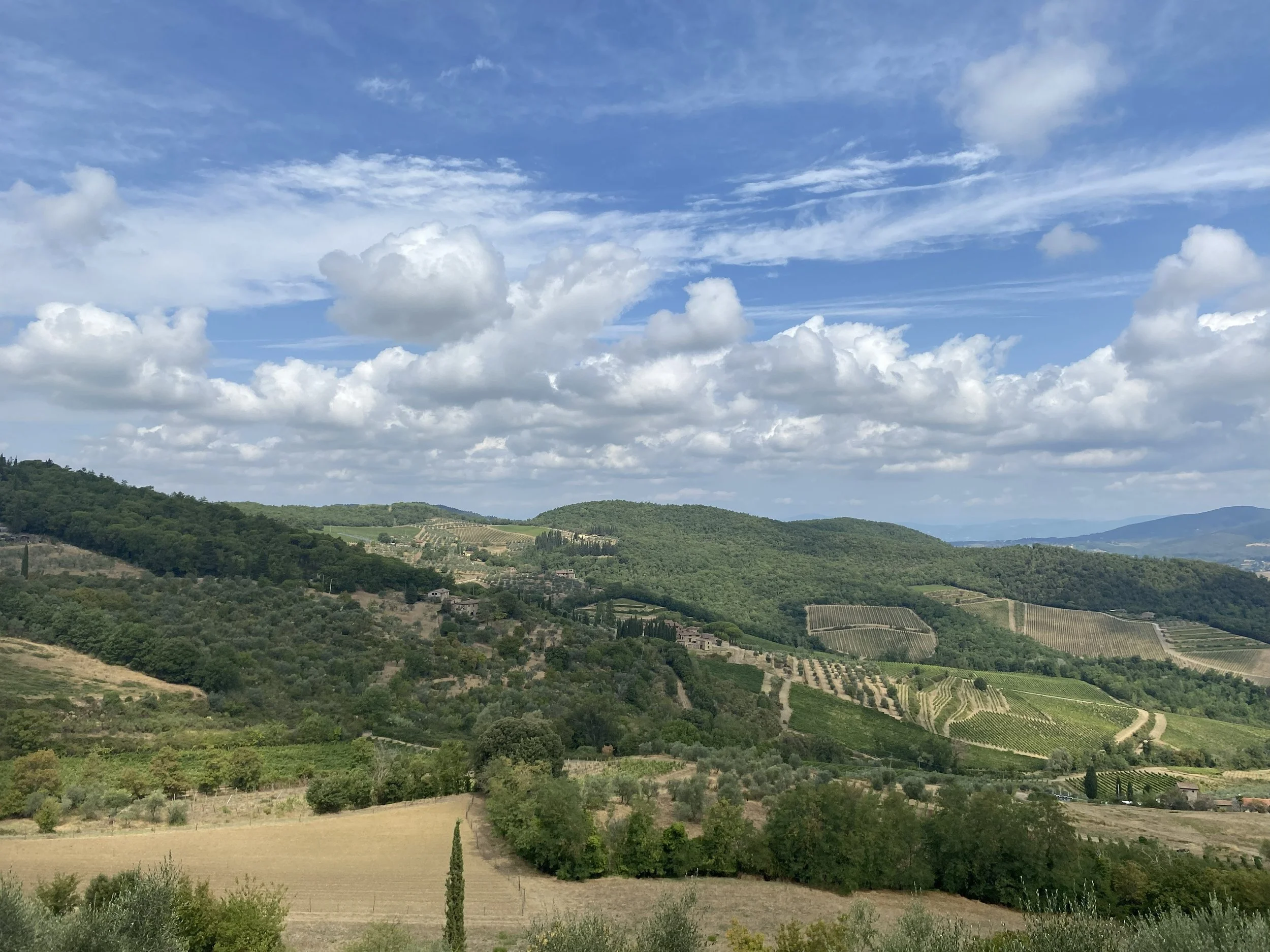
Figure 6. Outside of Panzano in Chianti, August 2022. The landscape in peak summer before the harvest. Photograph by author.
The convergence of these issues of migration, tourism, and landscape and architectural design highlight vital questions of identity and place-making. For many consumers, the authenticity of Chianti’s identity is defined by the percentage of Sangiovese grapes in the wine. For others, authenticity lies in the territory and the landscape. And yet for others, it is in the culture and history of wine of the region and country. Does it matter that the many of the people owning the land, growing and cultivating the grapes, and drinking the wine are not Italians and have arrived from afar? That the plants and their care, the barrels, bottles, corks, and equipment are not made in Italy? These points about migration are not to dismantle the value of what it means for something to be “Italian.” The intention through an examination of Chianti wine is to understand that the fetishization of “local” or “terroir” is an invention that has served economic purposes, as well as social, political, and symbolic ones. And that all parts have been brought together to create a story and give meaning to this classic Italian wine.
Citation:
Min Kyung Lee, “Invented Food Identities: Entangled Migrations and Representation of the Chianti Landscape,” Platform, May 4, 2026.