The Politics and Poetics of Infrastructure Under Fire
I try not to check the news first thing in the morning. I tell myself this every night, as a kind of promise, that tomorrow I will protect the early hours, that I will return to the manuscript to which I have dedicated more than a decade of my life. That I will finish this last stretch, so the book will come out in time: this will be my resistance against a world that seems determined to consume me. But the silence no longer holds, and the news is the first thing I reach for as I open my eyes, because it is the only window left into a world that has gone dark.
The Islamic Republic government has cut the internet and shut down international phone lines in Iran. Friends and family, the faces I carry in memory across an ocean, are impenetrable, sealed inside a silence I cannot break through. What reaches me comes in fragments, through those who manage to slip past the filters at great expense, and the picture they portray is filled with the sound of warplanes, the shudder of explosions, and below it all, the boots on the ground (Figure 1).
Figure 1. The column of smoke rises over the Azadi Square of Tehran, following bombardment near Mehrabad Airport, April 5, 2026. Source: Vahid Online via X (https://x.com/Vahid/status/2041105838413082823/photo/1), Creative Commons.
But this is not where the story begins. Three months ago, and many times before January 2026, those same streets were full—full with a different kind of presence. People had come out, demanding life and dignity. They filled the squares and intersections and long avenues, claiming with their bodies what they could not claim any other way: That Iran belonged to them. The state answered with its security forces and with bullets, leaving thousands dead; with mass arrests and disappearances into prisons and underground interrogation centers, from which some emerged broken and others did not emerge at all. Behind closed doors, executions continue quietly, but daily. The protest was not defeated by argument. It was silenced by making the cost of standing in public unbearable.
The bombardment by Israeli and American war planes, exacerbated what the state crackdown had started.[1] The Basij paramilitary forces flooded the streets again, not to protect but to consolidate what they had already won, setting up checkpoints, moving through alleys in clusters.[2] Their loud chants of Heydar, Heydar, invoking the first Shi’a imam, land in the ears of those who are trapped in their houses not as devotion but as threat, not as a call to the sacred but as a warning to the living. People are pressured once more, this time from two directions at once: the bombs from above, and the state forces on the ground. The streets that had become sites of defiance contracted into corridors of danger, and the people who had tried to claim them disappeared from view.
I sit with this, and I write about Isfahan—a city that was once capital of this country.
I write about a city built at a time when the influx of silver from the Americas and the forced labor of enslaved and colonized people reshaped Europeans economies, sending them to the shores of Asia in pursuit of raw materials and commercial adventures—a seventeenth-century capital that dazzled European travelers, a city that housed Muslim, Armenian, Zoroastrian communities, as well as a Jewish community, whose synagogues still stand today, bearing witness to their centuries-old roots in this land. A city that raised a monumental public plaza (Maydan-e Naqsh-e Jahān) at its heart where the world seemed to converge (Figure 2): where merchants spread their wares and wandering performers drew crowds, where makeshift stages appeared and disappeared, where diplomats from distant courts, and traders from across the Indian Ocean, and curious Europeans who traveled long journeys all moved through the same space alongside the ordinary city dwellers. A plaza that was less a monument than a living stage: porous, crowded, continuously in motion, where the public life of the city unfolded not by design from above but through the accumulated presence of people who claimed it, day after day, as their own.[3] Most importantly, I write about the city’s waters: the canals engineered through the hinterlands to carry water from the Zāyandehrud River across the plain, delivering water to gardens, to streams, cascades, and fountains that threaded the city’s public spaces. I write about the bridges that worked simultaneously as dams, as promenades, and as stages for public and royal life over the river. I write, in other words, about infrastructures—the hidden arterial systems that made the city possible and turned arid land into green, that gave people pleasures they could hold in common, in the open air, in each other’s company.
Figure 2. Naqsh-e Jahān Plaza as seen from the terrace of the seventeenth-century royal palace of Āli Qāpu in Isfahan, Iran. Photo by Sahar Hosseini.
I read the news: U.S. and Israeli strikes damage Naqsh-e Jahān plaza and its adjacent seventeenth-century structures in Isfahan. Explosions are reported near Kuh-e Soffeh, the popular ridge that rises at the southern edge of Isfahan. My thoughts immediately go to the military zone at the foot of the mountain. The garrison there, sits on the ground where the last Safavid king once established a new town he named Farahābād, a name that means in Persian, the place of delight and prosperity. Construction in Farahābād was still ongoing when the city fell to Afghan forces in 1722, and the king surrendered on the very ground he had been building.
The garrison that now sits on this land came two centuries later, as a military installation planted over the ruins of a royal development that would have been impossible without water. In an otherwise barren landscape, it was a canal, drawing from the Zāyandehrud River, and redirected towards Farahābād, that made the whole ambition possible. I write about the canal that drew water from the Zāyandehrud, threading life into the land that would otherwise have remained dry (Figure 3). I write about this old infrastructure: a canal whose traces are barely visible on the land.
Figure 3. Lined with a row of trees, the canal delivered the water of Zāyandehrud to the southern plains of Isfahan facilitating the expansion of the city, its gardens, and verdant and water-laden public spaces. Cornelis De Bruyn, Travels into Muscovy, Persia, and parts of East Indies, vol.1 (London, 1737). Digitized by Boston College, via HathiTrust Digital Library.
In my search for traces of this seventeenth-century infrastructure, I have explored various repositories, including the landscape. I have come across retaining walls, ordinary and unremarkable, never properly studied, which appeared to have been built to keep the water canal elevated as it crossed the piedmont before descending into the plain. Islamic Republic’s Ministry of Culture must not have had any budget for a proper examination of it. The budgets had gone elsewhere: into underground missile cities carved from rock, into hardened silos designed to shelter ballistic missiles, into infrastructure built for the projection of force rather than the protection and understanding of a nation and its history. The state had long been building for war. For half a century it had been chanting “Death to America,” and yet, for all the military buildup, no shelter was built for the people. No plan for protecting civilians, civic institutions, cultural heritage, and the ordinary infrastructures that supported daily life. The underground missile cities were not built for the citizens who lived above the ground.
The news does not dwell long on any single place. It moves, from target to target, from once-announced intention to the next. Not only military targets, or institutions and residential buildings in the city, but also bridges, airports, petrochemical facilities, universities and medical research facilities are hit: whatever falls under the category of “legitimate target” and “strategic asset.” It’s a vocabulary designed to serve those who wage war, not those who lose homes, hospitals, lives, and hope. Its true function is to measure success in strategic outcomes and political gains, obscuring the human suffering that lies beneath.
“Every bridge in Iran will be decimated… every power plant in Iran will be out of business, burning, exploding, and never to be used again,” the president of the United States said in a press conference on April 6, 2026, as he demanded the Islamic Republic open the Strait of Hormoz.
““Ghamsari is insisting, by his presence and his music, that this structure belongs to the domain of humanity, that it is not an abstraction or a military asset or a bargaining chip in a geopolitical standoff, but the material ground of people’s daily lives.””
And then the news shifts again, and with it the lens of the camera widens from the rubbles and collapsed buildings, from the dark smoke that hovers over Tehran, a city of 9 million people, to something vast and still: a powerplant, its cooling towers rising against the sky in great cylindrical columns, enormous and steady. It is a kind of structure that usually registers as purely functional, as background, as the invisible condition of ordinary life. And there, small as a word in the margin of that industrial vastness, sits Ali Ghamsari—a celebrated Iranian musician, a tār player, whose work moves between the classical Persian tradition and something more restless and searching. He has brought his instrument to the Damavand powerplant, the facility that provides half of Tehran’s electricity; and he is playing (Figure 4). He has stationed himself there not as a protest in any conventional sense, not with a banner or a slogan, but with the thing he knows best: sound, breath, the vibrating string, the long resonance of the tār in open air. He is doing something older and stronger than political demonstration. He is insisting, by his presence and his music, that this structure belongs to the domain of humanity, that it is not an abstraction or a military asset or a bargaining chip in a geopolitical standoff, but the material ground of people’s daily lives, the invisible structure through which a civilization sustains itself in the most ordinary and irreplaceable ways: light in the evening, warmth in winter, and hum of a city that has not yet gone dark.
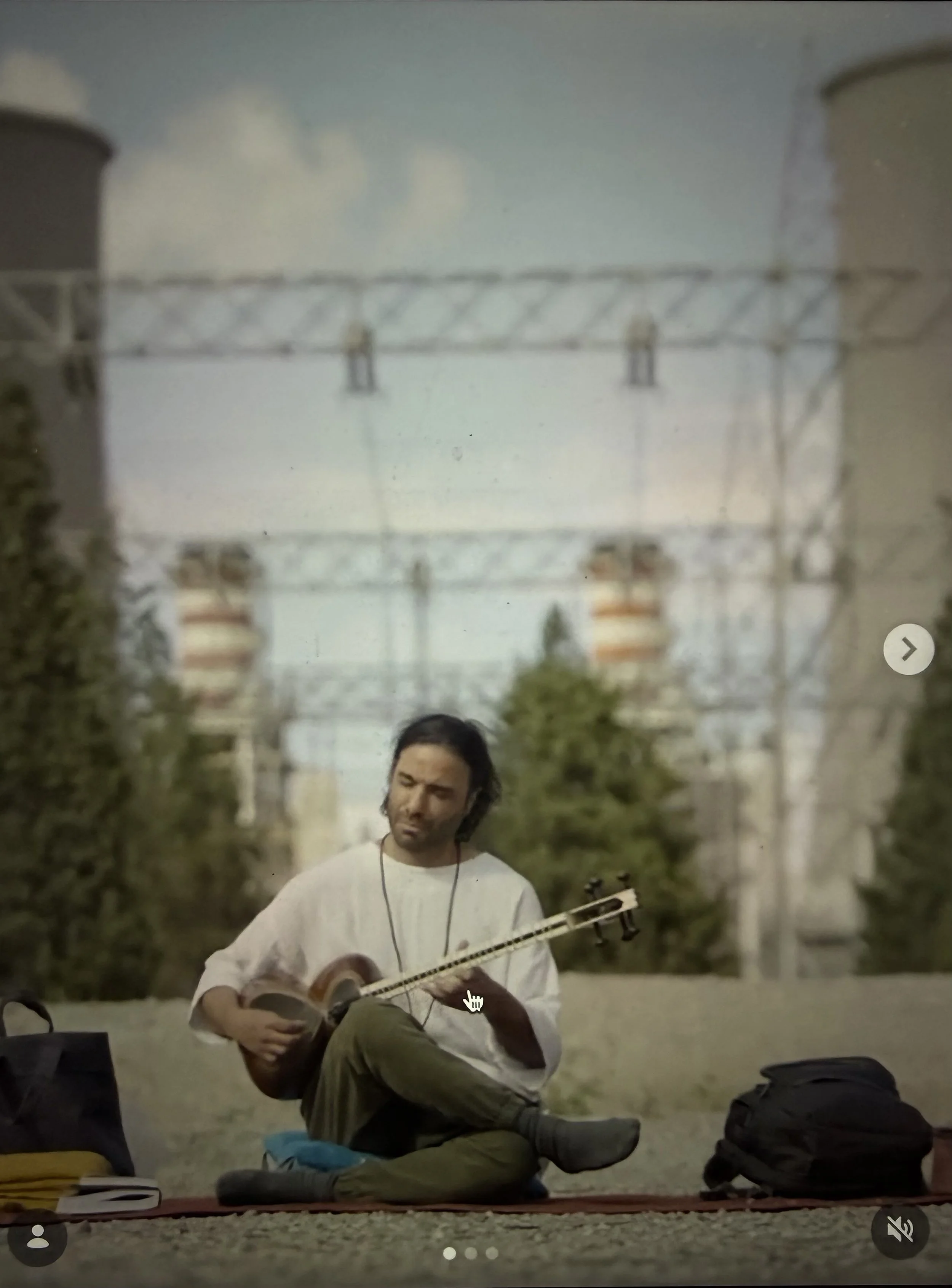
Figure 4. Ali Ghamsari at a sit-in outside the Damavand powerplant, April 6, 2026. https://www.instagram.com/p/DW2Aw5ZiEIb/?utm_source=ig_web_copy_link
What Ghamsari’s act does, quietly but powerfully, is make infrastructure visible as something that belongs to the people who depend on it, rather than to the state that administers it. This is a distinction that tends to collapse in times of war, when the state claims national assets as its own domain and its own leverage, when powerplants become strategic targets and bridges become symbols of the regime’s reach, and ordinary people are left as the unnamed and uncounted inheritors of whatever remains after both sides have made their calculations. The Islamic Republic government in Iran, in those same hours, called on young people to form human chains around the powerplants and bridges, mobilizing the bodies of citizens it has long treated as expendable, asking them to stand as shields for the infrastructure the state had failed to protect through diplomacy. Unwilling to compromise, the state offered its subject’s bodies as a substitute for political will, buying itself more time, holding on to power at any cost. Whether those who answered the calls were desperate ordinary people or the same members of paramilitary basij forces who had just finished sealing off the streets, the image resists celebration. This is a portrait of a state that has run out of everything except its citizen’s bodies and is spending those too.
The U.S. president doubled down on his threat on April 7, 2026, as his deadline for Iran approached and the world held its breath: “A whole civilization will die tonight, never to be brought back again.” His threats, even if rhetorical gestures, targeted a living nation. He did not say “will be destroyed”. He said, “will die,” as though he understood what he was threatening was not just a political regime, but a living thing, something that breathes, has hopes and fears, and sustains itself through the system he had named as his target: “every bridge and powerplant.” He was not wrong that his target breathed.
That is, in the end, what becomes visible in Ghamsari’s sit-in. Sitting in the shadow of those large cooling towers, with every stroke on the string filling the air with a familiar tone, Ghamsari insisted that the thing behind him is alive, that it belongs to the people who need it, who paid for it, and counted on it, and that someone should say so before it is gone. This is not the first time Ghamsari has used his music to bear witness to a place. Over the past few years through his Iranian Tār project, he has played across more than a hundred historical sites in Iran, deliberately weaving music and place together. Against this background, Ghamsari’s solitary figure acquires its full weight. He is not a human shield. He is making an argument, in the language he has mastered, one that speaks from deep within the life of this land—that this infrastructure, these turbines, these cables, running under the ground, this electricity moving through the walls of many homes in Tehran, belong to people and not to the calculations of power.
In his influential essay “The Politics and Poetics of Infrastructure,” Brian Larkin observed that infrastructure operates on two registers simultaneously. The first is political: Infrastructure is the material form through which states exercise power and govern populations. The second is poetic: Infrastructure is the form through which societies imagine themselves, encode their aspirations, and sustain a collective sense of what kind of world they inhabit and what kind of future they are moving toward. These two registers are always present at once, but they are not equivalent, and when infrastructure becomes a target, it is the second register that reveals what is truly at stake. What is being aimed at is not only steel and concrete, not only the state’s assets or a regime’s leverage, but the substrate of ordinary life itself: the capacity of ordinary people to exist in ways that makes life recognizable as life—with light in the evening, with water in pipes, with the ability to move through a city, to gather, to imagine a future with hope and dignity.
Figure 5. People gather on the steps and within the arcades of the Khāju Bridge, resting and socializing, a social practice as old as the bridge itself. Isfahan, Iran. Photo by Sahar Hosseini.
Figure 6. Resting in the shaded arcades of seventeenth-century bridges has been a common social practice in Isfahan for generations. The practice still continues even when the riverbed beneath runs dry. Isfahan, Iran. Photo by Sahar Hosseini.
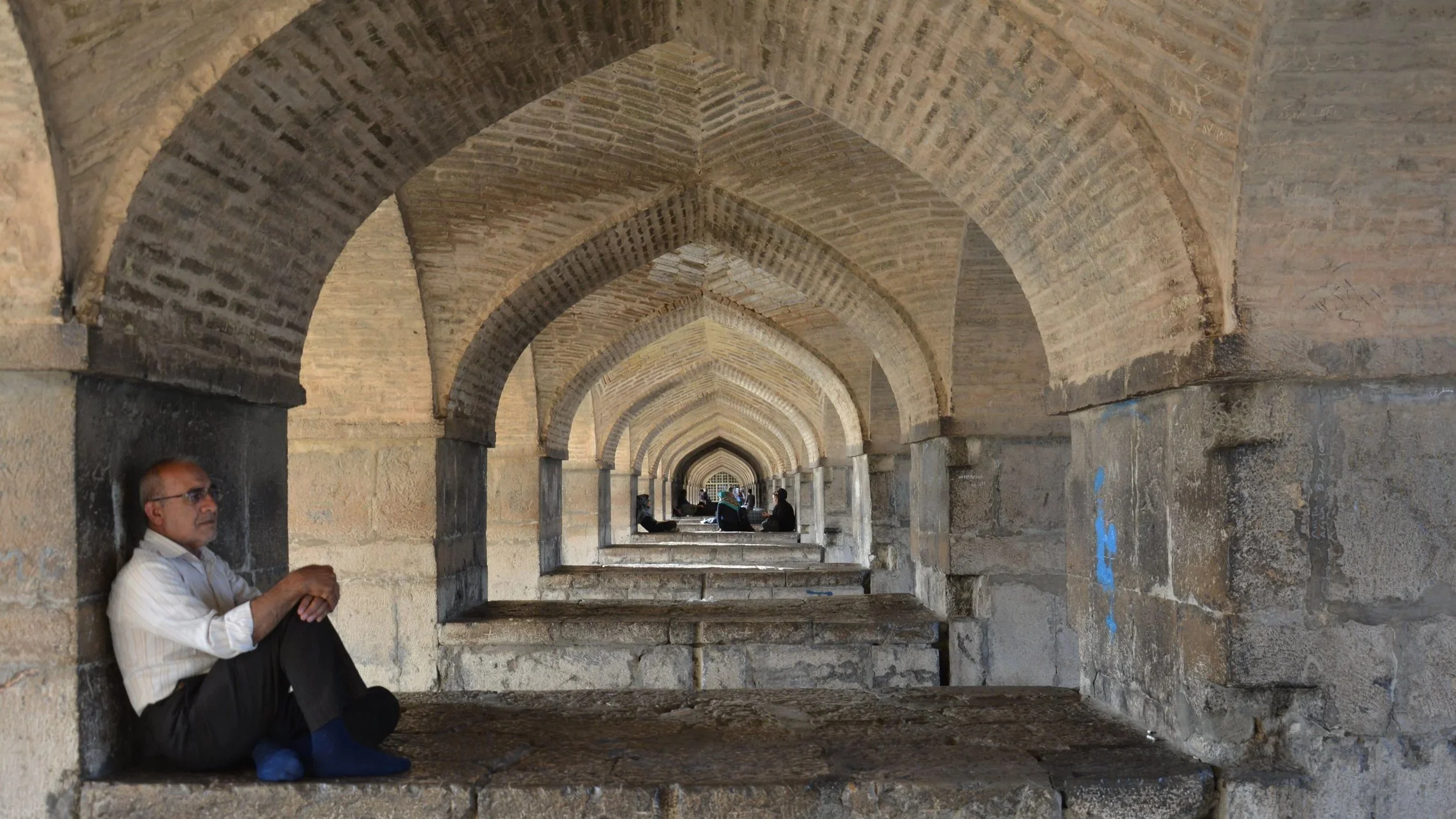
I am writing about water infrastructure in seventeenth-century Isfahan. I have spent many years reading this city through its canals, its bridges, its fountains and cascades, trying to understand how water shaped not only the physical fabric of the city but its social life, its pleasures, its sense of itself as a place worth inhabiting, and its aspirations for the future. I could not have imagined, when I began, that by the time I came close to finishing, the descendants of those systems, the bridges, the powerplants, and the infrastructure of the same land would be announced as legitimate targets by the most powerful military force on earth, and that a musician would be sitting alone in front of a generator, playing, because there was nothing else left to do…yet, Isfahan has taught me that infrastructures are not strategic abstractions, that cities are not just built, but claimed by people. For generations, across centuries of turbulence, Isfahanis have claimed their bridges as places of urban life, socialization, and conviviality (Figure 5). I have seen this in their literary works, historical photographs, and in person: people populating arcades of the bridge, the space filled with the tone of a singing voice. Even when the river runs dry, someone sits in the shade of the bridge and lets their voice fill the air—insisting, as Ghamsari does, that this place belongs to life (Figure 6).
Citation:
Sahar Hosseini, “The Politics and Poetics of Infrastructure Under Fire ,” Platform, April 27th, 2026.
Notes:
[1] While portions of Iranian population, inside the country and across the diaspora, viewed the war as a possible path to liberation from the Islamic Republic government, opposition to war has only deepened with each passing week. The government’s systematic suppression of internet access has silenced those inside Iran who bear the war’s immediate consequences.
[2] The Basij is a paramilitary organization whose membership is not only ideological but also driven by material incentives. They are formally subordinate to the Islamic Revolutionary Guard Corps (IRGC), as such, they operate outside normal legal accountability and are not answerable to the elected government. Historically Basij forces have been systematically used to suppress protests, from the 2009 Green Movement to the most recent Woman, Life, Freedom movement of 2022.
[3] For a quick history of Isfahan’s development as a Safavid capital and its architectural monuments see Susan Babaie, “Isfahan x. Monuments,” Encyclopedia Iranica, December 2007. For more sustained scholarly treatment see Sussan Babaie, Isfahan and Its Palaces: Statecraft, Shiʿism and the Architecture of Conviviality in Early Modern Iran (Edinburgh: Edinburgh University Press, 2008); and Farshid Emami, Isfahan: Architecture and Urban Experience in Early Modern Iran(University Park: Penn State University Press, 2024).