Monumentalizing the Maya: An American Company’s Attempt to Redesign the Past
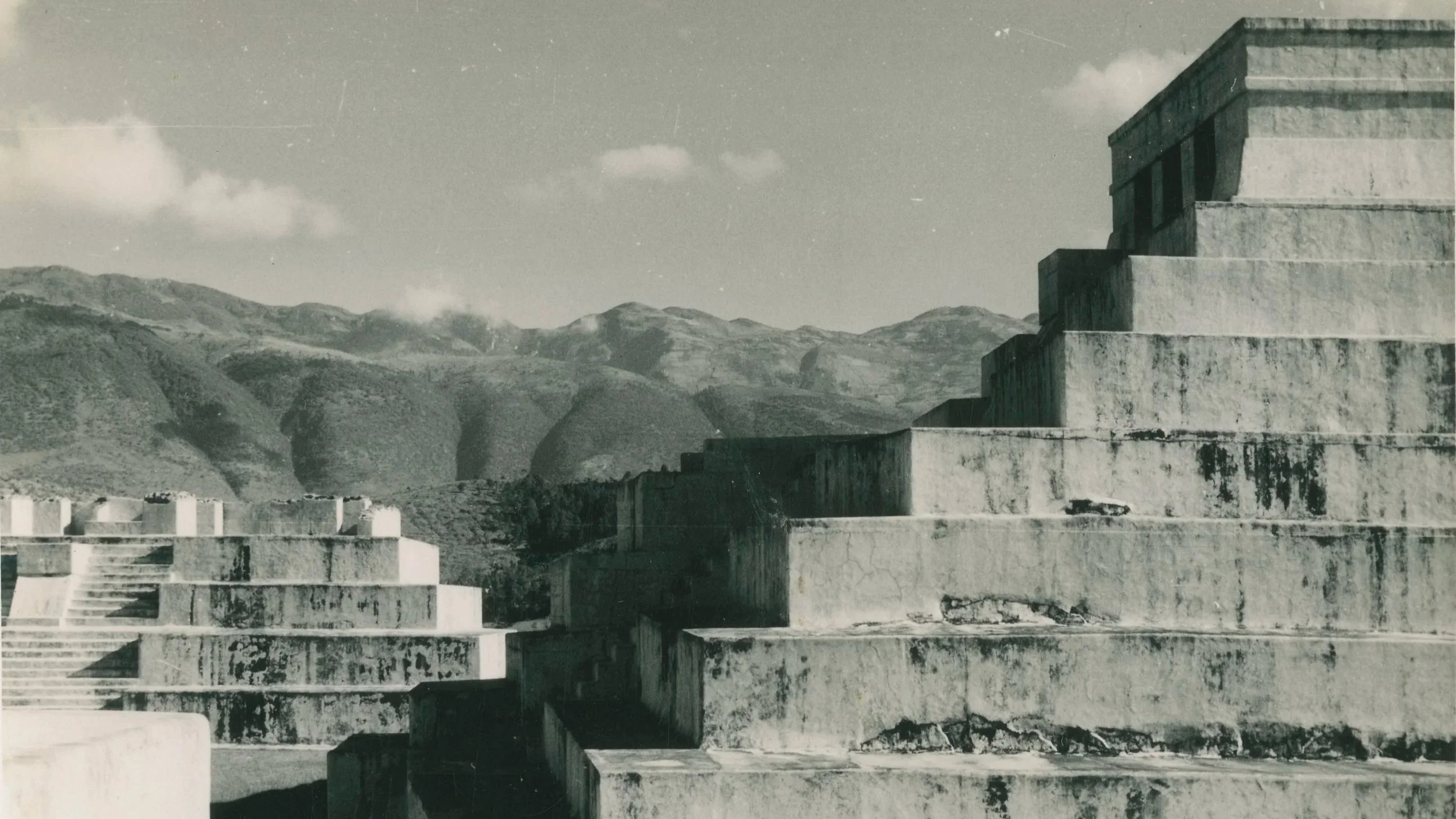
In Huehuetenango, Guatemala, a series of water-stained concrete structures rise from a hill. From a distance, they appear to be a modern complex, with sharp rectilinear lines, uniformly painted white. In reality, the buildings’ core belong to the ancient Mam Maya site of Zaculeu, established around 250 C.E. Their facades, however, are testament to one of the most aggressive conservation projects in Central America. Conducted in the 1940s, this conservation project was sponsored by an American corporation that at the time was one of the largest private land holders in Central America: the United Fruit Company (UFCO). In addition to conservation rife with anachronism, the choices around the project’s technique, styles, and materials signal how a notorious American company with outsized influence cemented ideals about modernity, newness, and monumentality in Zaculeu’s structures (Figure 1).
Figure 1. “Estructuras” [Structures] at Zaculeu. Georges Francois Guillemin (1957). Huehuetenango, Guatemala. Image courtesy of the Centro de Investigaciones Regionales de Mesoamérica (CIRMA) Antigua, Guatemala. FG-016-002-001-005-010
The antecedents of UFCO began in the 1890s with an American businessman Minor Cooper Keith, a railroad magnate who won a land concession from Costa Rica to build part of their national rail. Capitalizing on the Costa Rican government’s land concession, Keith planted bananas as a cheap way to feed workers, and eventually shipped them out to a growing global consumer base. The company evolved, merging in 1899 with a rival company “Boston Fruit Company” owned by Andrew Preston, and acquiring Cumayel Fruit in 1929 under Sam Zemurray. With its main offices in Boston and New Orleans, this conglomerate retained so many arms of operation entrenched in Central American governments that it became nicknamed “el pulpo” or “the octopus.” Lasting from 1899 to about 1970, UFCO was one of the largest landholders in Central America, controlling major banana and sugar plantations in Honduras, Guatemala, Costa Rica, and throughout the Caribbean. Its descendant company has morphed to the company we now know as Chiquita Banana, which as recently as 2024 was held liable for funding paramilitary groups in Colombia.
To ensure its monopoly over arable land, the company dug roots into international politics; UFCO staged coups, quelled labor reforms, and acted as a quintessential gear in the project of American imperialism. Guatemala in particular became a site of extreme American intervention. In the mid-twentieth century, nearly 200,000 hectares of its land were controlled by UFCO for banana production. By the 1940s, the company’s control of territory, and its corrupt labor practices became national issues for Guatemalan citizens seeking major rights reform, claims for land expropriation, and safeguards against increasing American land grabbing that they deemed “Yankee imperialism.”
In an effort to quiet concerns of American interventionism, the company conducted what they called “goodwill” projects. In addition to building schools and hospitals, UFCO also invested in archaeological work. The company’s foray into archaeology allowed the company to filter its image through promotional materials, pamphlets, and tours, creating the impression of the company as a scientific innovator capable of preserving Maya sites for the benefit of appreciative American audiences. Conveniently, many of these Maya sites were located in the company’s own land concessions which were legal territorial designations that allowed the company to operate ostensibly with their own laws and regulations within semi-sovereign spaces, often with tax-exempt privileges. Within these concessions, the company actively prospected for some archaeological sites. Others they stumbled upon in the process of dredging for irrigation, planting crops, and bulldozing ground.
““...the restoration work sat firmly within the aesthetic of sanitizing and ordering the landscape. These choices concealed parts of the site, causing destruction that affect our contemporary ability to analyze and understand the archaeological record.””
At the archaeological site of Zaculeu, however, UFCO intervened beyond its own territorial purview to stage a large-scale archaeological excavation and conservation project. While the company did not own the land on which Zaculeu sat, UFCO claimed it could provide an archaeological site not through the transfer of property title, but rather through transfer of scientific expertise and conservation style.
Zaculeu is a highland Mam Maya urban center that was continuously occupied from 300 C.E. until about 1525. An immense city with stepped pyramids, a public court for playing ulama, (a widely practiced Mesoamerican ballgame) and ceremonial structures, this economic node would have been a vibrant space, populated by citizens who lived within bright red-hued walls. Under the company’s conservation agenda to “gift a monument to the Guatemalan people,” the leaders of the project chose to only mimic what would have been the monument’s layer of white limewash primer for a polychrome façade and ignore traces of red pigment. [1] The company chose a freezeframe of the building’s history by painting it white.
Figure 2. Photograph of Excavation of the Ballcourt, Zaculeu, Huehuetenango Guatemala. (c.a. 1947). Image courtesy of the Middle American Research Institute (MARI); holding institution: Tulane University. G.5.1.170.
Figure 3. Cover from Unifruitco Magazine (February, 1950). Holding Institution: Middle American Research Institute (MARI), Tulane University. Unifruitco 050 U58.
In 1946, John Morton Dimick, an adventurer, former intelligence gatherer, and archaeological enthusiast, secured funds from the company’s president, Samuel Zemurray, in order to “develop some ancient ruins.”[2] From 1946 to 1949, Dimick led a team of American archaeologists and nearly 44 Guatemalan laborers to re-monumentalize the site, with the aim to create an archaeological park that UFCO publications referred to as fully restored (Figure 2). Laborers contracted by UFCO were instructed to recreate the site by first fabricating an adhesive that was created of discarded excavated soil, quarried stone, and a concrete mixture that they then applied to major structures. The buildings were then painted in stark white, which, even at the time, was commented on by Guatemalan newspapers as anachronistic and an overly aggressive method of conservation (Figure 3).[3]
Spanish colonial sources refer to painted facades, and even UFCO archaeologists report finding remnants of red pigment throughout parts of the structure. [4] Regardless of both the historic and physical evidence of polychrome facades, UFCO archaeologists Aubrey Trik and John Dimick ignored traces of color in their conservation agenda. [5]
Subsequent American articles about UFCO’s project at Zaculeu highlighted American scientific ingenuity alongside the stark “before and after” photographs, signaling that large-scale corporate-sponsored projects could transform the ruination of the past into more modernized national monuments (Figure 4). Concrete signaled an advanced technology that required timed, choreographed labor. It also allowed for an efficient means to build rectilinear forms that conjured sanitized, austere environments that looked more “modern.”
Figure 4. Superimposed before and after images of altar restoration. Superimposition by author; photos from Zaculeu: a Restoration by the United Fruit Company. (New York: Middle American Information Bureau: 1947). Holding Institution: Middle American Research Institute (MARI), Tulane University.
Their choices conveniently photographed well in black and white, and looked, in their starkness, more modernized. Much like how the polychrome decoration of Greek and Roman statues was never restored in order to match the taste of collectors, the site of Zaculeu was conserved as white to match the taste of the company. The decision to conserve Zaculeu in this way was deeply reflective of the company’s values of control and regulation and conducive to their architectural and infrastructural branding. Their corporate enclaves, which contained hospitals, workers’ houses, and commissaries, were regulated, controlled spaces marketed to Americans as comfortable, sanitized spots in the “tropics” (Figure 5). The buildings were mostly painted white, and when photographed for pamphlets, Unifruitco (the company’s internal magazine) and tourist promotions, they contrasted against dark vegetation, meant to symbolize American modernity (Figure 6). UFCO’s ships, which ferried both banana cargo and tourists, were white-painted banana boats that operated for over 100 years as the “Great White Fleet.” This control and regulation extended from the very aesthetics of the buildings, and into their manner in which the company publicized their controlled labor force responsible for their construction.
Figure 5. “A Sea of Bananas.” Photo from Upham Adams’ Conquest of the Tropics: the story of the creative enterprises conducted by the United Fruit Company (Garden City, New York: Country Life Press, 1914): 17. https://archive.org/details/oftropicconquest00adamrich/page/368/mode/2up
Figure 6. United Fruit Company Hospital in Quirigua, from Upham Adams’ Conquest of the Tropics (Garden City, New York: Country Life Press, 1914): 292. https://archive.org/details/oftropicconquest00adamrich/page/368/mode/2up
Early writers championing UFCO pointed to how the company’s country clubs, hospitals, and infrastructure demonstrated the company’s ability to conquer jungle environments. This was accomplished by contrasting rural, “disorderly” spaces with inclusions of “modernity” in which uniformly painted walls created a stark visual against the wildness of nature,[6] and grid-like patterns ordered agricultural fields and roads.[7] Many point out that the kind of architectural forms produced by UFCO as well as their photographic legacies, were ways for the company to visually justify their presence to American audiences.[8] Other scholars have written about UFCO’s involvement at Zaculeu and the local backlash it received. An overlooked aspect of the project, however, is its deep roots in the company’s branding and marketing scheme, in which aesthetic choices around minimalism, abstract severity, and the color white as coded for sophistication embedded themselves in the conservation logics.
In UFCO’s publications and branding, the restoration work sat firmly within the aesthetic of sanitizing and ordering the landscape. These choices concealed parts of the site, causing destruction that affect our contemporary ability to analyze and understand the archaeological record. As part of this aesthetic choice, the use of concrete in itself signaled a technological prowess, whereby archaeological conservators could demonstrate reconstruction with a material that necessitated a large labor force, an intricate timing system, and proficiency in science.[9] Enveloping the buildings in concrete also meant destroying the different layers and styles that had been built up over hundreds of years by Zaculeu’s builders. As scholars have argued, aggressive restoration can often mean inventing a new “unity of style” that erases the bricolage of the past in favor of aesthetic continuities.[10] These aesthetic continuities can then be mobilized for various purposes, from national patrimony, to, as UFCO hoped for, tourism and propaganda.
UFCO’s intervention was memorialized in photographs that documented the transformation of loose stone platforms into bright white rectilinear forms. These images were circulated in print media, from newspapers to the company’s internal magazine, Unifrutico. The company not only dispersed information about Zaculeu to global audiences, but it also sought to bring audiences to the site itself. UFCO publicists and John Dimick himself invited spectators and tourists to the site to see the act of conservation taking place.[11] The ability for people to witness labor as a touristic activity in and of itself at the site is an important and yet overlooked feature of the UFCO’s involvement. In the very act of restoration, onlookers could view how teams of local laborers were deploying their company-sanctioned technical training. In a kind of archaeological theater of UFCO’s design, spectators could see the company’s transformation on the landscape in real time.
In a Chicago Daily Tribune article published June 9, 1946, the act of restoration was described as a monument to see in itself, in which visitors could see “the wonders of an ancient civilization under the process of reconstruction.” The conservation project at the site of Zaculeu, in its use of concrete and in its labor force, thus became an arena for staging conservation science.
Figure 7. Estructuras [Structures] at Zaculeu. Georges Francois Guillemin. Fototeca CIRMA (Centro de Investigaciones Regionales de Mesoamérica) Antigua, Guatemala. FG-016-002-001-005-002.
A contrived Maya archaeological site conjured from surviving architectural details, Zaculeu was touted as not only the company’s, but also America’s gift to Guatemala. The lasting legacy is a time capsule to American interventionism. UFCO’s project created monuments that, while anachronistic to the Maya past, signaled how the use of cement, coordination and labor, and white paint brought ancient Maya buildings into an American-controlled future (Figure 7).
Citation:
Charlotte Williams, “Monumentalizing the Maya: An American Company’s Attempt to Redesign the Past,” Platform, April 13, 2026.
Notes:
[1] In the review of the UFCO monograph, The Ruins of Zaculeu, Guatemala, by R. B. Woodbury, A. S. Trik, J. M. Dimick, C. W. Goff, W. C. Root, T. D. Stewart, & N. F. S. Woodbury published in 1954, the reviewer states that to establish goodwill and ignite American tourism, the true aim of the project was to “provide Guatemala with a National Monument.” Review of]. S. F. Borhegyi, Boletín Bibliográfico de Antropología Americana, 17 no. 2 (1954), 132.
[2] John Dimick, Episodes of Archaeology: Bit Parts, Big Dramas (Barre, MA: Barre Publishers, 1968), 15.
[3] In Episodes, Dimick narrates a moment in which the company has to halt work on account of bad press, in which a newspaper ran the headline that the company was “ruining the site (Dimick 1968: 58). In addition, in a 1953 Revista Guatemala article, the anonymous author states that the restoration work was a fantasy unbased in scientific reality and instead made for publication. Original text reads, “Un trabajo que pudo haber sido un modelo de interdisciplina entre arqueología y restauración arquitectónica se transformó, por parte de las prioridades publicitarias, en una fantasía sin ningún asidero científico.”
[4] An early description of the site appears in Recordación Florida, a Spanish colonial source by Francisco Antonio de Fuentes y Guzmán, originally published in 1690. Fuentes y Guzmán, Francisco Antonio de. Recordación Florida. Edited by Celso A. Lara Figueroa. 3rd ed (Guatemala: Editorial Artemis-Edinter, 2000).
[5] See Dimick. Episodes of Archaeology. This is also mentioned in the monograph of the site. See Richard Woodbury and Aubrey Trik. The Ruins of Zaculeu, a Restoration by the United Fruit Company (Richmond, VA: William Byrd Press, 1954.)
[6] An early 20th century example of this kind of writing is in a pamphlet book. See Upham F. Adams, Conquest of the Tropics: The Story of the Creative Enterprises Conducted by the United Fruit Company (New York, NY: Doubleday Page and Company, 1914).
[7] Charles Morrow Wilson, Empire in Green and Gold: The Story of an American Banana Trade. (New York: Henry Holt and Company, 1947).
[8] Lilliana Gómez, Archive Matter. A Camera in the Laboratory of the Modern (Zurich: Diaphanes, 2023). See also Kevin Coleman, A Camera in the Garden of Eden: The Self-forging of a Banana Republic (Austin: TX, University of Texas Press, 2016), and Natalia Solano-Meza, “Arquitectura bananera, degradación ambiental, e imágenes de violencia espacial en el Caribe costarricense,” Revista De Filosofía de la Universidad De Costa Rica 62, no. 163 (2023): 189–205.
[9] Michael Osman, “The Managerial Aesthetics of Concrete,” Perspecta 45 (2012): 67–76.
[10] See for example, Heike C. Alberts and Helen D. Hazen, “Maintaining Authenticity and Integrity at Cultural World Heritage Sites,” Geographical Review 100, no. 1 (2010): 56–73. See also Meredith Cohen, “Restoration as Re-Creation at the Sainte-Chapelle,” Anthropology and Aesthetics 48 (2005): 135-154.
[11] Dimick for instance explains a time in which he invited the press and photographers to the site to witness restoration. Episodes p. 58.