Irksome Dichotomies: A Conversation About Data, Technology and Architectural History
At the EAHN conference in Athens in June 2024, Theodora Vardouli and Eliza Pertigkiozoglou convened a panel entitled Data Narratives of Architectural Modernity.
From that roundtable, a conversation continued through the winter over email with three of the participants: Ultan Byrne (Columbia University), Anna-Maria Meister (Karlsruhe Institute of Technology and the Kunsthistorisches Institut in Florenz – Max Planck Institute), and Emily Pugh (Getty Research Institute). There were several themes that emerged around histories of digital technology and the field’s conceptualization of technology; they all focused on a discussion of false dichotomies: digital vs analog, virtual vs material, objectivity vs subjectivity. These scholars offer questions and several references to frame our understandings of data and architecture. The conversation has been edited in length and for clarity by Min Kyung Lee.
Fig 1: High-resolution photogrammetric 3D scan of the American Center in Paris Model, ca. 1988-1994, Frank O. Gehry and Associates, architect. Getty Digital, digital capture and 3D render. Frank O. Gehry papers, Getty Research Institute, 2017.M.66. © Frank O. Gehry
Histories of the Digital vs. the Material
Emily Pugh: Something that drives me nuts is when people talk about digital forms of information (i.e. data) as if they are in opposition to physical or material forms, or as if they must rank them vis-à-vis each other. Likewise, I see critics or historians lament what they characterize as the replacement of sketching or physical models with digital design software. I understand why one might approach the topic with this way of thinking. There is a pervasive notion that architecture used to be non-computational until the 1960s or so, at which point computers were inserted into the design process. In the Foreword to The Architecture Machine, for example, Andres Lepnik describes the use of AI and “virtual reality” in architectural design before posing the anxious-sounding question: “Will computers soon take over the remaining areas of architecture?”
To me, this instinct to view computers and data as alien and a possible (or actual) threat to architectural design reflects a common human response to all kinds of technological developments. While often perceived as sudden or unexpected, the advent or widespread adoption of a new technology is in fact always the result of much more gradual processes, processes that are often social and economic as much as they are technical. This was true of analog photography and moving image cameras and projectors, of course, and it is also true of computers and artificial intelligence.
What do you two think of this? Is this something you have observed, and does it irk you as well? How do you think the relationship between data and architecture should be regarded and/or discussed? I guess part of the question is how we define these two terms. Without wanting to go too far down a semantic rabbit hole, I do think that we should be aware of the assumptions we bring to words like “data” and “architecture,” especially as they relate to historically and culturally specific ideas about technology.
Anna-Maria Meister: It absolutely irks me for several reasons: historically and factually data and material are inseparable, both in terms of actual stuff, but also economically and epistemologically. And the dichotomy between treating new technology either as savior or threat is as old as human activity on the planet, or at least very well documented wherever people introduced novel techniques. I think it doesn’t help much in thinking about the question of data or information critically when it becomes ideological.
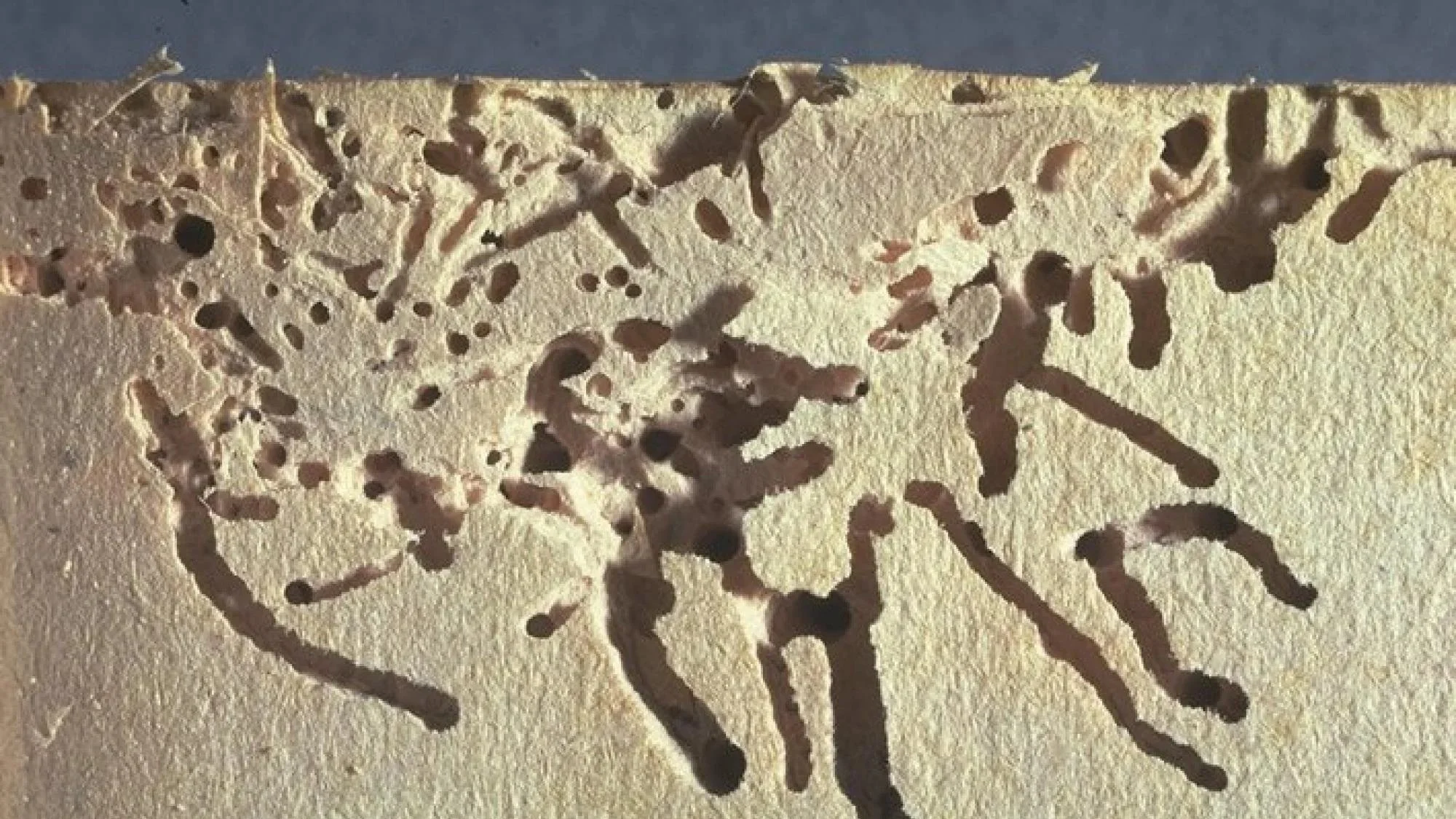
Fig 2: Anobium tunnels in a book. In the research project “The Intelligence of Loss in the Archive” by Anna-Maria Meister and Rafael Uriarte, artificial intelligence is used alongside historical artefactual intelligence to understand and investigate patterns of loss in archives as knowledge production rather than glitch. Documentation “What’s eating your collection?” initiated by the Birmingham Museum and Art Gallery.
In my Coded Objects group we try to bind together the coded with the material object, but also attempt to read coded differently: what I would be interested in and what we tried to do at the “Coded” Symposium is the totally other side (or seemingly other side) of the data coin if you will (pun intended): namely looking for questions of nostalgia, empathy, or affect when speaking about data or the “digital turn” (another ahistorical phrase I find problematic).
““When we overemphasize historical breaks, we deny ourselves the historical reference points for thinking through our (apparently) new circumstances””
Ultan Byrne: This is such a great place to begin. I think something that both of you are getting at is the relationship between (1) how we think about the temporality of technological developments and (2) the kind of response that we have to these changes as a result. When we overemphasize historical breaks, we deny ourselves the historical reference points for thinking through our (apparently) new circumstances. Maybe this is what leads people to messianic or apocalyptic feelings? Anecdotally, I can recall a time when I was teaching parametric design tools to students (maybe a decade ago) and some of them responded with just the kind of lament that you both mention… only it wasn’t nostalgia for sketching or hand drafting but instead for what they described as the more direct and unmediated capacities of their old CAD software. I’ll never forget it because they were echoing exactly the arguments that were so often invoked around an analog/digital shift.
This is why I find it useful to think about data and architecture on a longer time scale. For instance, the government architects that I am studying as part of my dissertation already had a computer in the office in the 1850s, his name was Bartholomew Oertly. His job was to collect data (again, their word) about transportation routes, sources of building material, and local trades in order to inform the design and estimate the costs of constructing post offices and other federal buildings across the United States. He worked within a bureaucratically-organized office with a division and hierarchy of labor that became increasingly structured over the second-half of the nineteenth century. Is this computational design? This might sound facetious, but scholars from Jon Agar to Cornelia Vismann have explored pre-histories of the electronic computer in the practices and equipment of bureaucratic offices, and—to your point Emily—Charles Babbage himself was influenced by the division of labor in his proposals for early computing machines. I think it’s noteworthy that before the end of the 19th century, critics of this government design office’s work disparaged it as architecture “by machine.”
How do we acknowledge the importance of the specific material basis of information and computation in a given historical moment, while also recognizing continuities over time as these material bases change, such as from paper to electronic computers?
EP: Yes, I agree with you both completely. To argue that the current moment of technological change has historical precedents and analogs is definitely not to suggest that AI or 3D imaging, for example, are unproblematic or don’t merit critical evaluation. Ultan, I think you raise just the right question: what is the way forward? The prevailing view of digital and material information as oppositional is so irksome in part because it is so entrenched: many people cannot see things in any other way. I think this is due partly to a lack of knowledge of how computers (or for that matter libraries or archives) work. Certainly, I can say my own thinking in this regard has evolved as I’ve become more familiar with particular processes, such as archival description, digital imaging, collections interface design, and how they shape and are shaped by computing technologies.
Conversations that pit “technology” against the analog (or anti-technological) are boring, frankly. More than that, this type of discourse prevents us from addressing important issues around how digital forms information and infrastructures are shaping our field in fundamental ways. In other words, this approach to discussing contemporary technologies does not shield us from their potential ill effects, but on the contrary makes us blind to them. I fear that, in not making data literacy and informed critical discourses around technology part of graduate (or even undergraduate) training, we are leaving students ill-prepared for negotiating the reality of architectural history research and writing as it currently exists right now and as it will exist in the future.
Fig 3: Microfilm copies of fourteen perspective drawings for post office projects in different cities. From the collection "Photographs of Federal and Other Buildings in the United States, 1857–1942" at U.S. National Archives, College Park. 121-B.
Can it be Called “Technology”?
AMM: We have a reading group at the Kunsthistorische Institut in Florenz - Max Planck Institute organized by my colleagues Hana Gründler and Rafael Uriarte on “The Art of AI”, and last session we had a discussion where I wondered whether we can even call certain developments “technology” anymore? My suspicion is it might be tremendously misleading, intentionally or subconsciously - or both. Because the term is, as Emily says, not at all opposed to the analog - but frankly deeply entrenched in it. But it is also not opposed to the human or humane, despite certain developments, but increasingly intertwined with it. And when we read Nick Bostrom or other “Deep Utopia” narratives, the enhancement of living beings and everyday life with what still gets called “technology” will be - and is already - deeply integrated not only in our practices, but our memories, emotions, affect and thinking. So calling it “technology” and, even more so, to keep calling developments like Large Language Models and multi-neural networks and different forms of AI a term associated with industrial serial production within the modern paradigm seems to completely miss the point entirely. What if ‘technology’ is not only the wrong term, but the completely wrong framework to think about developments today? What if we need different tools altogether (another problematic term: “tool”)? That is what I meant above by using a different terminology for technology discourse to explore other kinds of knowledge, introducing empathy, affect, or nostalgia, for example. I think this is necessary not despite, but specifically for the developments we observe and are involved in: maybe we need more expertise in history of emotions, in psychological approaches, in sensorial reflection and experience to adequately even address the questions at hand?
““…can even call certain developments ‘technology’ anymore? My suspicion is it might be tremendously misleading, intentionally or subconsciously - or both. Because the term is…not at all opposed to the analog - but frankly deeply entrenched in it.””
UB: This idea of thinking through recent developments in AI by considering the affective, psychological, and sensorial aspects is very interesting. I could imagine extending this also to consider the intertwined histories of research in AI and these more intractable features of human experience. After all, so many of the statistical techniques that drive machine learning algorithms were initially developed in the context of trying to quantify and classify features of human psychology (such as perception, intelligence, and personality) during the first half of the 20th century. These methods of description later became models of function and then, when they began to be implemented on electronic computers, “machine learning” was off to the races. Anna-Maria, I like how what you are suggesting really brings things full circle by reflecting on the ways in which now these increasingly ubiquitous systems are transforming our own psychology.
I am teaching a seminar this semester (Spring 2025) for upper year M.Archs, focusing on that pre-history of machine learning algorithms in the applied statistics of the first-half of the 20th century. Emily, to your point, part of the motivation for me in teaching this course is to respond to exactly these kinds of concerns: how can we frame the present moment by stepping back from it and thinking critically about its historical antecedents. It has been interesting to think through this history with architecture students, especially given the central role of geometry and graphical techniques in these early statistical methods.
When it comes to humanities scholarship, I have the sense that the discourse of near vs. distant reading, centered around Franco Moretti, set back the work of carefully thinking through the implications of computing for research. The polemical for-or-against framing of much of the work in the digital humanities and digital history (as well as the responses from its critics) makes it seem as though these are things that we either take up as central to our studies or can comfortably disregard altogether. I wonder if a more nuanced approach that could cultivate a critical literacy might involve starting from the seemingly mundane but pervasive processes like mass-digitization, optical character recognition, and search, and to ask what impact these have had on the shape and content of all of our scholarly work.
Fig 4: Installation Hidden in Plain Sight by Anna-Maria Meister. Cross-medial translations of archival documents through redaction and (manual) re-rendering questions material layers of data processing and information handling. Oil paintings from redacted archival materials in DIN Formats, 2024. Photo by Anna-Maria Meister.
“Other Ways of Knowing”
UB: I’m curious, for both of you, what your sense is of the ways in which these same questions of literacy and criticality are playing out in the context of architectural archives?
AMM: The statistification of emotion or experience as per the 19th century that you bring up above is in a way a double mirror here, but more in the sense of how emotions and their experiential knowledge were not taken seriously as science, only once they were rendered into statistics - a phenomenon that maybe 10-15 years ago we could observe in neuroaesthetics, a field in which processes that humanities scholars and artists had traced and investigated for centuries became “knowledge” only once they could be mapped into and onto the brain. What I meant really is to sidestep that logic by considering things as knowledge that does not fall into the modern history / history of modernity narrative of scientification, but tries to engage otherwise. I think the pre-histories are really necessary, of course, but they are often somewhat impoverished. I am thinking of a show at the Tate Modern on “Electric Dreams,” which is fantastically curated and includes so many imaginaries, exuberant aesthetics and wild dreams of and with these pre-histories. Many we seem to have lost as avenues in lieu of the narratives of cybernetics, statistics and customization. And counterintuitively perhaps that would also be my answer to the question of literacy and criticality: while we need to train and be trained in discriminating and assessing the results of AI and algorithmic processes (which means technically and historically), we might also need to access other ways of knowing to not be always already three steps behind, because we are stuck critiquing the “innovation” driven by others in their terms and paradigms?
““There are important differences between hard sciences and the humanities; however, I would argue we have over emphasized these differences by insisting that the two are fundamentally in opposition to one another. Science requires imagination, creativity, and subjectivity just as the humanities entails quantification, precision and standardization.””
EP: Anna-Maria, I’m very intrigued by your suggestion that technology may be the wrong framework in which to discuss the various changes we are currently witnessing and experiencing. What we are really talking about is how we know what we know, and how we communicate what we know. These are questions in many ways agnostic of specific technologies, even if they are deeply shaped by them, the idea of technology can often operate as a distraction from what we really want to talk about. In your comments about how emotion and experience were not taken seriously until they could be quantified, I also detect the pernicious influence of the supposed divide between art and science that is often traced (rightly and wrongly) to C. P. Snow’s 1959 lecture “The Two Cultures.”
Certainly, there are important differences between hard sciences and the humanities; however, I would argue we have over emphasized these differences by insisting that the two are fundamentally in opposition to one another. Science requires imagination, creativity, and subjectivity just as the humanities entails quantification, precision and standardization. This assumption that subjectivity and objectivity exist in two, separate worlds or cultures, has furthermore led to a lack of critical engagement with the ways these two modes often exist together and in tension. I think this is part of what leads to the “for or against” framing that, Ultan, you so astutely observe exists in the fields of digital humanities and digital history. As a result, DH has arguably reinforced these divides as much if not more than it has bridged them.
To your question regarding how literacy and criticality are playing out in architectural archives, my own admittedly circumscribed experience, working at a library and archive at the Getty, is that archival professionals in general are much more attuned to the tensions between the subjective and objective, since navigating the transference from one mode to the other is at the core of their work. These professionals deal with the question of how to describe, for example, drawings or documents or architectural models in ways that are precise and standardized, yet do not overly restrict their interpretation. This is a field that has been debating the how to balance between subjectivity and standardization since the 1970s. Specifically, in debating the concept of institutional neutrality, librarians have adhered to neutrality and standardization of knowledge as core principles while simultaneously acknowledging the ultimate impossibility of both. I have found texts like Hope Olson’s 2002 book invaluable in shaping my thinking about how we exist as scholars in the contemporary information ecosystem. It is an approach that informs the work I do at the Getty. As part of the project “Understanding the Architectural Model,” for example, I am working with colleagues to explore the use of 3D imaging techniques, some that leverage AI, to create digital renderings of objects in the Getty Research Institute’s extensive collection of architectural models. At the core of this project are questions not only about how we create such renderings, but also the ways in which these digital forms of information represent the physical model. What kinds of information are they presenting to the archive patron, and how can we provide the necessary information about how these 3D images were created to enable their accurate interpretation?
More recent debates in library and archival circles regarding reparative cataloguing and epistemological models that exist outside of the European or North American traditions, exemplified by the work of Michelle Caswell, among others, reflect an abiding interest in and attention to what you term, Anna-Maria, “other ways of knowing.” I surmise that the necessity of engaging with the messy coexistence of the subject and the objective in the space of archives and libraries is part of what has generated the rich scholarship of figures like Olson and Caswell. Likewise, while this messy coexistence is endemic to all humanistic disciplines, I find that architectural history provides a particularly rich venue in which to explore it. Similar to archival science, the study of architecture requires that we simultaneously confront the immovable facts of engineering and the interpretive aspects of building art.
Citation:
Ultan Byrne, Emily Pugh, and Anna-Maria Meister, “Irksome Dichotomies: A Conversation About Data, Technology and Architectural History,” Platform, March 16, 2026.