From Rubble to Resistance: Soft Architecture of Displacement in Palestine
Within the context of escalating violence in Palestine—manifest in the extensive destruction of Gaza and intensifying displacement across the West Bank—questions of land, shelter, and survival have become increasingly urgent. Entire neighbourhoods have been reduced to rubble through repeated cycles of military violence, leaving behind not only material devastation but the dismantling of everyday infrastructures of life and networks of care. In the aftermath of such destruction, rubble is not only evidence of loss; it can be understood as an active spatial condition that shapes how space is inhabited, remembered and navigated.
In 2020, I collaborated with Shamsaan, a South African non-profit organisation working at the intersection of youth activism, creative practice and cross-contextual solidarity between South Africa and Palestine. Together, we worked with the Youth of Sumud (Arabic for "steadfastness"), a collective of Palestinian university students in the South Hebron Hills engaged in grassroot forms of resistance within communities facing ongoing spatial and territorial threat.
““The choreography of stacking these loose stones, not bound by mortar, which can be re-assembled after it is repeatedly torn down by soldiers, becomes a quiet resilient act for the community.””
As a South African architect, my engagement was shaped by a socio-political context in which settler colonialism and apartheid persist as lived and institutional realities rather than historical episodes. South Africa’s political position in relation to Israeli actions in Gaza reflects a broader public consciousness, shaped by ongoing histories of racialised dispossession and enforced segregation. These transnational parallels point to shared patterns of spatial injustice, while also informing forms of political solidarity.
This work emerged from a sustained political and intellectual commitment to the Palestinian cause, developed through practices of solidarity and critical learning. I worked remotely with the Shamsaan team, contributing to a community-led process through creative and architectural input. The project was situated within a wider network of collaboration involving practitioners contributing resources, dialogue and conceptual exchange. This dynamic—at once proximate and distant—shaped how the work was documented and interpreted, raising questions of representation, mediation and agency. The increasing intensity of violence in Palestine has also reconfigured the ethical conditions of visibility, sharpening the political stakes of representation in contexts where documentation is entangled with relations of risk, exposure, and accountability.
Although this project was developed in 2020, it offers an analytical lens through which contemporary conditions in Palestine can be read not as episodic ruptures, but as part of an ongoing continuum of dispossession structured by settler-colonial urbanisation. In this context, architecture does not primarily emerge through large-scale reconstruction or formal planning but through small-scale, collective practices that engage directly with what remains. These acts —incremental, adaptive, and often ephemeral—enable communities to sustain everyday life while asserting presence within landscapes shaped by fragmentation, surveillance, and constraint.
Figure 1. Livestreamed drone footage by the Youth of Sumud guiding the Shamsaan team in South Africa through the village of At-Tuwani, 2020. Courtesy of Shamsaan and the Youth of Sumud.
At-Tuwani: Building on Ruins
This project took place on the ruins of a destroyed home in At-Tuwani, a Palestinian town persistently targeted by Israeli military and settler aggression. The Bedouins living here are systematically neglected, enduring heavy military presence, and constantly at risk of their houses being demolished, leaving them homeless. The site, reduced to stones and dust, holds deep symbolic meaning, but importantly it is where local children wait each morning to be escorted to school in the neighboring village across from an Israeli settlement (Figure 1). Here, the Youth of Sumud began exploring ways to transform this fragile ground into a space of safety, memory, and defiance, a place where children could wait without fear of destruction by the Israeli army.
Figure 2. Local children photographed activities on their phones and shared the images with Shamsaan via WhatsApp for an unfinished film project, 2020. Courtesy of Shamsaan and the Youth of Sumud.
This challenge was met with collective enthusiasm by the Youth of Sumud and the wider community as they decided on a ceremonial reappropriation of the land through simple acts of planting trees, stacking stones, erecting fabric canopies, and singing and dancing. Every day after school, children passing the site would lay a stone on the existing foundations of the destroyed home; the piles grow higher and higher (Figure 2). The children are usually supervised by an elderly woman of the village, adorned in traditional thob, a black and green or red embroidered Palestinian dress (Figure 3). They sing Palestinian songs of resistance as they work. There is joy and care in these actions that attests to the needs, desires, and aspirations of the people.
Figure 3. Activities of local children in At-Tawani, 2020. Courtesy of Shamsaan and the Youth of Sumud.
Figure 4. Locals continue building the structure throughout the day, working under the watchful eyes of soldiers, 2020. Courtesy of Shamsaan and the Youth of Sumud.
Figure 5. Members of the Youth of Sumud laying stones, 2020.Courtesy of Shamsaan and the Youth of Sumud.
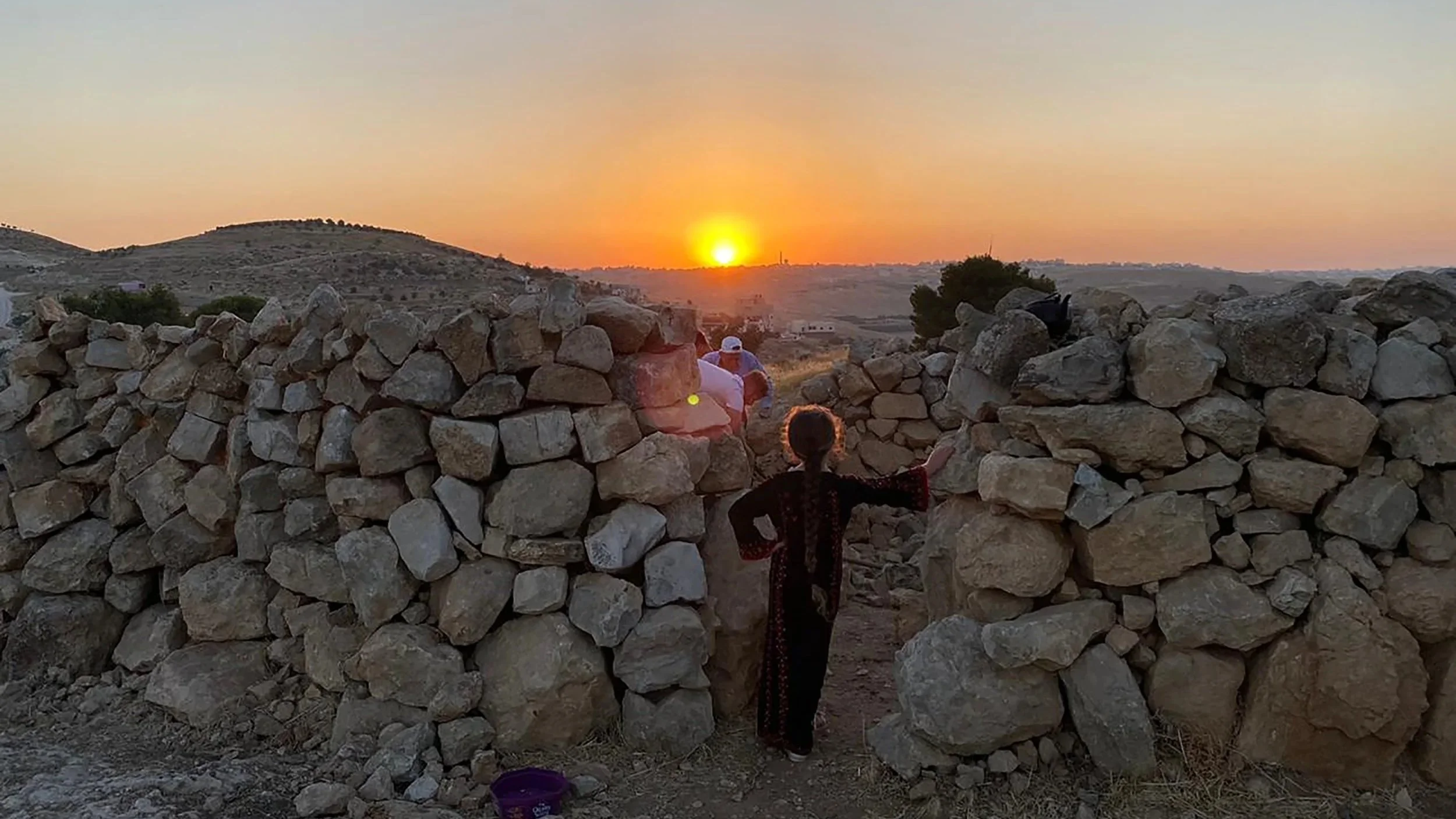
The activity conceives an architecture at the scale of a stone that is light and small enough for a child to carry. The choreography of stacking these loose stones, not bound by mortar, which can be re-assembled after it is repeatedly torn down by soldiers, becomes a quiet resilient act for the community (Figure 4). What emerges is not a fixed structure, but a sustained practice of returning to the object, thinking through ways of repair and maintenance (Figure 5). This illustrates how agency- and the power and freedom to act for oneself - is inherently spatial, especially where access to land and resources is denied.
Figure 6. Though incomplete, this image captures the structure at its fullest realisation, still existing as a ruin, 2020. Courtesy of the Youth of Sumud with Shamsaan.
When people are dispossessed or excluded from land, their agency is curtailed, not due to a lack of will or knowledge, but because the spatial conditions necessary for action are restricted or erased. Even in the face of such exclusion, agency is reclaimed through the shaping of one's environment through collective acts. Communities come together, not only to resist erasure but to resurrect the memory and meaning of the site through shared rituals of care, rebuilding, and remembrance (Figure 6). These acts are not just symbolic; they are material interventions that reclaim space and reinscribe its significance.
Figure 7. Intergenerational care in action as communities come together to stack stones and build the structure, 2020. Courtesy of Shamsaan and the Youth of Sumud.
There is also a profound emotional and sensory closeness to the material and building process, as is purposefully prepared, choreographed, and enacted by people (Figure 7). This intimacy with the physical act of construction reflects a deeper relationship between people, place, and memory. The tactile engagement with soil, stone, and structure becomes a form of storytelling and resistance. These structures speak of the land that they sit upon, of the physical and social resources drawn upon and the needs, values and politics of those who inhabit and continually shape these spaces (Figure 8).
Figure 8. The stone structure under construction at the end of a full day’s work, 2020. Courtesy of Shamsaan and the Youth of Sumud.
Soft Architecture, Resistance and Spatial Agency
In this work, these acts are framed as ‘soft architecture’: ephemeral and temporary practices shaped by people in the making of their everyday environments. ‘Soft architecture’ is not a response to destruction alone but a mode of persistence under conditions where permanence is systematically denied. These practices sustain social and cultural life in response to the ‘hard’ infrastructures that structure and constrain the built environment.
Forced displacement, in this context constitutes a distinct form of migration often overlooked in architectural discourse - one rooted in exclusion, fragmentation, and the denial of return. Understanding it requires attending to the structural violence that precedes movement, as well as the material and relational practices through which people survive, remember, and reclaim space.
Recent architectural scholarship has expanded this understanding of spatial practice as political production. Nasser Abourahme foregrounds how everyday acts of inhabitation generate political subjectivity under occupation and infrastructural control, while Mahdi Sabbagh conceptualises sumud as a spatial practice embedded in daily life rather than a static form of endurance. Together, these perspectives shift attention from exceptional acts of resistance to the continuous reproduction of lived environments.
“‘Soft architecture’ is not simply a response to destruction—it is a mode of persistence under conditions where permanence is systematically denied.”
This emphasis on everyday life extends into recent writing on repair in Palestine, where repair is understood not as restoration, but as an ongoing negotiation with ruin. In Gaza, acts such as reassembling rubble, enclosing space with fabric or inhabiting partially destroyed structures do not restore wholeness, but sustain conditions of liveability.
Read through this lens, the practices in At-Tuwani are not isolated gestures but part of an ongoing spatial logic. Each act of stacking stones, gathering and returning contributes to a cumulative assertion of presence. ‘Soft architecture’ is therefore not defined by its material form, but by its process: open-ended, collective and shaped by persistence.
Conclusion
While grounded in a 2020 collaboration, the conditions under which the Youth of Sumud operate have since intensified, marked by increased settler violence and restrictions on movement. Practices of sumud persist in more dispersed and less visible forms, shaped by ongoing precarity. Shamsaan has similarly shifted towards advocacy, humanitarian support, and awareness initiatives around violence affecting Palestinian children, while maintaining networks of solidarity under constrained conditions. These shifts do not indicate cessation, but a reconfiguration of practice under conditions of intensified crisis.
Shamsaan’s work continues through long-term relationships with communities in Palestine. These engagements form part of a relational practice of exchange in which creative and pedagogical acts circulate across distance in both material and symbolic forms. Among these are paper butterflies made by South African children and sent to Palestinian children—small but durable acts of correspondence that carry attention, imagination, and connection across fragmented geographies. Together, these practices form a relational field in which the collaboration with the Youth of Sumud appears as one situated encounter among many, shaped by continuity and attentiveness to everyday forms of resistance.
In contexts of ongoing violence and displacement, there is an urgent need to rethink architectural practice in relation to survival. Practices of ‘soft architecture’ foreground an alternative approach: one grounded in adaptation, collective action, and intimate relationships to site. Here, rebuilding is not a singular event, but an ongoing process of reassembly where rubble operates as both material and memory through which continuity is negotiated rather than restored.
These practices suggest that what follows destruction is not simply reconstruction, but the emergence of new spatial logics in which survival itself becomes a mode of architectural practice. Architecture, in this sense, extends beyond built form to encompass the conditions of living, remembering, and resisting—pointing toward futures shaped not by permanence, but by persistence.
Acknowledgements:
I would like to acknowledge Nadia Meer, Director of Shamsaan, and the Youth of Sumud, whose support, participation, and contributions were integral to the development of this work.
Citation:
Amina Kaskar, “From Rubble to Resistance: Soft Architecture of Displacement in Palestine,” Platform, May 25, 2026.