Commemorating New York’s Little Syria at Al Qalam
Into the urban cacophony of New York City’s Financial District, a new memorial arrived a few weeks ago: Al Qalam: Poets in the Park. The artwork sits in Elizabeth H. Berger Plaza, a small oblong park opened in 2018 with plentiful benches and three entrances to the Rector Street subway station. The site commemorates the Syrian American community that lived in the neighborhood at the fringes of Lower Manhattan in the late nineteenth and early twentieth century. Called Little Syria, the vibrant immigrant enclave, home to more than two dozen of nationalities, had shops, places of worship, and Arabic-language newspapers and magazines. Its tenement buildings were cleared through eminent domain in the 1940s to construct the Brooklyn Battery Tunnel, and community dispersed (some to nearby Radio Row, itself cleared in the 1960s for the construction of the World Trade Center).
This public artwork was designed by Moroccan artist Sara Ouhaddou and commissioned by the Washington Street Historical Society. The WSHS as a whole “aims to restore to the Great American Story the forgotten history of the earliest Arabic-speaking community in the United States.” Al-Qalam commemorates this history with a design based in Arabic script that excerpts the work of nine prominent Syrian authors of the early twentieth century, including Kahlil Gibran. Many of these authors were part of the Pen Bond literary society (al-rabita al-qalimiyya), from which the work derives its title: al-qalam (the pen).
Figure 1. Sara Ouhaddou, Al Qalam: Poets in the Park, main sculpture, New York 2026. Photograph by Alex Dika Seggerman, May 8, 2026.
The Financial District is laden with history and brimming with memorials. It overflows with English-language pronouncements of all kinds. Al Qalam, by contrast, uses abstracted Arabic lettering to provide a moment of semantic rest, inviting the viewer stop, observe, and puzzle out what has been written. Instead of instructing — loudly — what to think, to remember, or to buy, Al Qalam asks the public to read slowly, savoring and contemplating each word.
I am a professor of Islamic art history, and I teach at Rutgers University-Newark, where approximately one quarter of our students have family roots in the Arab world. I have been researching modern and contemporary art of the Arab world since the early 2000s. While I was initially inspired by New York-based artists like Ghada Amer and Walid Raad, the first decade of my research focused on twentieth-century Egyptian painting and sculpture. I wrote about public art in Cairo, like Mahmoud Moukhtar’s monumental pink granite sculpture, Nahdat Misr (Egypt’s Reawakening), unveiled about a hundred years ago. Like Al Qalam, Mukhtar’s sphinx and peasant pair is a public artwork that references a historical heritage in a modern style and contemporary urban space. The pandemic and my experience teaching Arab-American students led me to turn to take a closer look at the history of art and Arabic in the United States.
Figure 2. Sara Ouhaddou, Al Qalam: Poets in the Park, 2026. Detail of Kahlil Gibran’s name on main sculpture. Photograph by Alex Dika Seggerman, May 8, 2026.
Figure 3. Sara Ouhaddou, Al Qalam: Poets in the Park, mosaic bench, 2026. Photograph by Alex Dika Seggerman, May 8, 2026.
In what follows, I carefully describe Al Qalam’s key attributes to explore how it provides a place for slow reading in a loudly textual urban environment.
Figure 4. Sara Ouhaddou, Al Qalam: Poets in the Park, explanatory plaque, 2026. Photograph by Alex Dika Seggerman, May 8, 2026.
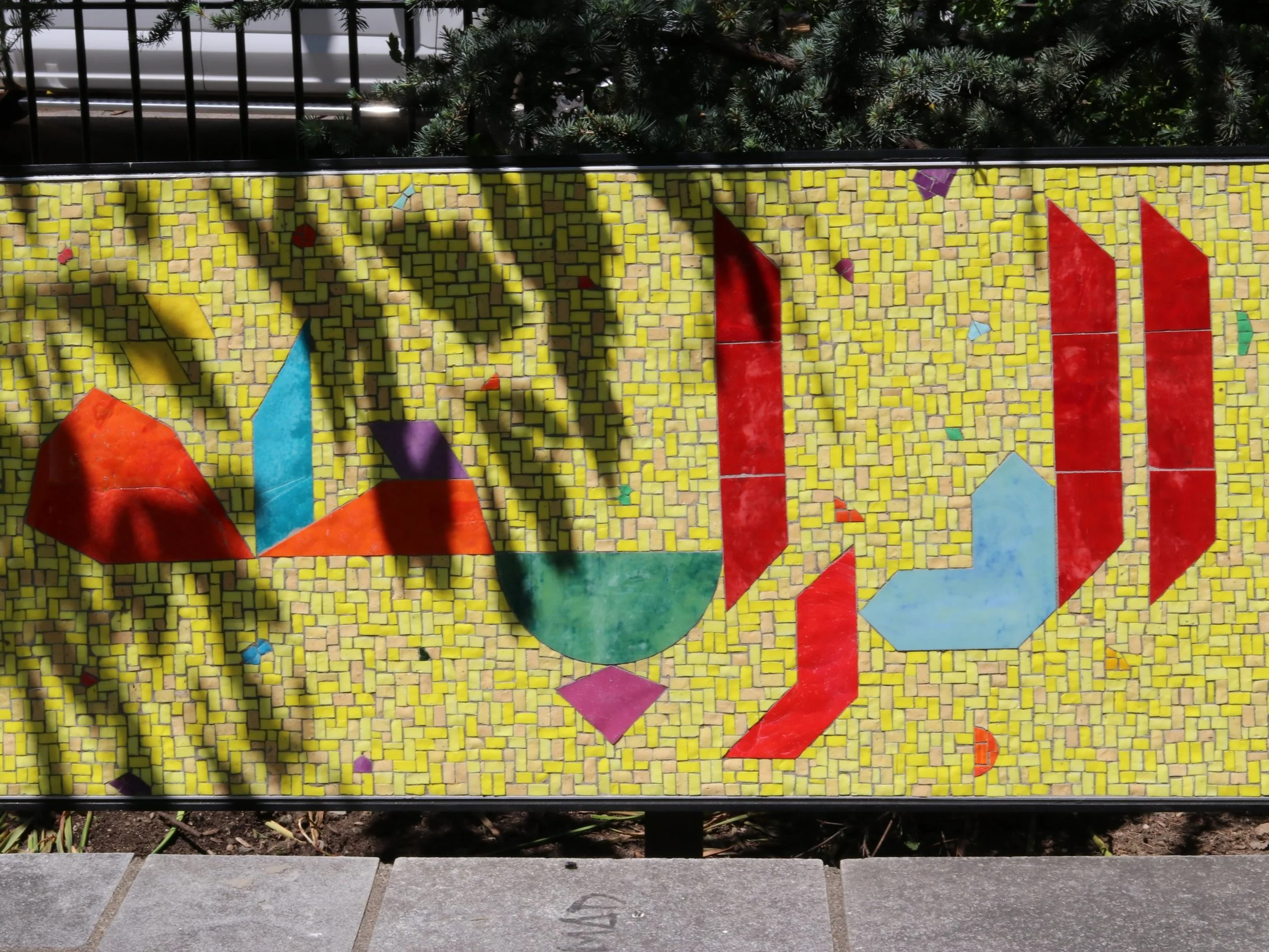
Al Qalam has three parts: a central sculpture and two mosaic benches. The yellow central sculpture hovers on a small grassy hill, landscaped in spring with blooming flowers. The shape of the piece replicates the Arabic word al-qalam (the pen). The word has five Arabic letters: ا ل ق ل م alif, lam, qaf, lam, mim. The straight-lined forms of the alif and the two lams are flat cuboid shapes. The qaf and the mim are rounded three-dimensionally, with section cuts revealing mosaic panels.
The sculpture alternates between smooth painted metal mosaics. The mosaics on the main sculpture feature the names of nine writers from Little Syria’s literary community: Naseeb Arida, Agabia Malouf, ‘Afifa Karam, Mikhail Naimy, Elia Abu Madi, Nadra Haddad, Ameen Rihani, and Kahlil Gibran.
The names in the mosaics appear in three different scripts for maximum legibility. They are written in Ouhaddou’s “own abstract alphabet” which she based on Arabic but is difficult to decipher. These scripts are embedded in the mosaic with tesserae of bright colors that approximate Arabic lettering. The writers’ names also appear in sans serif English and an Arabic naskh script, recognizable to Arabic speakers as the default Arabic font in Microsoft Word. Through readable typography, the authors’ names are highly legible.
Figure 5. Sara Ouhaddou, Al Qalam: Poets in the Park, Arabic: “al-rābiṭa” [the bond], 2026. Photograph by Alex Dika Seggerman, May 8, 2026.
Two long, arced benches with mosaics feature calligraphy of selected lines of poetry from each of the nine poets. The calligraphy is again in Ouhaddou’s stylized script, and a nearby plaque lists all the selections with English translations. A virtual reality smartphone application accessible via QR code transcribes and translates the selections. Sadly, it was not working on a recent day that I visited. According to the WSHS’s website, the original plan called for a diagram to decode Ouhaddou’s script, but it that did not make it to the final iteration of the park’s design.
Figure 6. Sara Ouhaddou, Al Qalam: Poets in the Park, main sculpture, script in reverse, 2026. Photograph by Alex Dika Seggerman, May 8, 2026.
The mosaic panels are laid out in a rectangular network of yellow and beige rectangles, interspersed with the colorful calligraphy and geometric shapes. On a sunny, early May Friday, the mosaics glistened under the dappled light spilling through the trees. I sat for a half hour. I watched an unending stream of people walk through the park: school children engaged in an outdoor activity, office workers scurrying back to their desks, tourists walking slowly and ogling skyscrapers, and well-dressed couples heading to the subway. Compared to a Chelsea gallery or even the Met or MoMA, huge numbers of people walked by the artwork. As is so often the case with public art, no one stopped, however, to look at the sculpture or read the explanatory plaque.
To New York City’s seventy-five thousand speakers of Arabic, sixty thousand speakers of Urdu and Persian (both written in the Arabic script), and approximately million Muslims, the installation’s Arabic speaks. Even on the reverse side of the sculpture, where the word reads in reverse, I recognize the tell-tale alif and lam. Though abstracted, the angle of the top of the two letters emulates the way in which an Arabic calligraphy pen hits the page. So, despite the modifications, I can read al-qalam from either angle.
Figure 7. Food cart in Zuccotti Park, New York, with two Arabic blessings: baraka allah fikum (left) and mashallah (right). Photograph by Alex Dika Seggerman, May 8, 2026.
To the viewer who cannot read Arabic, however, or who did not specifically visit the work, the content likely goes unnoticed. Illegible or difficult to decipher Arabic scripts have a long history across the Arabic-speaking and Islamic world. Many can recognize letters, words, and phrases in complex but standardized scripts like Kufic or thuluth. (These classic scripts are familiar to the general New York public, appearing occasionally in public space, as on a food cart at nearby Zuccotti Park.) Ouhaddou’s script, however, is not one of these standard types.
Ouhaddou and the WSHS have thus made a public artwork that speaks on two levels. For most passersby, the mosaic benches offer a moment of beauty and calm. Berger Plaza is bounded on all four sides by tall structures, and the ear-splitting noise of automotive traffic reverberates through the space. Still, the memorial remains tranquil. Perhaps most visitors, like a sixty-something man reading the New York Post and drinking a lime LaCroix seltzer on the bench on a recent day, have no idea they are resting their backs against an Arab American poem. Yet for those with Arabic or who are curious enough to pause and look, this monument speaks volumes, conjuring a lost community important to the history of the city, region, and Arabic diaspora.
The introductory plaque makes no mention of religious identity, but the former Syrian Orthodox church nearby on Washington Street points to the community’s mostly Christian identity, though a Muslim minority was present as well. While in the early 2000s, Arabic script, especially so close to the World Trade Center, would have been inextricably tied to Islam and Islamic fundamentalism in mainstream American media, perhaps triggering Islamophobia, in 2026 the monument speaks to a new chapters in the life of the city and to the growing Arab American and Arab-literate community in the city and region.
Figure 8. FDNY 9/11 memorial, bronze, 124 Liberty St, New York, 2005. Photograph by Alex Dika Seggerman, May 8, 2026.
Figure 9. Signs outside a souvenir shop, 23 Trinity Place, New York. Photograph by Alex Dika Seggerman, May 8, 2026.
In Lower Manhattan, signs, banners, plaques, and markers almost yell at the pedestrian: Remember! Learn! Buy! Eat! Textual accounts of historical events are embedded in sidewalks. 9/11 memorials, from the World Trade Center’s fountains to small Fire Department bronzes offer tributes to the slain. Across from Al-Qalam a classic tchotchke store with loud signs hawks souvenir keychains and hats, their prices in bright red. Al-Qalam is quiet and peaceful. It speaks softly, but only if you want to listen.
Nine poetic excerpts are embedded in the benches, likely selected with the help of the WSHS, as the artist does not read Arabic fluently. Many of the lines address the immigrant experience. The first is by Naseeb Arida, the editor-in-chief of Al-Funoon, the first Arabic literary journal in the United States, published nearby in Trinity Place:
I chose America as dear homeland.
I sought in her a life of freedom
and that I have found.
إتخذت أميريكا وطنا عزيزا
طلبت بها حياة مع الحرية المثلى
فنلت
Figure 10. Al-Funoon magazine, c. 1915, publication page, New York Public Library. Photograph by Alex Dika Seggerman, May 14, 2026.
This verse emphasizes what the residents of Little Syria shared with other immigrant communities, gently upturning conventional understanding of the Arabic speaker as other (to the extent the culture acknowledges them at all).
In the second Trump administration, with its anti-DEI rules belied in part by Christian nationalism, this monument’s hard-to-read scripts operate under the radar. If it were more overtly legible, with text in English or even a standard Arabic script, like other monuments in the area, it might have become a target. There are thousands of Syrian refugees in the United States, after all, whom the administration wants to deport. In April 2026, the U.S. Supreme Court heard arguments challenging the Temporary Protected Status program, which includes thousands of Syrians as well as Haitians.
Instead, Al Qalam speaks on two levels: quietly to the general public and loudly to smaller counterpublics. Anyone can enjoy the benches and bright mosaics. The deeper reward, though, comes to those with Arabic or an interest in history, who spends the time to decode Ouhaddou’s script. Everyone, though, can appreciate the moment of rest (راحة) it offers the city that never sleeps.
Citation:
Alex Dika Seggerman, “Commemorating New York’s Little Syria at Al Qalam,” Platform, July 7, 2026.