Housing Hong Kong
In early May, the Hong Kong government’s Housing Bureau announced that the average waiting time for a public housing unit in the special administrative region (SAR) had dropped to 4.7 years—the lowest in more than eight years. The positive report followed concerted efforts on the part of Chief Executive John Lee and his administration to boost the number of public housing units in response to long-unfulfilled public demand. New, innovative construction practices such as Modular Integrated Construction (MiC) have been hailed as key to hastening the rapid construction of 9,500 light public flats to bridge the city’s chronic gap in public housing supply (Figure 1). By 2028, the government aims to produce 30,000 such units for families to live for up to five years while they wait for more permanent, public housing.
Figure 1. Ronald Lu & Partners, Eminence Terrace I, Hung Shui Kiu, Hong Kong, 2024.
This news comes amid ongoing redevelopment plans involving several of Hong Kong’s largest and oldest public housing estates, Choi Hung and Wah Fu (Figures 2 and 3). Originally completed in 1963 and 1967, respectively, the two massive development projects were early and important models for self-contained “town centres,” each designed by teams of architects, and consisting of flats, schools, markets, and other civic spaces on the outskirts of the colony’s existing urban centers for thousands of Hong Kong’s expanding and chronically under-housed middle class. Sixty years later, the government has initiated plans to clear and revitalize these communities while retaining their key “cultural characteristics,” which include clusters of small shops and accessible neighborhood environs for tightly knit pockets of predominantly ageing residents.
Figure 2. Palmer and Turner, Choi Hung Estate, Wong Tai Sin, Hong Kong, 1963. From Government Information Services, The Hong Kong Housing Authority (Hong Kong Government Printer, 1963).
Figure 3: Housing Authority, Wah Fu Estate, Aberdeen, Hong Kong, 1967. Image courtesy of Wpcpey - Own work, CC BY 4.0, https://commons.wikimedia.org/w/index.php?curid=107834258).
Taken collectively, these milestones document more than the efforts of officials to rejuvenate and redefine their responsibilities for managing over one-third of Hong Kong’s population. They also lay bare the contradictions at work in one of the largest public housing bureaucracies in the world while marking a new and uncertain era for Hong Kong’s largest landlord and property holder—the Hong Kong government itself.
Demonstrating interest in the well-being of a demographically shifting population through new and improved housing stock is itself a political strategy in a city that has long measured the success and quality of residential life through metrics. Fundamental and underlying pressures remain at the heart of Hong Kong’s contemporary housing conditions that are themselves the product not merely of the city’s famously free market economy, but of the forms of governance designed to sustain it.
““Early colonial-era racial inequities … became inscribed within Hong Kong’s built environment and remain consequential to how the city maintains and governs through housing today.””
The government’s dominant control over Hong Kong’s land resources, and the extent to which it has long leveraged such power to influence where certain people live, and in what conditions, date back to the colony’s founding. From the mid-nineteenth century through the 1930s, colonial British authorities managed and manipulated leaseholding interests, housing types, and zoning regulations in ways that prioritized the well-being and comfort of the colony’s White and Chinese elite over its poorer, predominantly Chinese population, which was largely undocumented and free to move between the colony and mainland China amid the lack of a fixed geopolitical border.
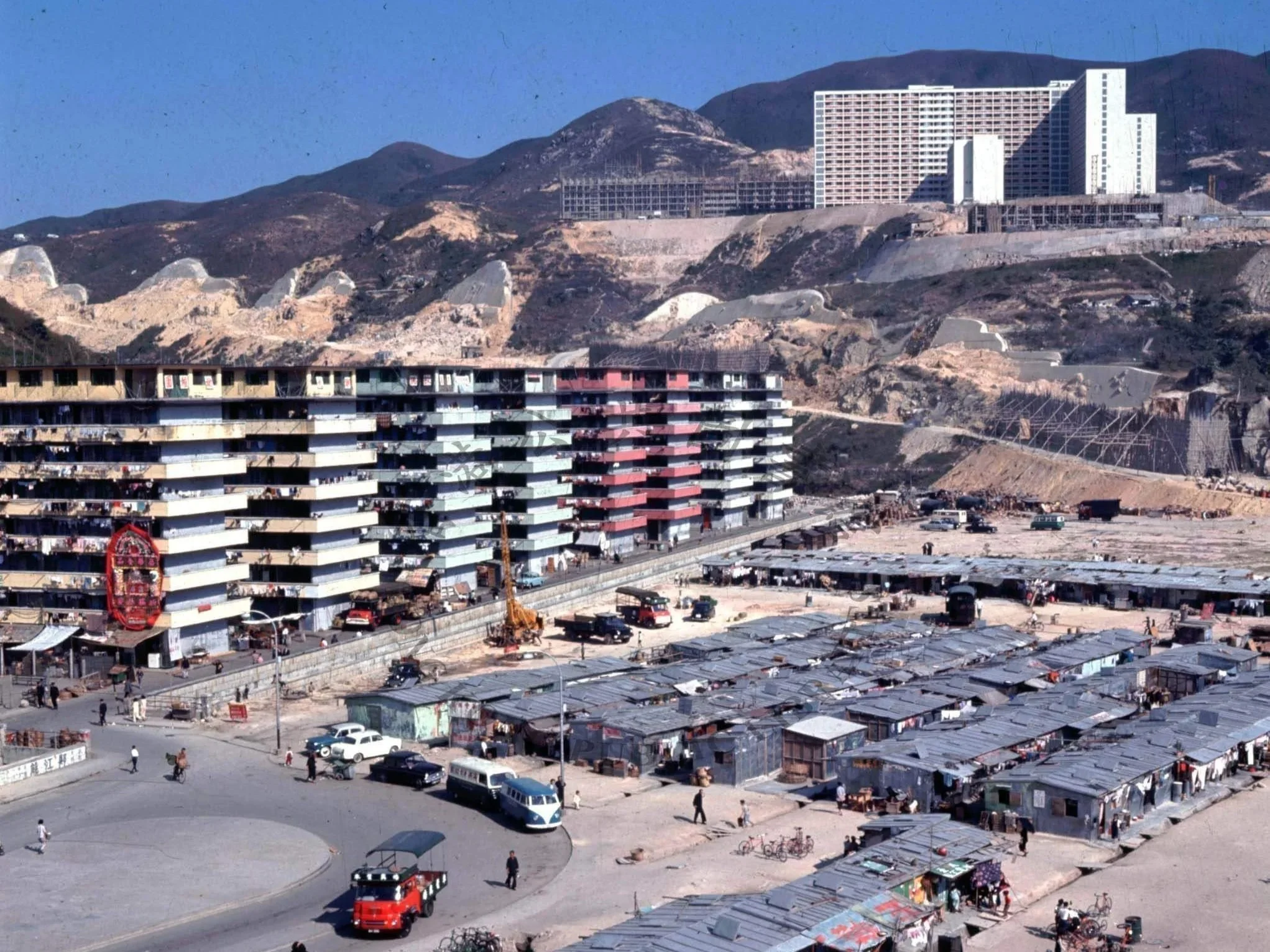
Figure 4: Kwun Tong Resettlement Area with Tsui Ping Estate in background, Kwun Tong, 1966.
Only in 1949, and with the launching of China’s civil war and the dawn of the Cold War, did the border become militarized, closed, and ultimately reinforced by a Frontier Closed Area Order in 1951. Despite these efforts, influxes of Chinese refugees both prior to and following the order triggered a related series of humanitarian crises that eventually prompted the launching of the colony’s first public housing program. Racist building ordinances and discriminatory zoning practices were repealed, only to be replaced by building categories based upon equally rigid forms of socioeconomic class stratification present within Hong Kong’s Chinese population—from resettlement estates designed to house recent emigres to the higher-quality Housing Authority estates such as Choi Hung or Wah Fu intended for the colony’s existing but inadequately housed lower- to middle-class residents based upon their salary (Figure 4).
Many of the colony’s most prominent architects were tasked with designing and overseeing the construction of these projects, which largely adhered to colonial norms of separation, now cloaked in the metrics of income and labor productivity. These practices did more than simply limit access to existing civic resources for many of the city’s recent arrivals; they also arguably blunted the architectural discipline’s generative capacity for imagining diverse and livable communities at a time in which new models of cohabitation—for colonial and rapidly decolonizing environments alike—were urgently needed. In 1964, for example, W.G. Gregory, Professor of Design at HKU, observed:
Integration in fact did take place in many aspects of living—work, social benefits and in education—but not in perhaps that most important sphere of living, in housing. . . . Integration of the housing for refugees (which when all is said and done is merely a priority classification) with other housing would have produced a considerably healthier environment in terms of citizen-like attitude towards community living as well as in terms of amenity. The regimented arrangement of identical blocks of resettlement housing is inhuman. . . . Recent designs by the Housing Authority have [also] suffered from a repetition of standard designs. Both forms of housing would benefit from being integrated together, interacting with each other to produce better circumstances for living.[1]
In 1966 and again in 1967, a series of riots laid bare the lingering racial and ascendant class-based tensions rippling through Hong Kong’s precariat. The violence triggered introspection on the part of Hong Kong’s architectural profession—and the colonial government at large—with regards to how designers might have more effectively capitalized upon architecture’s representational and spatial capacities, particularly its ability to instill social and cultural meaning within spaces for Hong Kong’s nascent postwar community. Hong Kong Society of Architects’ Alan Fitch described the events of 1967 as a “professional crisis” fueled by “anarchy” and “political troubles,” which had in turn affected investment and “the profession of architecture” itself. “We are planning our new towns,” reflected Fitch, but “will we ever build them?”[2]
Figure 5. Sha Tin New Town, Hong Kong, early 1980s. Information Services Department, HKSAR Government.
Hong Kong did in fact build its new towns—nine expansive satellite cities such as Tsuen Wan, Sha Tin, and Tuen Mun within which approximately half of Hong Kong’s population currently lives (Figure 5). Many of the design and construction strategies originally devised to keep the colony’s public housing costs low were gradually repurposed and adapted by the colony’s private housing market to populate these new environments. The government initially encouraged such cross-pollination, arguing that the public dissemination of “type, plans, building and planning standards and unit costs” offered examples for private developers to follow for better, “low cost housing.”[3] In 1978, the government’s subsidized Home Ownership Scheme (HOS) was launched to encourage lower-middle-income families to vacate public housing for affordable private housing. This was followed, in 1979, by the Private Sector Participation Scheme (PSPS), which encouraged private developers to help build these subsidized residential projects. Between 1981 and 1991, approximately 25% of the colony’s gross domestic product (GDP) derived from its property and construction sectors.
In addressing and exploiting Hong Kong’s housing crisis, the colony’s architects and developers transformed the work of architecture itself. Early colonial-era racial inequities gave way to late-colonial class imbalances that became inscribed within Hong Kong’s built environment and remain consequential to how the city maintains and governs through housing today. The results: a model for architect-designed mass housing acutely sensitive to the economics of density, standardization, and efficiency, if not necessarily the needs and desires of its lower-income users. Between 2004 and 2020, the prices of Hong Kong’s lowest-value housing units grew exponentially faster than the city’s higher-end flats. Public housing rents remained low, but the number of new, affordable public and private housing options also stagnated, limiting what the city’s lower-income residents could afford. By the late 2010s, this paradigm helped to make Hong Kong the world’s least affordable housing market in the world.
““Quality public housing derives from more than economic rationales or financial imperatives. Like good governance, it is itself an index of well-being.””
At a time in which the future of housing remains an urgent and critical issue around the world, Hong Kong must reconcile with its colonial history as a site for extreme and at times inhumane housing experimentation. Growing public interest in the history of Hong Kong’s estates, and what they have meant not only to the city’s governance and Hong Kong society at large, but to global housing histories, present opportunities for the government to re-imagine its current redevelopment plans through distinctive forms of public engagement. To do so, however, the government must also reconsider not only where and how it governs in relation to the housing market, but the ways it might reimagine housing itself as a vital interface with the Hong Kong public.
Figure 6. Wang Fuk Court after the fire. Courtesy km30192002, CC By SA 4.0, https://www.flickr.com/photos/km30192002/54957378951
The recent tragedy and ongoing controversy surrounding the fire at Wang Fuk Court, a HOS estate built in 1983 in Tai Po, just north of Sha Tin, has done more than simply fan public concerns regarding safety, government oversight, and the blurring of public and private interests at the core of Hong Kong’s housing market (Figure 6). For many, the tragedy evoked the devastating squatter fires and related social risks that triggered the launching of Hong Kong’s public housing program in the first place. At the same time, the government’s proposed buyout and relocation plan has angered some residents, fanning controversy regarding the government’s priorities and those of residents eager to rebuild and maintain community ties. More generally, it remains unclear as to how the rapid production of more new housing will address class-based housing divisions or enhance the sense of well-being among many of Hong Kong’s most vulnerable residents. Quality public housing derives from more than economic rationales or financial imperatives. Like good governance, it is itself an index of well-being.
Citation:
Cole Roskam, “Housing Hong Kong,” Platform, June 15, 2026.
Notes:
[1] W.G. Gregory, “Candid Comment,” Hong Kong and Far East Builder (June 1964), 3.
[2] “HKSA President’s Review,” Far East Architect & Builder (December 1967), 25.
[3] “Collaboration on Housing Design,” South China Morning Post, 14 July 1966, 6.