Fieldwork and the Practice of Freedom in the University Classroom
As a scholar focused on interpreting vernacular cultural landscapes, fieldwork is at the core of my research. While what constitutes “the field” of fieldwork is broad, the idea of moving outside of the office, laboratory, or classroom is foundational. I have spent the better part of three decades attempting to bring this approach into undergraduate courses. I have led several project-based (usually grant-funded) fieldschools, which teach research methods through applied work. But decreased financial support, concerns about risk, and demands for higher enrollments, fieldschools — at least at my institution — are a thing of the past. I now face the challenge of incorporating fieldwork into courses with thirty or more students, many of whom have minimal knowledge of architectural history or experience with humanities research.
While striving to integrate my teaching with my research, I have also become increasingly attentive to “active learning” pedagogy. Through involvement in my campus’s Center for Teaching, Learning and Mentoring, I have experimented with active learning in face-to-face and online modalities, asking students to design digital projects based on buildings around them. Yet bringing fieldwork together with the active approach in a way that is manageable, particularly outside of a small seminar, has proven difficult; I struggle with how to measure success and to mentor large numbers of students in ways that produce tangible products (digital or otherwise) of the sort I expect from fieldschools.
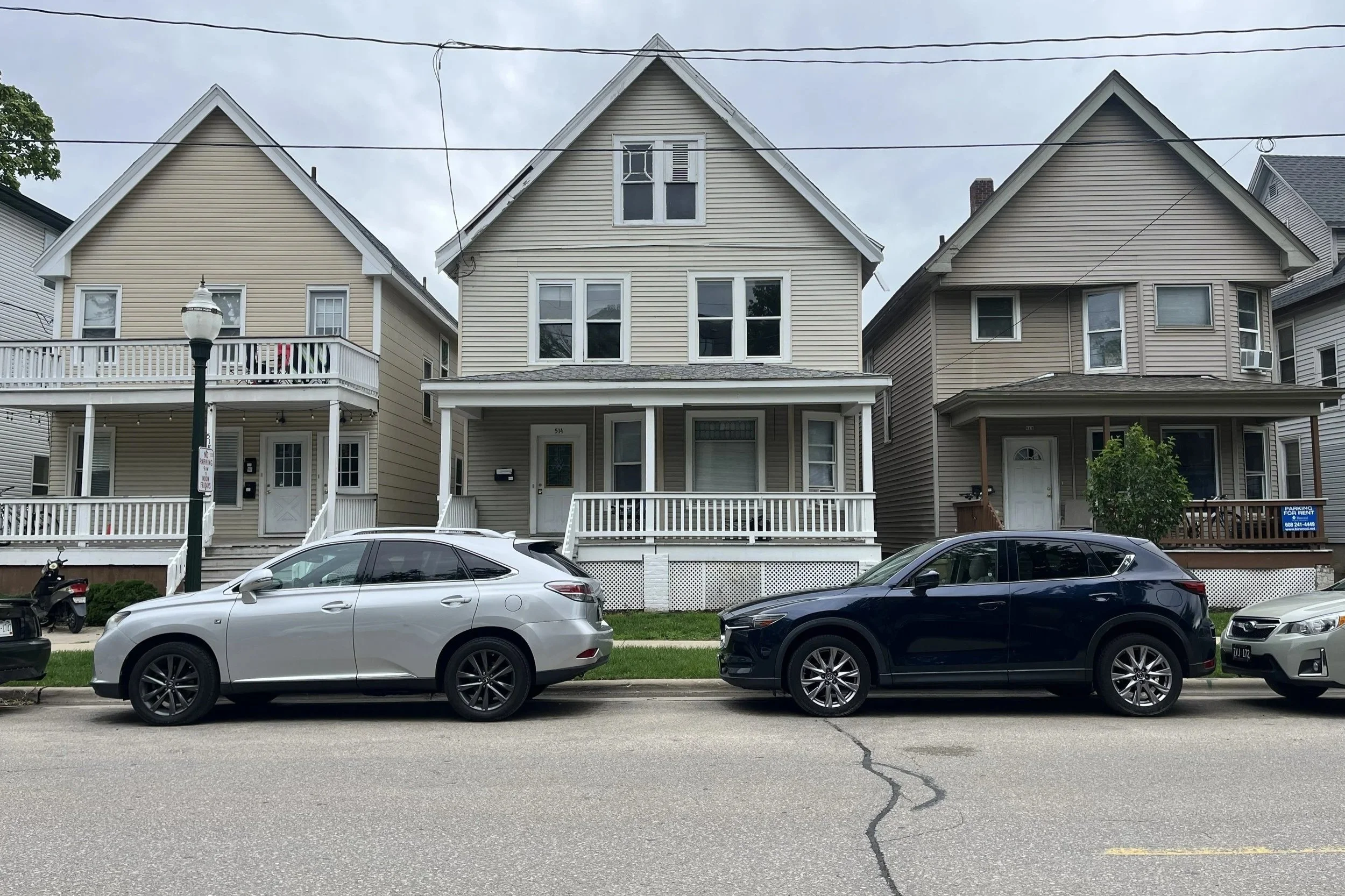
Figure 1. View of multifamily residences on south side of 400 block of West Mifflin Street, in Madison, Wisconsin, looking southeast. Photo by Anna Andrzejewski, June 17, 2026.
I recently revamped my lecture course on American Vernacular Architecture to incorporate fieldwork. My approach resonated with what bel hooks described as “engaged pedagogy” in her 1994 book, Teaching to Transgress. Hooks explains that engaged pedagogy fostered a “practice of freedom,” where teacher and students work collaboratively. She writes that “engaged pedagogy does not seek simply to empower students. Any classroom that employs a holistic model of learning will also be a place where teachers grow, and are empowered by the process.” She describes the classroom as a place of risk taking and encourages the professor to model vulnerability for students to create a space of sharing and experimentation. She also examines the ways in which engaged pedagogy fosters teambuilding, allowing people to bridge divides, including those between teacher and student, students and other students, and the classroom and the community.
Adopting this outlook meant letting go of product-driven expectations as well as a degree of control; instead, I allowed students to lead with what they produced and provide feedback to one another. In the process, I gained new insights about my students as well as what fieldwork offers them. Fieldwork fed their curiosity, prompted their engagement with class content, taught them “real world” skills, and fostered collaboration with one another. At a time when the humanities are facing cuts because of alleged irrelevance, I believe that an engaged pedagogy of the sort hooks espouses also reveals the importance of research to skeptical administrators and the public.
Structure & Product
The cost of this restructuring of my course along these lines was abandoning any pretense of covering the topic of American vernacular architecture in any comprehensive way, geographically or temporally. Instead, I covered topics thematically, with bi-weekly units on broader themes such as building technology and materials, architectural style, form and plan, building type, and the use and interpretation of archival sources. I delivered an opening lecture for each unit that conveyed a general sense of the topic geographically and temporally but focused on methods for assessing the particular aspect of the built environment in the landscape. Lectures were shorter on content but helped students build skills. Following lecture, students went into the field then shared their findings the next class.
Figure 2. View of multifamily residences on north side of 500 block of West Mifflin Street, in Madison, Wisconsin, looking north. Photo by Anna Andrzejewski, June 17, 2026.
Students worked in groups of three or four to investigate clusters of early twentieth-century domestic buildings along two residential blocks near campus (the 400 and 500 blocks of West Mifflin Street). These blocks were familiar to many; two students lived in flats there and it was home to an annual spring student gathering, the Mifflin Street Block party. Returning there every other week, once per unit, with specific research goals, both defamiliarized it and allowed students to forge a new sense of ownership over it. (Students started referring to the buildings as “our houses” in their presentations.)
For maximum flexibility, I also allowed students to choose the format and emphasis of their final research projects, provided that they engaged with the landscape and used some of the course’s tools. Because I had students from all corners of campus — majoring in such fields as design, urban planning, real estate, and history — projects varied in their focus and modality. None of the eight groups picked a “research paper,” though in each case, the depth of research and the conclusions the students drew exceeded my expectations.
Student Responses
Using fieldwork to structure learning in the class produced unexpected results in terms of outcomes, student satisfaction, and teambuilding. The risks I faced in relinquishing control were matched by the risks that my students took in sharing their findings with the class. They were reticent at first to say “I couldn’t figure it out,” but after a few weeks they relished the chance to solicit classmates’ opinions. Students would often chime in with “we struggled with that too!” and “we thought that but then tried this.” This kind of dialogue reinforced what I’ve long cherished about studying vernacular buildings in the field: that one depends on others to help draw and nuanced conclusions.
The structure of this class — with small groups reporting out to the larger class on the same landscape — reinforced this dynamic across the semester. I marveled at the way the groups mentored one another during our “share out” sessions. When things did not go smoothly, students supported one another. One student, a senior art history major, for instance, reported on her struggles with finding information in the archives about her buildings, particularly in using the Sanborn maps and in municipal records. She had been looking online and kept running into pay walls, which she shared with the class out of frustration. Students in other groups immediately came to her rescue, explaining more productive paths as well as other kinds of information she could find.
Figure 3. Screenshot of webpage on 448 West Mifflin Street, part of final student project by Anna, Alejandro, Luke and Ruth, with permission of authors.
While the class began with the physical (the archival work), the final few weeks proved revelatory for the students. This was when I came to believe the course was successful. As another student, Virginia, explained in her class journal, getting hold of primary documents
felt like a little gift. Assessing our buildings through observations and with our continually growing knowledge on how to make educated guesses has felt like something of a puzzle . . . .[Uncovering] the identities of the previous residents, their names, jobs, and families, along with floor plans and renovations, was a whole new layer we had the pleasure of peeling back. Even though I knew people had been residing there since the early 20th century, seeing their names and occupations, particularly the students, gave me a more tangible grasp of the immense history of these now shabby college flats . . . .the buildings we've spent quite a bit of time on have gained a new life.
No two final projects were alike in emphasis or format, but all reflected synthetic thinking. Each narrated a story that wove together field observations, archival evidence, and course concepts. One group focused on an influential Madison family, producing a public website. Another looked at redlining, and another unearthed the precise timing of the transition from working-class family homes to student rentals.
Fieldwork and the Practice of Freedom
In their final written reflections, students wrote frankly about their experiences in the course. Several commented on how they were surprised about what they had learned. Ruth wrote the class was “sneakily educational”:
Not to make it sound like I wasn’t learning thing . . . some of the concepts we discussed I somewhat understood before I took this class, but it was the application and rerouting of them in a tangible practice that was most educationally significant. Before, these concepts were definitions in a vacuum, separate from their context. They had no meaning until I saw them play out in human patterns in our research on Mifflin Street.
““Fieldwork gives my students the freedom to ask questions, take risks, and learn together while also showing me — and higher ed administrators so concerned with “skills building” — the power of engaged pedagogy to build new knowledge””
Reese appreciated the cumulative impact: “each concept helped build off the previous, which allowed me to better retain what I learned and see it as a puzzle, rather than piece-by-piece.” The “puzzle” metaphor appeared throughout the reflections, above all in the fact students felt they were each contributing, albeit in different ways, to the whole.
Others took away lessons that seemed to change what they thought the practice of history-writing was. Luke liked the way his group marshaled evidence to produce a narrative:
With the help of my classmates . . . it became clear that having a . . . story that reads like a narrative, something that you can empathize with, makes that research significant and more impactful. I had thought that academic research had to be numbers and graphs and whatnot, but I think especially within the field of design and history and people, it is important that research conveys that these were people who had lives and families and interests . . . .This newfound perspective has really changed the way I think about what can and should be academically significant.
Figure 4. The author’s Art History 457 class in December of 2025. Photo courtesy of Anna Andrzejewski.
Like Ruth, Emily was surprised at all she had learned, but particularly so in the context of doing research, which for her transcended her major in design studies. “I am walking away with skills in concepts such as “reading from the street” and a better understanding of style, form, materials and field research. I am now aware of the process of observing, asking questions, observing some more, doing research, observing again and finally making conclusions.”
Planning the ways in which students engage in fieldwork affects the outcome. Getting them into the field is quite different than getting them engaged in the work of fieldwork. Doing so in hooks’s terms offers my students the freedom to grow as thinkers while also teaching them the value of collaborative knowledge-building. Fieldwork gives my students the freedom to ask questions, take risks, and learn together while also showing me — and higher ed administrators so concerned with “skills building” — the power of engaged pedagogy to build new knowledge.
Acknowledgements: I would like to thank all thirty students in my fall 2025 class History of American Vernacular Architecture and Landscape, especially those who consented to having their journals reproduced here. I also appreciate the support of Antonella Caloro in the Instructional Design Collaborative in the College of Letters & Science, an excellent partner in my efforts to improve learning and engagement.
Citation:
Anna Andrzejewski, “Fieldwork and the Practice of Freedom in the University Classroom,” Platform, July 13 2026.