Aesthetic Piracy
“Brown indexes a certain vulnerability to the violence of property, finance, and to capital’s overarching mechanisms of domination. Things are brown by law insofar as even those who claim legal belonging are still increasingly vulnerable to profiling and other state practices of subordination.” -José Esteban Muñoz
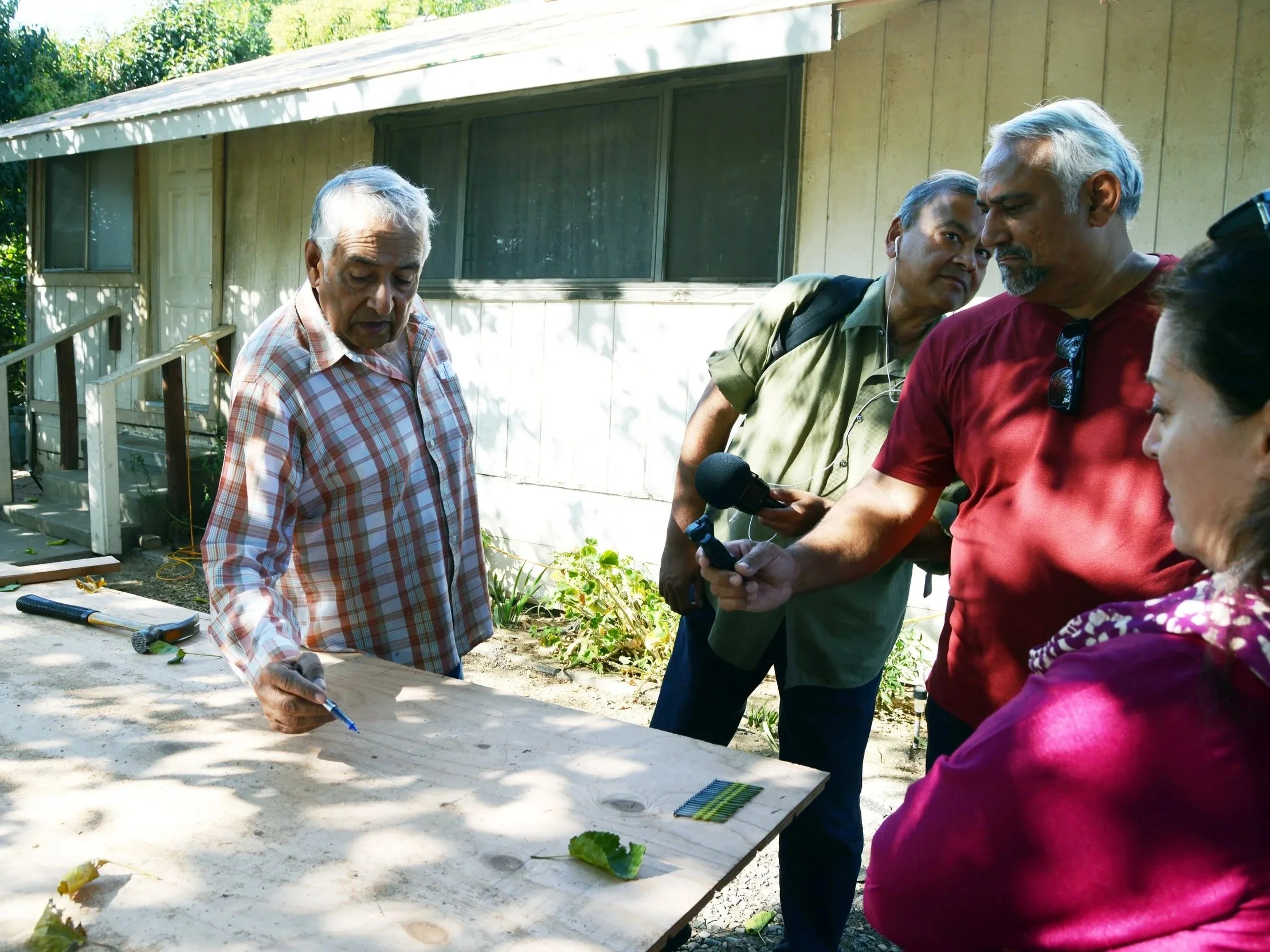
Figure 1. Model Adobe Home at Luna Community College. October 2025. Photographs courtesy of Barb Odell.
On a sunny but windy October day, I joined a group of nine people at the 2025 New Mexico Historic Preservation Conference to help make enough mud, prepare, and plaster the walls of a model home. The structure's construction was led by Cornerstones Community Partnerships at the Luna Community College in Las Vegas, N.M. as part of a course to test the viability of adobe construction as an affordable material. [Figure 1] In northern New Mexico, the question of whether adobe is sustainable—the earthen brick and mortar made from a wet mixture of sand, clay, and straw set in wooden frames and cured in the sun—is an easy “yes.” Many attendees are in the process of achieving adobe builder certification through programs at community colleges or private institutes. Some proudly share that they are in the process of building or having built their own residences from adobes, are renovating others (sometimes long time family structures), or have recently purchased 1930s adobe homes off the Santa Fe Plaza.
“Once stigmatized as lowly, poor and dirty, adobe is now a popular material in residential markets across the now U.S. Southwest.”
A few facts: adobe is a durable, adaptable, ecologically sound, and relatively affordable material that requires attention to detail, maintenance, and care. In some ways, the structures it generates are alive. The landscape dictates the materials in the dirt used to build structures, in turn shaping the communal relationship to the raw earthen source: annual rituals to add new mud plaster, “enjarre” like those at the San Francisco de Asis Church in Ranchos de Taos speak to this as a fact of life in adobe culture. [Figure 2] Relationships are crucial to a structure’s life span: each adobe community has its own techniques and sites for soil and clay harvesting, and the “health” of a building is often an indicator of that community’s well-being. Adobe brick is a powerful cultural symbol for the region’s ongoing history of land dispossession, where many people understand housing scarcity as the newest iteration of colonial struggle since the arrival of the Spanish, and then Anglo settlers to these lands. Associated with poor, agrarian, Mexican American families, it’s common to hear jokes about it being “dirt cheap” alongside stories about older relative’s confusion as to why their grandchildren have an interest in a material they worked diligently to separate themselves from via class mobility and assimilation. Adobes have historically been seen as humble structures that “…embod[y] an authenticity that bestows its own sense of status…a note of progress…from the racial and cultural biases of the past when adobes were disparaged as primitive.”
Figure 2. San Francisco de Asis Church, Ranchos de Taos. April 14, 2025. Photograph by Alhelí Harvey.
Once stigmatized as lowly, poor and dirty, adobe is now a popular material in residential markets across the now U.S. Southwest. Adobe aesthetics and materials have become lucrative in art towns like Santa Fe and Taos in New Mexico and Marfa, TX. Santa Fe is perhaps the highest profile location for adobe’s revaluation, maybe only second to its little sister art town to the north, Taos. However, the material and practice aren’t confined to New Mexico even if the state’s tourism department and historical commission have worked many angles to make adobe architecture synonymous with its identity, from building code to tourist imagery to official Instagram page.
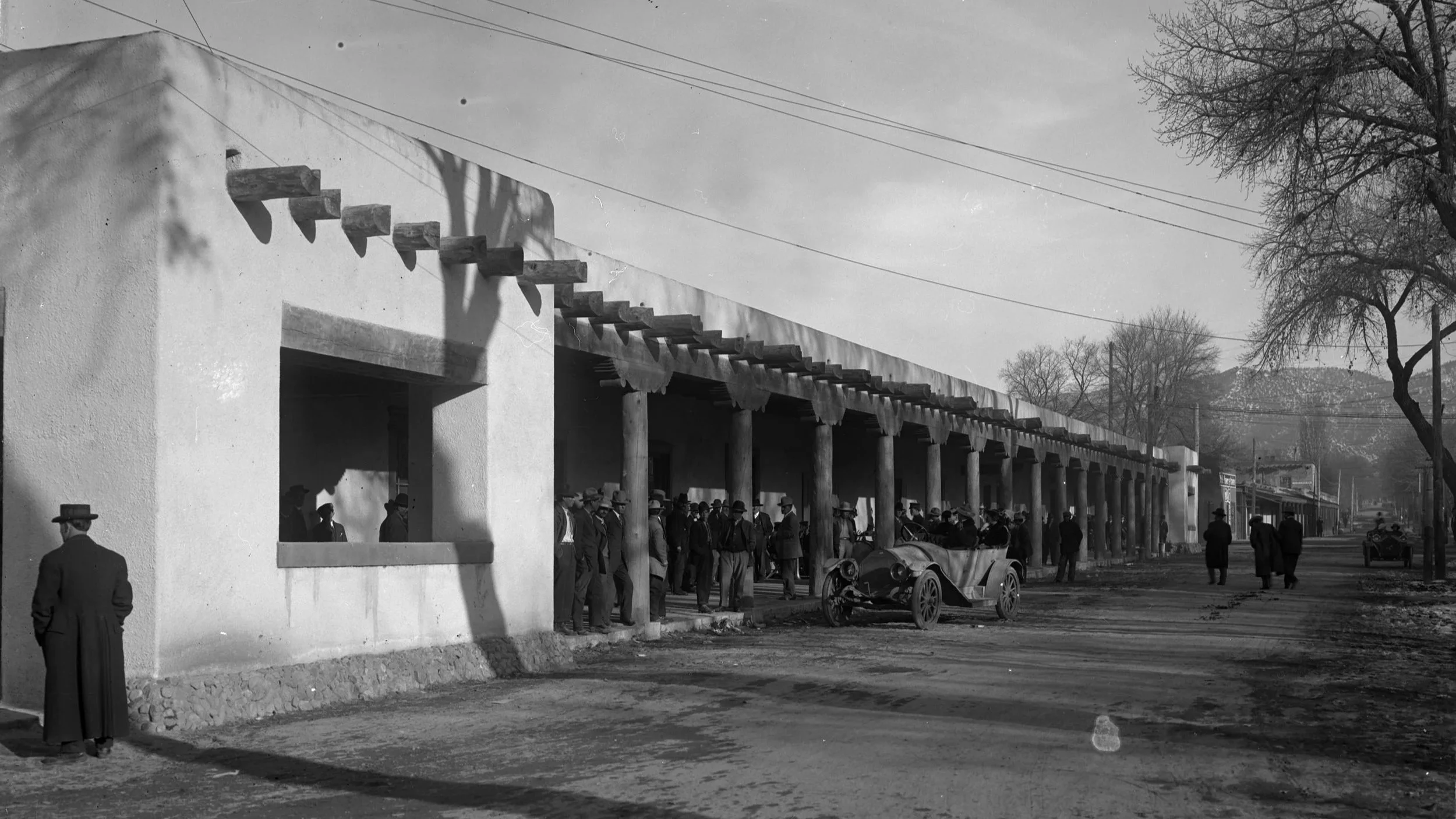
Among other things we know about adobe is that the practice is syncretic: indigenous building practices were incorporated by the Spanish, who applied their wooden frames to mass produce bricks. These techniques were spread throughout the region that is now the U.S. Southwest through trade routes and settlements. The Spanish learned to build with these materials and added to the technique (the wooden frame for making the adobes is from the Spanish); it’s not accurate to try to characterize adobe as only Puebloan or Spanish, but it is telling when and with whom the material is associated (and why). The Palace of the Governors on the Santa Fe Plaza offers one such example of Spanish building with adobe, the culture the material remains historically associated with is located in an imagined past. [Figure 3] Likewise, the stunning structures at Taos and multiple Spanish churches, missions, sanctuaries throughout New Mexico offer compelling histories of connection across the material.
Figure 3. Jesse Nusbaum, Palace of the Governors, Santa Fe, New Mexico, 1914-1916?, 5" x 7" glass negative, Courtesy of the Palace of the Governors Photo Archives, New Mexico History Museum, Santa Fe, New Mexico ( NMHMDC), Negative Number 022612.
Thinking with queer of color theorist José Esteban Muñoz, I understand adobe structures, materials, traditions, and communities in the Southwest as materially and affectively emblematic of the brown commons. For Muñoz, the brown commons are “human-nonhuman collectives that are… ‘provoked into existence by a shared experience of harm.’ ” Collectivity is a central feature of adobe culture, and in fact makes its labor unique. Many adobe structures in use today are domestic spaces made by previous generations and continually worked on or maintained. Due to this lived history of the immediate dwellings, the care for adobes is more than a concern about historic architecture. Quite literally, caring for the family home means stewarding the history of that family. The second part of Muñoz’s conceptualization is that the brown commons is “provoked” into being due to a shared experience of vulnerability. Anglo American anti-Mexican and anti-Native sentiment has historically manifested in the Southwestern built environment as biases held against adobes. Earthen building is seen as backward, unhygienic, lowly—it represents a failure to properly modernize and assimilate into proper (white) citizenship. Nevertheless, New Mexico’s Anglo state boosters throughout the 20th century worked to elevate the aesthetics of adobe buildings while distancing themselves from actual earthen materials and from collective building practices. Unlike the collective forms that inspired them, and despite their syncretic elements, Pueblo Revival buildings are attributed to individuals, thus conforming and contributing to modernist architectural and artistic historiographies of prominent figures regarded as exemplars of the region’s aesthetic repertoires such as John Gaw Meem and Georgia O’Keefe.
“Collectivity is a central feature of adobe culture, and in fact makes its labor unique. Many adobe structures in use today are domestic spaces made by previous generations and continually worked on or maintained.”
Carrying on the previous century’s state builders' cultural investment in earthen aesthetics, today's spatial design professions take similar approaches. Here, I am interested in how certain aesthetics and materials become stand-ins for other, less tangible but still concrete values. In the case of adobe, the material itself is a signifier for a particular vision of nature and the rural: as a traditional method, the material and technique is assumed to be static in production and implementation. Perceived as unchanging despite hundreds of years of practitioners, adobe is “primitive” according to Eurocentric architectural education or knowledge. In truth, much of how people build the world over can be argued to be old technology: wood frames, masonry, brick work are not exactly new innovations.
Figure 4. Exterior of old Mora Mill, Mora New Mexico showing exposed adobe bricks. October 5, 2025. Photograph by Alhelí Harvey.
Yet, adobe in the US Southwest is heralded as “byzantine”, connotating a sense of being “out of time” and unmodern for simply being mixed organic materials fired in the sun.[Figure 4] Its local sourcing (the earth) and conditions (sunlight, dry climate) make it an attractive, environmentally sustainable solution to housing needs in a time of climate crisis—a thoroughly contemporary problem. These trends have created what we can understand as a crisis of unafforablity organized a material known for being quite literally “dirt cheap”, what Beck Andrew Salgado and Stepahnie Aranda have refered to as the “adobe paradox.” In the art town of Marfa, Texas, adobe homes are increasingly revalued as the exclusive domain of wealthy art tourists.
Then, in 2023, an answer to the conundrum of unaffordable adobe was announced at South By Southwest (SXSW), the annual city-wide multimedia tech conference-music-and-film festival hosted across Austin, TX’s arts and cultural venues since 1987. The announcement celebrated the partnership between developers, tech startups, and architectural firms to develop and build a luxury 3-D “adobe” printed hotel and suburb. The project, known as El Cosmico (sic) 2.0 and touted as the “World’s First 3-D Printed Hotel and Development” consists of “60+ acres featuring 15 exclusive Sunday Homes with 2 floor plans.” Each “Sunday Home” (vacation homes on the new 60 acre development) purchase (3 bedrooms for over $2 million) comes furnished, with “curated interiors designed by [developer and hotelier] Liz Lambert.” The designs would be drawn up by Bjarke Ingles Group.
To echo ethnic studies scholar Genevieve Carpio, “…within architectural choice is an intrinsic debate over the cultural meanings attached to design and, through it, who is and who is not a member of the nation.” Lambert’s partnership with BIG reiterates how, to continue thinking with Carpio, “prominent architects played an important role in popularizing the “ideology and material culture” that would etch the “design and lifeways” of [3-D printed faux adobe] across the metropolitan landscape.” Connections between developers and architects solidify the position of the elite in shaping the future of places—stripping away at the hope Marfans see in adobe as a material that offers autonomy in placeknowing that is fostered by traditional adobe practices. Another way to think about the 3-D material of El Cosmico 2.0 is as a break from earthen materials indexing a mode of production that values community maintenance, care networks, and relationships to the natural world to one that ensures a higher return on investment for the parites involved.
“Adobe’s brownness—as a material but also as a system of traditional knowledge that is important to the Mexican American and Native peoples of the Southwest—is what makes it vulnerable to the economic interests and particular architectural motivations of the profession at large.”
ICON, an Austin based construction technology company and third partner in the project, likes to make preposterous claims: in a New Yorker profile, founder Jason Ballard was quoted as saying that “home building hasn’t changed since Middle Ages.” This claim, along with what 3-D “earth” or “primordial architecture languages” promises are what critic Kate Wagner calls “PR-architecture.”
Further, 3-D earth stands to represent a is a tax work around; In 2017, the state of Texas required Presidio County to find more revenue. According to the New York Times, Tax assessors realized that adobe structures were selling at a premium. So, to make the revenue, the assessors raised their appraisals, leading to skyrocketing home values. Ironically, the revenue was so much that the state of Texas then absorbed the gain and redistributed it to poorer counties—meaning that Marfan schools did not receive a significant windfall because of the new real estate taxes that would otherwise have benefitted them. The tax also has deeper, far more damaging repercussions. In taxing a material, the assessors have endangered a cultural practice and tradition. This tax opens a door and rolls out a red carpet for ICON: 3-D printed earth is definitionally not adobe in material or in practice. It will thusly never be liable to be taxed as adobe, making it a cheap real estate investment in the context of Marfa’s adobe appraisals. What the new 3-D builds represent is an attempted work around these appraisals, but, as the county appraiser Cynthia Ramirez notes, there are no other 3-D builds in Presidio County, which means they’ll have to develop a new schedule to valuate these projects. She did mention that “If it were maybe, adobe, then those sales would impact the homes in that area.” Marfa’s brownness in the built environment is erased as the 3D build emerges as a form with the sole purpose of privileging the idealized reproducibility of a luxury vacation container.
Most homes in Marfa are family owned, and many are occupied by generations of Marfans who have built and maintained the adobe homes. However, this is not just a matter of adobe aesthetics and thus adobe techniques being hijacked: it is but also the physical land being bought up by out-of-town developers. ICON’s partnership with BIG and Lambert represents a “whitening” of adobe as a material, as a building practice, episteme, home, place, labor. The 3D “primordial” designs usher in a spatial imaginary that sees the full and final disappearance of the native, this time not through revival architecture, but by the manipulation of the material most intimately tied to the history, tradition, and health of living communities and building practices. Marfa’s population of 1,788 people—over half of which is Mexican American—in no way benefits from this project. We can productively understand Marfa and its adobe as constitutive of Muñoz’ brown commons. In extending the question of “what it feels like to be a problem”, Muñoz theorizes that it is the brownness of subjects that makes them vulnerable to appropriation. Adobe’s brownness—as a material but also as a system of traditional knowledge that is important to the Mexican American and Native peoples of the Southwest—is what makes it vulnerable to the economic interests and particular architecural motivations of the profession at large.
In many ways, my survey here adds to what architectural historian Albert Narath has noted as the repeated portrayal of adobe practices today as another brick in a long maintained cultural-historical wall. Narath’s focus on how adobe as a material represents a specifically ecological narration of historical continuity of building traditions that are climatically and culturally specific to the Southwest, and NM in particular, is overdue. His critique parallels my concern with how these bricks are taken up in the service of a settler architectural discourse and very pressing concerns about building in a time of climate crisis. Part of the cultural side of this unavoidable political debate is the ever present collective community knowledge that stewards adobe buidling processes. This last element is what Isleta Pueblo architect and scholar Ted Jojola terms as placeknowing— the idea that places have been inherited and it is the role of community to both acknowledge and sustain meanings of culture and identity into the future. [Figure 5] Like Jojola, many adoberas see the brick as a representation of a lifecycle of place and body, of balance with climate and environment. In Marfa, adobero Sandro Canovas has made flyers that you can see posted around in windows, or flanking doorways of adobe homes: “SAVE THE ADOBES” “ADOBE IS POLITICAL.”
Figure 5. Laguna Ladies Plastering; 1960; Lee Marmon photographs, NMAI.AC.054; Courtesy of the National Museum of the American Indian Archives Center, Smithsonian Institution.
The political valence of adobe (what Narath notes as “unavoidably political”) is that adobe, as a signifier of the brown commons, represents what Muñoz, following Chicana feminist Norma Alarcón, recognizes as “identity-in-difference.” Adobe as signifier locates a self-awareness of how brown difference places cultural production, aesthetics, affect outside of majoritarian public spheres. Jojola’s conceptualization of placeknowing is a political relation as well: of reciprocity to larger chains of human and nonhuman. Adobe brick circulates as a signifier of a sustainable, ecological, and therefore humble material. This trifecta—sustainable, ecological, and humble—assemble as an abstraction of a passive indigeneity itself. Taken outside of these reciprocal frameworks, adobe materials are caught in another paradox, this time signifying without the substance of reciprocities that render it affectively and physically meaningful and sustainable. [Figure 6-7]
Figure 6. Screenshot, ICON Builder’s “Materials” tab, Nov. 7, 2025
Figure 7. Screenshot, ICON Builder’s “Materials” tab. Nov. 7, 2025
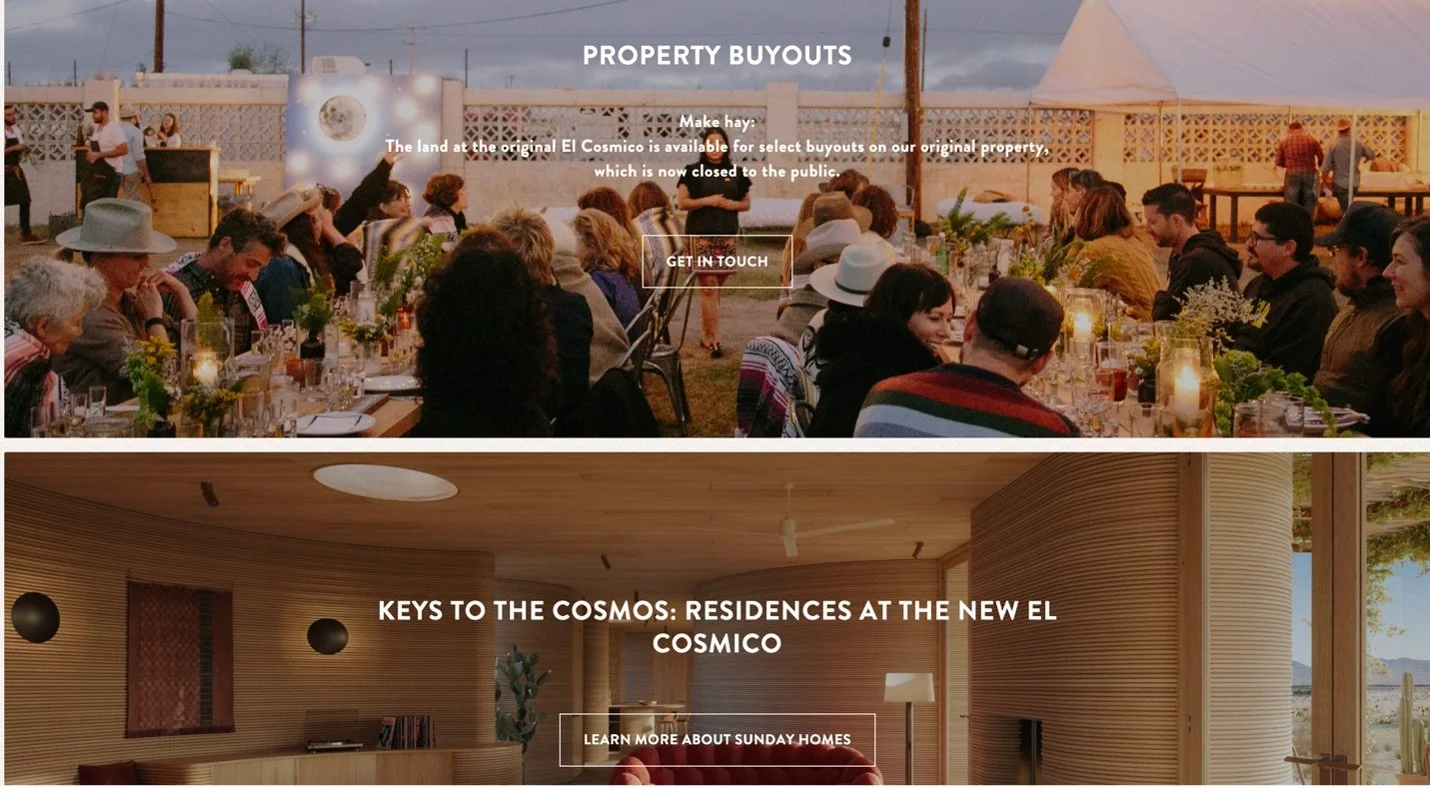
The cultural weight attached to earthen materials that make their aesthetics a site/sight are taken up in service of the prestige of architectural firms, developers, and spatial practitioners’ role in facilitating a settler move to innocence in a time of political hostility to people racialized as unwanted others of the United States civic and cultural body. A feature of the prestige-making enterprise of the spatial trades is the anestheticization of settler guilt. I see the prestige surrounding 3-D printed earthen building as a PR-campaign that works to secure what Eve Tuck and Wayne Yang recognize as a settler move to innocence in a time of existential climate change. Cosmico 2.0 relies on the premise that adobe is inherently primitive—that is, it rests on reanimating the antibrown affects to cast itself as “proper”, aspirational, modern, efficient. Claiming to innovate and make earthen architecture “better” reinforces the preexisting bias against non-Eurocentric forms and methods. Fundamentally, what is being changed at Cosmico 2.0 is a labor structure, production, and process: these are designs attributable to individuals, not communities. They are built in top-down, not horizontal collectives. [Figure 8
Figure 8. Screenshot, El Cosmico website landing page still featuring one of the interiors on offer at the original campground. Dec.1, 2025
Importantly, the claim that ICON’s structures are the solution to building in the climate crisis because of the use of earthen materials relies entirely on the legitimacy of adobe building discourse, and the widespread cultural and aesthetic regard for adobe in the Southwest. In the immediate context of Marfa, it deflects critiques away from how developers stand to make yet more profits from the very conditions of gentrification they cultivated by claiming to remedy that same problem via their housing “solution.”
Prestige works to blunt an increasingly more critical architectural eye amid the field’s glacial pace to diversify. Rather than develop, fund, or promote projects by designers, collaborations, or labor structures that chart paths to make the built environment more equitable, El Cosmico 2.0 siphons the aesthetics of earthen materials and their cultural weights to cast partnership with brand studios like BIG and private industry (ICON and Lambert) as innovative. What it is, is more of the same, enabled by the very precarity created by gentrification and housing unaffordability. [Figure 10]
Figure 10. Adobe structure in state of disrepair, with graffiti on a plywood plank in the doorway that reads “PRADA”—a local spoof on the nearby tourist attraction/ permanent installion of a Prada Marfa (2005) shop by artists Elmgreen & Dragset. Architects Ronald Rael and Virgina San Fratello assisted in the design. Relatedly, Rael/ San Fratello’s Muddy Robots is also a 3-D printer for construction purposes. Rael’s projects are firmly situated as 3-D applications of adobe, and his use of a Nubian vault inspired forms for his projects on his family land in southern Colorado align Rael’s forms with projects of Hassan Fathy’s student Simone Swan to practice global forms of earthen building in Marfa. March 17, 2022. Photograph courtesy of Melanie Ball.
Citation:
Alhelí Harvey, “Aesthetic Piracy,” Platform, June 8, 2026.