Doing Architectural Histories in Dark and Cruel Times
In the United States, the deliberate separation of immigrant families—regardless of legal status—has become a weapon of state power. Detention centers operate as sites of systematic inhumanity, staging forced estrangements out of public view. Such practices rely on a narrative that flattens immigrants into a single figure: the powerless outsider and inevitable target of violence.
How can historians repair national narratives distorted by cruelty and collective amnesia?
We can complicate “single stories” by writing accounts that describe the resilience and humanity of migrants. Our narratives have the power to humanize and amplify migrant perspectives. Yet the term “migrant’s perspective” requires careful unpacking. These testimonies give evidence to their lives, providing a record of their experiences. Understanding how migrants construct and construe their worlds demands deep listening—or as Merav Shohet writes, “to listen beyond the words authorized by master state narratives or even those legitimized by our own interlocutors.”[1]
Creating Alternative Worlds During an Era of Separation
As we witness family separation at the border today with horror, historians recognize that this practice is not new. What remains less understood, however, is the extent of its use in the past and the profound ways that enforced separation reshaped family structures and cultural practices. Migrants nevertheless survived and built worlds for themselves in inhospitable lands.
In the late 19th century, South Asians from the British Indian region of Punjab traveled by ship to San Francisco, Seattle, and Vancouver along the Pacific coast where they entered Canada and the United States. It was common at the turn of the twentieth century for younger sons to travel abroad, earning wages to send home for land purchases and the upkeep of extended families. These migrants confronted violent anti-immigrant hostility and contended with an onslaught of racist laws at the state and national levels in the 1910s and 1920s barring them from becoming citizens, owning land, and bringing their family members to join them. They moved in groups, taking work in lumber yards, railroads, construction sites, and farms. Despite hostility, these “pioneering bachelors,” as they are remembered in the Punjabi American community of Yuba City, laid roots as farmers in California’s valleys.
US law barred them from bringing families, leaving wives and children stranded for decades in Punjab unable to join their husbands and fathers abroad.[2] The hardships endured by these families have received little scholarly attention. We still know too little about the domestic and family spaces sustained across continents—households stretched between villages in Punjab and migrant settlements in North America—spaces that were fragmented yet enduring, fragile yet foundational.
Consider the story of Lal Singh Rai and Chanchal Singh Rai, who left the village of Boparai in Punjab for America in 1927. Their journey took five years, moving through New Zealand, Fiji, Panama, Central America, and Mexico before they crossed into the United States illegally. Though not closely related, in Yuba City they came to be known as “brothers.”[3] More important, Lal and Chanchal treated each other like brothers, building intertwined lives in which they heavily leaned on each other for support. This re-created kinship was essential to how they acquired land and started farm businesses. Stories of affinity sustained the bond: when Lal contracted malaria in Panama, Chanchal “basically carried” his “brother” across the border into the US.[4]
The harrowing experience of migration, and the struggle to create a life in a hostile environment in rural California, profoundly changed ideas of family and the places migrants called home. Before World War II, South Asian migrants faced formidable challenges in establishing families in the US. Fathers, mothers, and children remained separated by vast distances for years or decades, and migrants often never saw their parents again. Surviving portraits of the handful of South Asian families from the early twentieth century invariably included distant and fictive relations.
During World War II, the two men created a “farm camp” once owned by Japanese Americans who were interned by the US government. The camps housed agricultural workers who lived communally, often in crowded, dilapidated bunkhouses. A White intermediary briefly held the deed until the brothers could acquire US citizenship after the war and, following the end of anti-Asian land-ownership laws, purchase the property themselves.
Figure 1. Udham “Bhani” Rai with her two sons, date unknown, Boparai, Punjab, India. UC Davis Punjabi and Sikh Diaspora Digital Archive.
But beneath this story of settlement lies a forgotten narrative of separation. Chanchal’s wife, Bhani, remained in Punjab, raising two sons alone and surviving by selling milk door to door. She and her husband lived apart for sixty-two years; when she finally arrived in Yuba City in 1989, she died less than two years later. In the American family’s memory, her struggles barely registered, though her face, worn by hardship, speaks volumes in a surviving photograph. (Figure 1).
Lal Singh’s trajectory diverged. Around 1947 he married Mary, a dynamic Punjabi Mexican American woman from Arizona. They first lived in a farm camp on Bogue Road before purchasing a single-family home north of Yuba City. In 1952, Lal and Chanchal pooled their assets to purchase a “palatial” home on a large plot of land – an act so unusual that multiple newspapers covered the first time in local memory that South Asian Americans purchased such a fine home.[5] Lal and Mary and their two children grew up in comfort, and Lal and Mary became civic leaders in Yuba City. (Figure 2).
Figure 2. Udham “Bhani” Kaur Rai and her husband, Chanchal Singh Rai, 1990, Yuba City. UC Davis Punjabi and Sikh Diaspora Digital Archive.
Chanchal, by contrast, never formed a conventional household in California. Even when Bhani joined him, he chose to continue to live separately from his wife in the old farm camp on Bogue Road. Like many of the early Punjabi settlers, he lived in a male world as he could no longer fit within a life of conventional domesticity. Even so, he made sure that his wife lived in a comfortable home nearby, and small moments of tenderness remained: when told “Sardar is coming over,” Bhani—then ninety—rushed to make herself presentable for her husband. Chanchal’s legacy endures in land he donated for the Bogue Road Sikh Temple, a reminder that kinship, identity and community were forged not only through settlement, but also through lives shaped by separation.
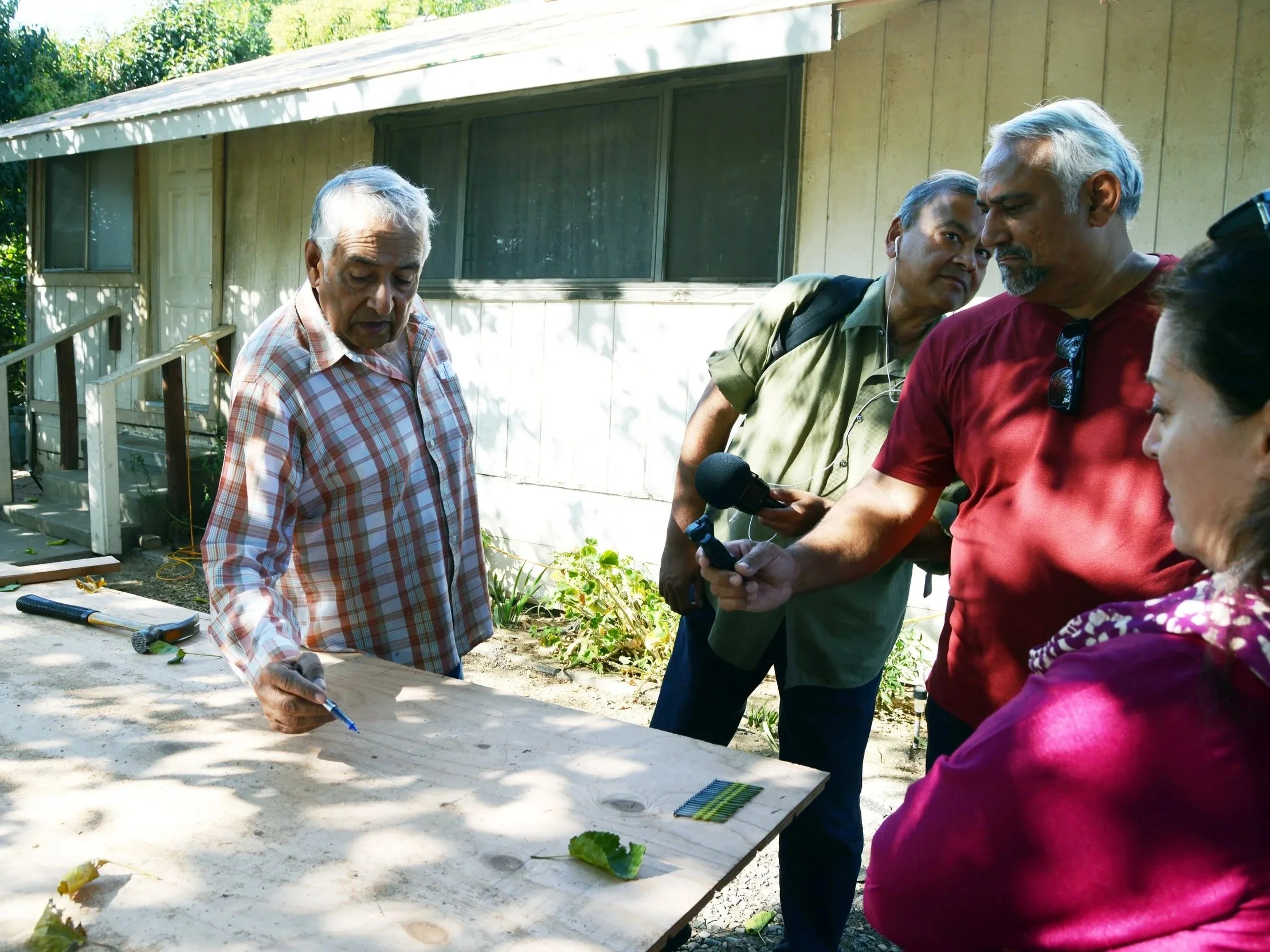
Figure 3. David Rai, Nicole Ranganath, and Arijit Sen at the Chanchal Rai Camp, Yuba City, CA, 2026. Photo Credit: Vikrim Chima, UC Davis Punjabi and Sikh Diaspora Digital Archive.
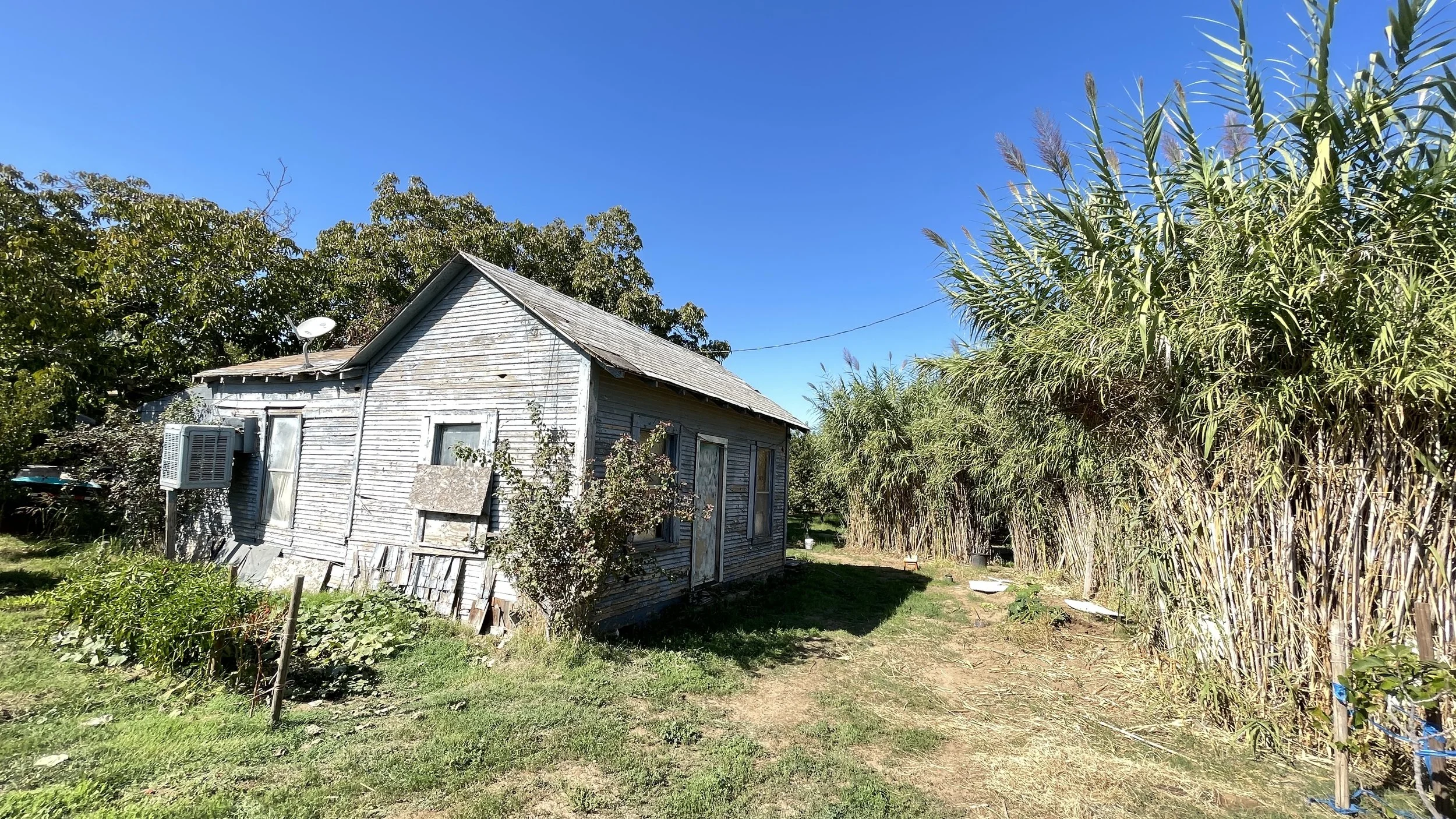
In 2023, we, Nicole Ranganath and Arijit Sen, along with preservationist Vikrim Chima visited the Bogue Road property in Yuba City with David Rai, son of Lal and Mary Rai. Standing beside the old camp, David recalled his tricultural childhood and sketched a floor plan on a tabletop. His drawing reclassified the space: a “living room” doubled as a bedroom, meals were prepared indoors but social life unfolded under two trees, and the yard functioned as a courtyard where Punjabi and Mexican farmworkers mingled. What archival documents would list simply as a “farm camp” emerged through David’s narration as a hybrid domestic and political space.
He drew a plan of the camp home on a tabletop and explained who occupied each room in the house. As he drew out the interior of the house and described rooms using traditional categories such as bedroom and living room. But these words, describing room-types common in the United States couldn’t describe the way these rooms were used. There were multiple beds in the living room, and it served as a bedroom for visitors and residents. Much of the eating was done indoors but living took place under two trees outside, similar to traditional outdoor living in homestead courtyards in India. He remembered an outdoor living room in front of the porch, located below two shady trees. People visited them often and Lal and Chanchal would hold court sitting around the table hosting guests.
Much of the outdoor living spaces have disappeared: a garden where the Rais grew squash, tomatoes, chilies, eggplant, bitter gourd—vegetables necessary to cook homemade Punjabi food. His mother would cook Indian and Mexican food, but David remembers with a grin a child’s paradise in which he could choose to eat with his family or the Mexican workers living just across the driveway depending on whose dinner looked tastier that evening. David’s memories reframed the farm camp not as a “temporary dwelling,” as the archive might suggest, but as a contact zone—a social space where cultures met under asymmetrical conditions of race and labor, what Mary Louise Pratt describes as a place where dominant narratives are unsettled and reimagined.[6]
In a town run and controlled by White Americans, the multicultural South Asian community had created a world of their own at the margins. David drew the plan of a Marysville where “no white people went”—a world he remembered as a child when he accompanied his father outside their farmhouse. He drew out an Indian spice store, the Chinese laundry on Oak Street a popular liquor store, the Lotus Inn restaurant, a Buddhist temple, Little Harlem, the Lyric Theater, an African American Pool Hall, and the Chinese barbershop, Tim’s. Outside the direct surveillance of White settlers and farm owners, the Mexican, Indian, and Asian farmworkers created a unique landscape.
New Methods for Hearing Migrant Perspectives
For architectural historians, the archive—property deeds, immigration records, government notes, building surveys—provides what might be called the mainstream perspective. These documents categorize migrants as aliens, laborers, tenants, or owners, fixing them within state logics of surveillance and control. Such records are indispensable, but they cannot fully capture how migrants actually lived, remembered, or reconfigured their worlds. To glimpse that reality, we must build alternative ways of knowing.
Our project proposes such an approach. We advance a method for constructing counter-narratives of migration, a methodology, grounded in collaboration with descendent communities. We argue that recovering what we call the migrant’s perspective requires moving beyond archival documentation toward collaborative, multisensory, and affective practices of history-writing. These narratives, centered on separation and resilience, unsettle architectural history’s dominant assumptions about culture and place. Sen approaches the project as a cultural landscape historian, tracing the networks of sites where migrants live and work, including spaces that are temporary, improvised, or reimagined through sensory experience—sounds, smells, courtyards created under trees. Ranganath draws on oral histories, songs, and memories, informed by Oceanic Humanities, to reconstruct how migrants and their descendants remember fractured worlds. Both approaches prioritize documenting emotions, attachments, and practices not available in official records. Three principles guide this work:
● Deep Listening – Listening not only to oral accounts but also to silences, gestures, and spatial descriptions. This means resisting the temptation to treat “testimony” as a transparent source. Instead, we attune ourselves to the ways descendants remember through fragments, anecdotes, or embodied memory, often in tension with official histories.
● Site-Based Collaboration – Visiting locations with descendants and community members, reinhabiting the spaces where migrants once lived and worked. Site-walks and sketching exercises allow participants to reconstruct place as they remember it: a “living room” that doubled as a dormitory, a yard that became a courtyard, a farm camp that functioned as a political commons.
● Expanded Archives – Reading material traces—gardens, kitchens, courtyards, and ruins—alongside folk songs, photographs, and family lore. These sources constitute an alternative archive that foregrounds affect, resilience, and adaptation rather than legal status or property ownership.
Taken together, these practices add to architectural history’s dominant assumptions about culture and place. Archival records chart migration, labor, and eventual property ownership after exclusion laws. But oral histories, site walks, and family memory expand this archive, restoring affect, texture, agency, and presence. In listening to descendants describe courtyards, kitchens, and gardens, we begin to glimpse the migrant’s perspective: not a seamless narrative of assimilation, but fragile, improvised worlds built in the shadow of separation.
Our project demonstrates how oral testimony and site-based interpretation both expand and unsettle the archive, shifting attention from official classifications such as, farm camp, alien residence, rental unit—toward lived and practiced categories of belonging and use. In doing so, these methods expose and disrupt the power relations embedded in traditional institutional archives, which presume an authoritative, objective record purposely separated from the very people whose lives they claim to document. An expanded archive emerges through collaborative practices in which narratives are co-created by the historian and their interlocutors while speaking, drawing, walking, and translating experience across modes of representation. These interactions traverse multiple forms of difference: between observer and observed, past and present, and the different media through which memory and meaning are expressed.
Methodologically, then, the migrant’s perspective is not recovered simply by compiling stories, but by reconstructing environments through collaborative memory, sensory reconstruction, and critical attention to the gaps in the record. Such a collection not only reveals how migrants remade place under conditions of surveillance and exclusion to create fragile but enduring worlds but also challenges the hierarchy that privileges institutional records over embodied knowledge. Such a historical narrative bridges lived experience and archival practice to build a more inclusive account of the past.
Citation:
Nicole Ranganath and Arijit Sen, “Doing Architectural Histories in Dark and Cruel Times,” Platform, June 2, 2026.
Notes:
[1] Merav Shohet, “Silenced Resentments and Regrets: Aging in a Changing Kibbutz,” American Anthropologist 125, no. 4, (2023): 896–899.
[2] US immigration from the Indian subcontinent was banned by the Asian Barred Zone Act of 1917 and the Immigration Act of 1924.
[3] According to descendent David Rai, Lal Singh Rai and Chanchal Singh Rai were probably cousins as they shared similar socio-economic backgrounds in the same ancestral village.
[4] Interview with David Rai by Nicole Ranganath and Arijit Sen, October 9, 2022, Yuba City, CA.
[5] “Costa Ranch Sale to L.S. and C.S. Rai Confirmed,” The Gridley Herald, June 13, 1952; “Costa Ranch Sale Confirmed,” Oroville Mercury Register, June 10, 1952, 6.
[6] Mary Louise Pratt, "Arts of the Contact Zone," Profession (1991): 33–40.