After Maghreb: The Spatial Politics of Grief in Wartime Tehran
This spring came earlier than usual, and more insistently. The sky over Tehran was an unlikely shade of blue; rain fell when it wasn't expected, and the air carried the petrichor that makes the city briefly feel like somewhere else, somewhere gentler. The kind of spring, one could not help but think, was too beautiful for anyone walking under it to be carrying grief. But many Iranians were.
Figure 1. Tehran in spring. Photograph by the author.
In January 2026, what began as peaceful strikes and protests—sparked by the economic crisis and the currency's collapse—spread rapidly from the Tehran Bazaar across the country and suddenly took a direction no one had anticipated. Security forces responded with lethal force, and on 8 January, the internet was blocked.[1] Iran's Supreme Council of National Security acknowledged 3,117 were killed during the uprising, while the UN Special Rapporteur on Iran estimated the toll to be at least 5,000, with some sources suggesting it may have been significantly higher.[2] The crackdown did not end there, and at least 3,000 more were arrested. Before the city had recovered from that shock, before the grief had been named or the fear had settled, came the war.
Figure 2. Columns of smoke rise over Tehran following the attacks of 28 February 2026, the first day of the war. Source: Wikimedia Commons
For the first time in nearly four decades — since the cities of Iran last heard the sound of sirens and air raids during the long war with Iraq — Tehran and several other cities across the country experienced heavy bombardment. The United States and Israel both insisted the strikes were targeted at military infrastructure and would not harm civilians.[3] The reality, however, was different. On 28 February 2026, the first day of the war, a US missile struck the Shajareh Tayyebeh Elementary School in Minab in southern Iran in a double-tap attack.[4] Those who survived the first strike and took shelter in a room were killed by the second. Hours later and miles away, two missiles struck a sports hall in Lamerd, Fars province, while a women's volleyball team was training inside. At least 24 people were killed. Independent investigations by the New York Times and BBC Verify identified the weapon as a US Precision Strike Missile—a munition designed to obliterate fortified military targets, but CENTCOM denied responsibility. These were not isolated incidents. Over 38 days, Israel alone dropped more than 18,000 bombs in more than 1,000 waves of airstrikes, while the United States struck over 13,000 targets, a combined scale of assault with no recent parallel. The strikes that were framed as targeting military sites hit 138,000 homes, destroyed more than 3,000 residential units, damaged 65 schools and 32 medical facilities, and killed over 3,600 people, of whom more than 1,700 were civilians, including at least 254 children. These attacks left marks on buildings, on the soil, in the water, and on the people who survived them.
““Grief is often understood as a private response to loss, a way of learning to live in a world altered by absence while maintaining a continuing relationship with what has been lost.””
Spring continued to blossom anyway, indifferent and fragrant, while the city tried to understand what had happened to it. But the grief that settled over the city that spring was not only the grief of war. It came layered over everything that had already been endured.
What does it mean to grieve in a city where grief has been accumulating for years, unnamed and suppressed, when the bombs of a war fall on top of all that? Grief is often understood as a private response to loss, a way of learning to live in a world altered by absence while maintaining a continuing relationship with what has been lost. It is carried in the body and unfolds over time. Yet grief rarely remains private. It seeks expression in the world, finding form in the spaces, objects, and rituals that come to hold it, from a grave or a photograph on a wall to a street corner where something happened or a route no longer taken. But grief does not only find form in spaces and objects. It is also performed, finding company in gatherings, processions, and crowds moving through the street, where mourning becomes visible, shared, and held in public space.
““In a city already marked by layers of unmourned loss, who gets to grieve, and where, and in what form, becomes a political question.” ”
Orhan Pamuk wrote of hüzün, the collective melancholy that settles into a city's stones, shared by all who walk its streets. What Tehran carried this spring was something similar but darker. Unlike hüzün, which belongs to the city as a whole, this grief was sorted before it could be mourned. The state selectively appropriated some of it and staged it, bestowing it with flags, banners, and the weight of fourteen centuries of Shi'a martyrology. The rest remained with those who carried it, unstaged, unmarked, and with nowhere to go. The distinction was not only between different losses. It was between the spaces that each loss was allowed to occupy. Space does not hold grief passively. It is where such distinctions are made, maintained, and made visible.
Figure 3. An evening gathering in a Tehran square, where participants wave flags as nohe-khani (the chanting of Shiʿa mourning laments) is performed from the stage.
Tehran came to the war already carrying the burden of griefs it had never been allowed to mourn. There were losses that received no official recognition or space for mourning, leaving grief private, without public expression. And now, as a result of the war, there were new losses that the state would choose to manage very carefully. In a city already marked by layers of unmourned loss, who gets to grieve, and where, and in what form, becomes a political question. Tehran in the spring of 2026 became the site of exactly this contest. Judith Butler's concept of grievability begins here. Not all lives, Butler argues, are understood as lives worth mourning. The differential—who is grievable and who is not—is structural. It is produced and reproduced through the institutions, images, and spatial practices that decide which losses are made visible, commemorated, and returned to, and which are left without a surface to land on.
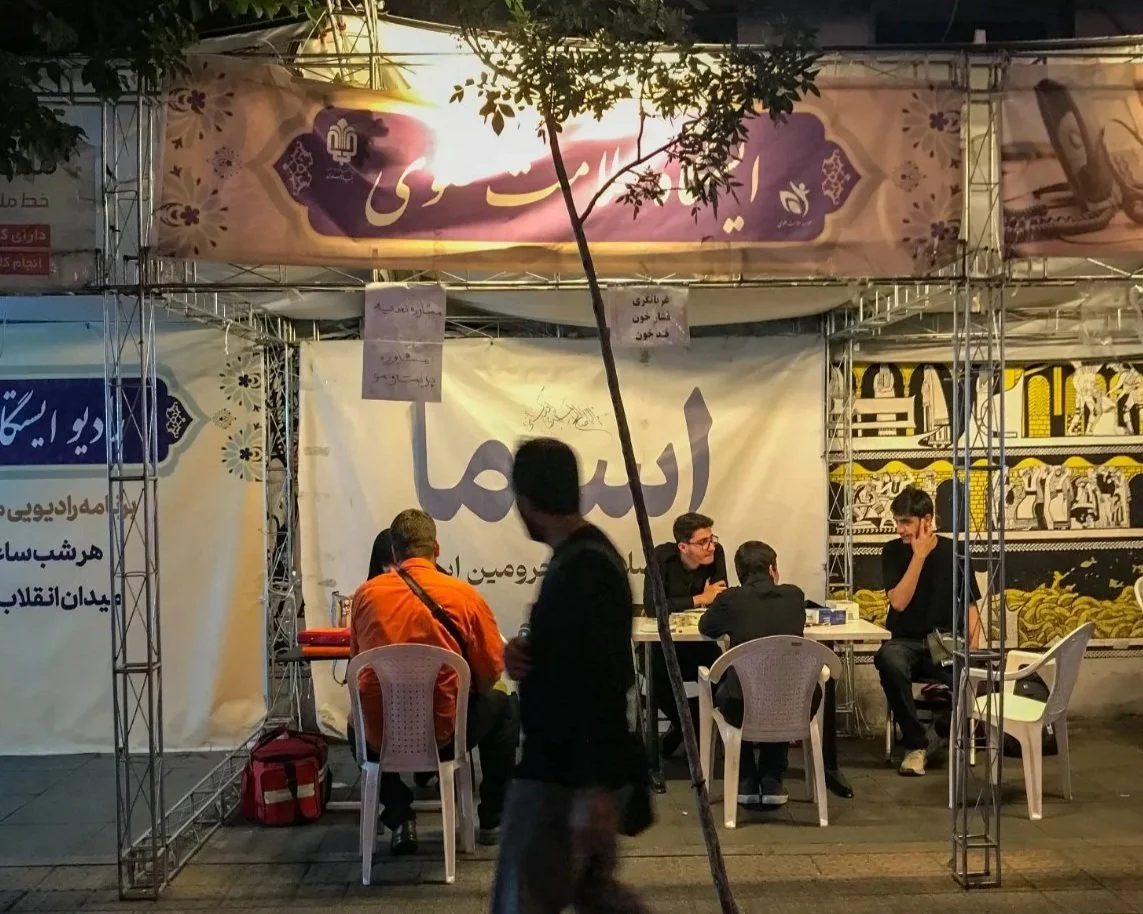
Figure 4. [Right] A "Talk to Me" counselling stand installed on the edge of a square in Tehran. The banner reads "National Mobilisation. Talk to Me. Free counselling services in wartime." [Left] Other points of activity around the square, including a bookstall, a calligraphy stand, shops, and donation points, remain empty during the day and operate only after Maghreb. Photograph by the author.
The images coming out of Iran during the war and after the fragile ceasefire are extraordinarily limited. Like everyone else, I had seen the partial, fragmented images, moving through the gaps of the internet shutdown like water seeping through cracks in concrete. One video in particular, uploaded by a young Iranian woman shortly after the ceasefire, showed something of what the city had become after Maghreb, the time of sunset prayer when daylight gives way to night.[5] It seemed that what had been an everyday urban space was converted into a stage, raising—perhaps unintentionally—a question about who the stage was for, and at what cost to everyone else. But images are one thing, reality is another. I wanted to see the city for myself.
Figure 5. A woman waves a flag during an evening gathering at Enghelab Square, Tehran. Photograph by the author.
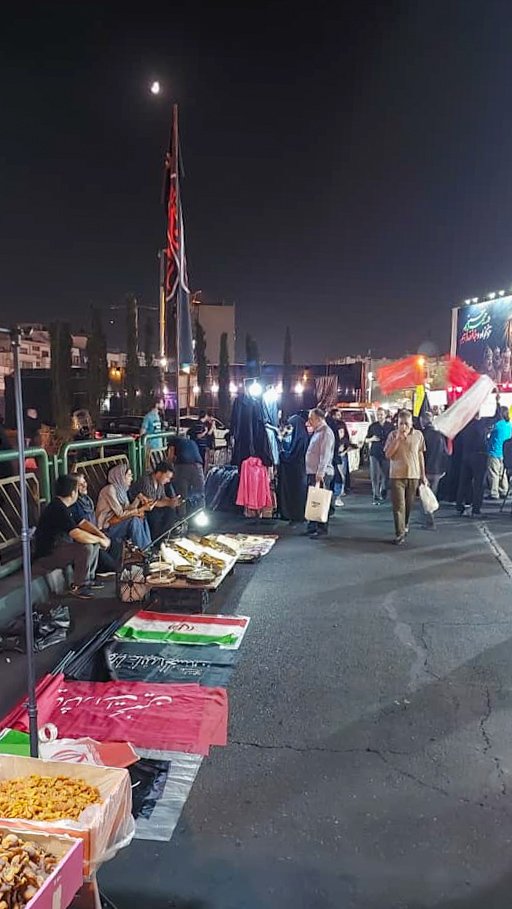
Figure 6. Vendors line Enghelab Street during the gathering, selling flags, food, clothing, decorations, and other goods catering to the needs and interests of those attending. Photograph by the author.
On my first evening back in Tehran, I walked to a square near my home at around half past eight, knowing more or less what I would find. People were already moving toward the square with flags in hand, joining what was taking shape. By nine o'clock, the roads around the square had been closed off by the police, the national anthem was playing, people were waving flags, and the square had turned into a stage, carefully arranged and managed. What I found there matched Asadi’s video in terms of crowd size, activities, and how the space was arranged, but being inside it felt different. Mowkib tents distributed tea and food. [6] A children's painting station had been set up to one side. There was a "Talk to Me" stand where people could sit with a counsellor. The care on offer was attentive, unhurried and organised with considerable thought. I moved through it as an observer, visibly different from most of those around me, and what struck me was not hostility towards an outsider but a kind of self-containment. The people gathered seemed to share a clear sense of what the event was and who it was for.
Around the square, and alongside it, everyday urban life continued. Cafés and restaurants were busy, with people sitting at outside tables. Shops remained open, and people carrying shopping bags moved through the surrounding streets. Yet only a few metres away, flags were being waved at the commemoration. This was not two cities in opposition to each other. It was one city operating at two registers simultaneously—the staged and the unstaged, the incorporated and the remainder—on the same pavement, under the same sky.
Figure 7. Flags for sale by vendors along the route to the gathering in Enghelab square. Iranian, Hezbollah, and Muharram flags bearing the names of Imam Hossein and other figures of Karbala. Photograph by the author.
A few days later, I walked the longer route, from Enghelab Square toward Valiasr Square. By now, Muharram, the annual Shi'a mourning period commemorating the martyrdom of Imam Husayn, had begun. Here, the scale was different, and so was the intention. The organisation was more deliberate, the spectacle more complete, and more consciously assembled. This was the product of coordinated efforts by a range of state, religious and charitable organisations.
Projectors cast light and slogans onto the squares and streets. The route was crowded, and not only with mourners. Many had come to just pass the time, to be out among others, and vendors had set up along the way selling posters and paintings with religious motifs, portraits of the martyrs, home decorations related to the occasion, as well as nuts and dried fruits. At intervals, there were broadcasting spots where small crowds gathered to talk into the camera, in Farsi and in English. Portraits of martyrs looked down from banners on buildings. Flags (Iranian, IRGC, Palestinian and Hezbollah) lined the route. Nohe-khani moved through the air.[7] One slogan emerged repeatedly from the chanting: میدان با تو، خیابان با ما (you tend the battlefield, we'll tend the streets). It was a spatial declaration as much as a devotional one. The front was elsewhere, but the street itself was being held, claimed and kept as an act of solidarity with those fighting. Like the first square near my home, the route was lined with Mowkib tents offering food and drink. But here, the provision was larger and more elaborate. Health stations were staffed with doctors, therapists, religious counsellors, and specialists for children. Every need grief might elicit was anticipated and met, at least for those the gathering was meant to hold.
In front of the iconic main gate of Tehran University, a large stage had been set up for Nohe-khani and talks. Black curtains marked off the enclosure and divided it, with separate entrances for men and women. It drew the largest crowds along the route. But it was not only the squares that had been claimed. Through the city's streets, caravans of cars moved slowly, flags streaming from windows, loudspeakers playing the Shi'a devotional chant bearing the name of Imam Ali. They moved through the same streets where, months earlier, people had marched in protest and been met with the state's violent crackdown.
Figure 8. People queue at a mowkib distributing food and drink along Enghelab Street, Tehran. Photograph by the author.
What I was witnessing was not simply a commemoration. It was a total environment, carefully constructed to answer every human need that follows collective trauma, including food, medicine, community, spiritual counsel, the opportunity to speak and to be heard. In that sense, the generosity was real. It was the kind of care the state knows how to give, through the mobilised welfare of the relief tents and the volunteer corps. It was also, in the same gesture, an official narrative. It said, this is what happened here, this is who suffered, this is what it meant, and this is who we are. The management of grief had become the management of meaning in the service of an official narrative.
But not everyone in that city could be contained by that narrative. The city was also full of people whose losses had no place within it, including the families of those killed in January, the disappeared, and those whose names the state refused to acknowledge. Their grief did not disappear but was channelled into other spaces.
Figure 9. Women’s and men’s sections arranged before a stage set up at the main entrance to Tehran University. Photograph by the author.
Figure 10. Medical and counselling stations operated along the gathering route by the Alavi Health Institute, an Iranian charitable organisation affiliated with the Foundation of the Oppressed, offering services such as nutritional, skin and hair consultations, health screening, and blood pressure and blood sugar testing. Photograph by the author.
Denied a place in public space, grief sank into the domestic interior. Across the city, corners of ordinary rooms became private altars: a photograph on a shelf, a piece of clothing, an object that belonged to someone now absent. Such was the story of Aida Heidari, a young medical student killed in the January crackdown. Her mother, unable to mourn publicly, cried from her balcony every night. A neighbour filmed it anonymously and shared it online. The balcony, that threshold between interior and public space, neither fully private nor fully visible, became the only space available for her grief. Grief also settled into the body. Across Iran, families of those killed in the January protests began turning burials into acts of resistance through playing music, clapping and dancing at the graves of their dead, the young above all. Their dancing was not one of joy; it was the body refusing the mourning assigned to it and finding its own form, a collective and political practice rather than private repair.[8] This was the grief the stage could not absorb, and it had nowhere else to go. And finally, the grief returned to the street in flowers left where people had fallen. Unlike the state's banners, they were ephemeral, easily removed, and gone within days. Where the permanent banners said some deaths were meaningful and served a story, the flowers said only that someone had died here. Someone I loved.
Having been pushed into homes, bodies and fleeting traces, grief also appeared at the margins of the state's own commemorative spaces. A mother carrying the photograph of her son, killed in the January protests, stood at the edge of a Muharram procession and wept alongside the mourners; she neither acknowledged nor disrupted the event. Her grief did not claim the stage, but neither did it remain outside it. Taken together, these unofficial expressions of grief did not create a separate space of grief. They formed a second economy of grief unfolding across the same ground as the official one. It was informal, where the official was organised, confined to the edges, where the other held the centre, and gone by the morning, where the other was built to last.
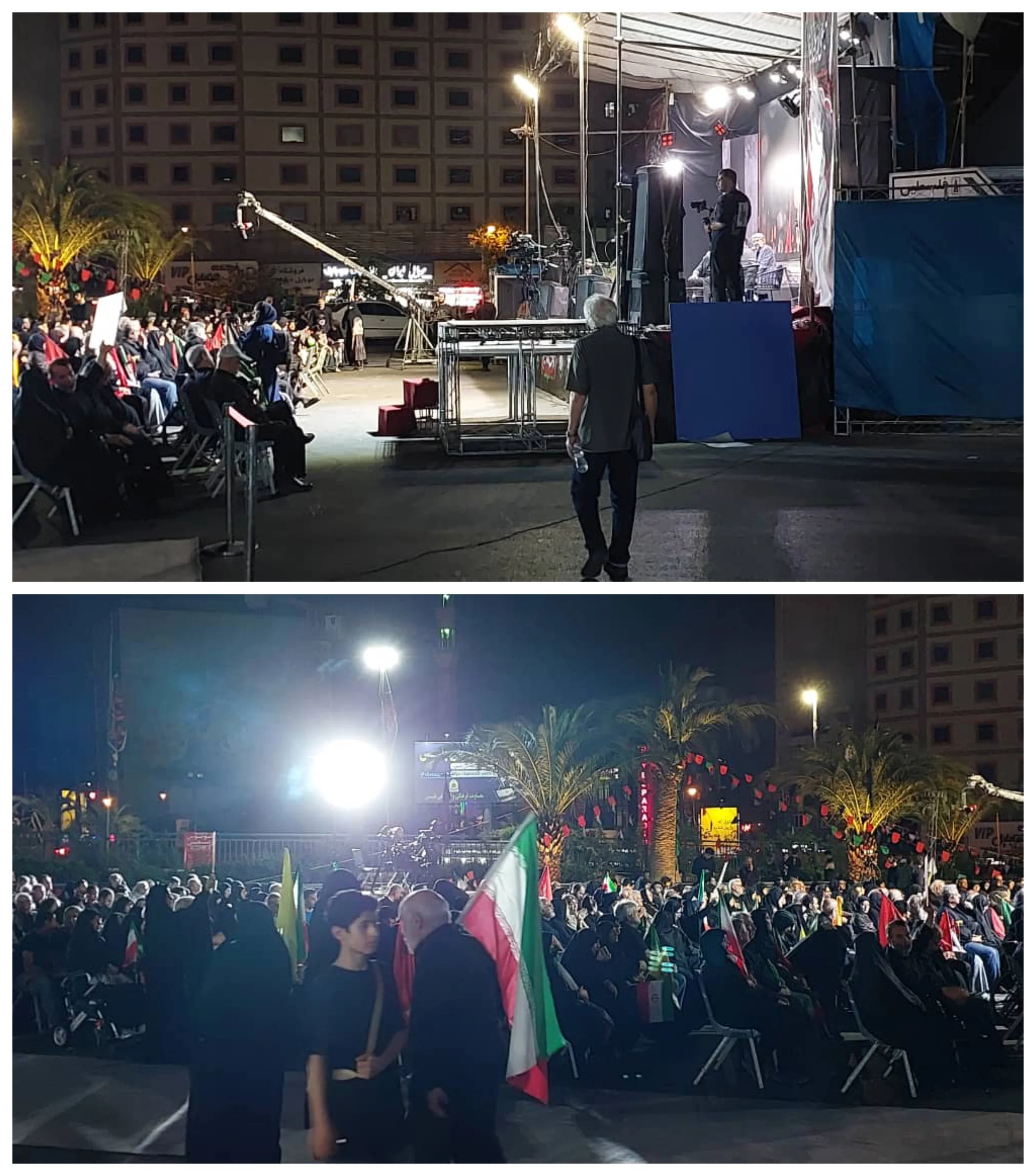
Figure 11. A seated audience listens to a public debate on the war and what may follow at Valiasr Square, Tehran. Rows of chairs temporarily occupy the square, transforming it into an open-air forum, while the discussion is filmed for national television. June 2026. Photograph by the author.
Grief that has nowhere to land does not disappear. It finds other spaces. Sara Ahmed writes that in grief, there is a grievance. To mourn is to register that a loss should not have happened, that something is owed. This is why grief is so often managed by those who bear some responsibility for it. The stage erected each night after Maghreb becomes the city's authorised space for public mourning. The state does not need every space. It occupies the central ones, such as the illuminated squares, the permanent banners and the places where grief could be publicly seen. It furnishes them so completely—with tents, counsellors, food, and a stage for every voice it chose to amplify—that little room was left for anything else. This is not control imposed against grief. It is control exercised by accommodating grief, by giving it a place and a script so total that no other place seems necessary. In these spaces, grief is expressed with real tenderness for the schoolchildren of Minab, the volleyball players of Lamerd, and others killed in the war unjustly. But only certain selected losses are permitted into it. They are subsumed into a single story of a nation attacked, its losses real and unjustly inflicted. The story is true, but it has an inside and an outside, and only some of the losses belong within it.
““To mourn is to register that a loss should not have happened, that something is owed. This is why grief is so often managed by those who bear some responsibility for it.””
But a space provisioned so completely also produces its own outside. The grief the state refused did not vanish. It found its way into the spaces the state had not occupied—through flowers left on the pavement where someone had fallen, a mother standing at the edge of a sanctioned gathering holding her son's photograph, another mourning her daughter from a balcony, families dancing at gravesides. These were not authorised places of mourning. They were the spaces that remained once the centre had been claimed, and sanctioned grief made them its own. So the city was not divided into two. It was one ground, held unequally. One grief was given every fixed and lighted surface. The other took what was passing and unclaimed, and grieved there anyway, in the open, without permission, refusing to be told it did not count.
Citation:
Sadaf Tabatabaei, “After Maghreb: The Spatial Politics of Grief in Wartime Tehran,” Platform, July 27 2026.
Notes:
[1] The blackout came in stages, starting with throttling and network jamming in protest areas from late December 2025, then a near-total countrywide shutdown on 8 January 2026 that cut off mobile, landline, SMS, satellite and even domestic networks. Connectivity was only partly restored in February, before a second, eighty-eight-day blackout followed the start of the war on 2 February. The partial connectivity was restored on 26 May 2026. NetBlocks, "Welcome Back Iran: Metrics Show a Further Rise in Connectivity as Mobile Networks and Other Segments Are Reconnected to the Global Internet." Mastodon, 26 May 2026. mastodon.social/@netblocks/116642131173028444.
[2] On 21 January 2026, Iran's Supreme Council of National Security issued a statement putting the death toll at 3,117. On 16 January 2026, the UN Special Rapporteur on Iran, Mai Sato, stated in a media interview that at least 5,000 people had been killed, possibly as high as 20,000. Amnesty International. "What Happened at the Protests in Iran?" 26 January 2026. For a critical review of how these and higher figures were produced and circulated, see Babaali, Parisa. Review of HRANA casualty data. Instagram Reel, 2026. www.instagram.com/reel/DXA52ChgCmC ; and Jamshidi, Maryam. "Where Did the 40,000 Iran Protests Death Toll Number Come From?" Zeteo, 3 June 2026. zeteo.com/p/where-did-the-40000-iran-protests.
[3] When questioned about reports of widespread structural collateral damage in Iran, Hegseth pushed back, asserting, “what I will emphasize to you and to the world is that, unlike our adversaries, the Iranians, we never target civilians” (Garrett & Hegseth, 2026).
[4] For more information see: https://forensic-architecture.org/investigation/airstrikes-on-minab
[5] Fatemeh Asadi (@FatemehAsadi_docs), video documentation of the city after the ceasefire, YouTube video, n.d., since deleted. For similar ongoing visual documentation by the creator, see Asadi's Instagram profile and YouTube page; Maghreb (مغرب) in Persian refers to sunset and the time of the evening prayer. In this essay, “after Maghreb” describes the hours after sunset, when commemorative gatherings began to occupy Tehran’s squares and streets.
[6] Mowkibs are temporary service stations that provide pilgrims and mourners with food, drink, and other forms of care.
[7] Nohe-khani is performed primarily in honour of the Shi'a Imams, led by a mourning reciter (nohe-khan, often a maddah), traditionally in communal settings that enable sociability and the sharing of grief.
[8] On grief as a collective and political practice rather than private repair, see bell hooks, Sisters of the Yam: Black Women and Self-Recovery (Boston: South End Press, 1993), especially ch. 7, "Facing and Feeling Loss," where the work of mourning is bound to self-recovery and to resistance.