Is there a White Architecture?
Last month, President Trump announced a new round of White House renovations after a year of changes to the historic site that included demolition of the East Wing to make way for an ever-grander ballroom and paving of the Rose Garden’s lawn for a dining patio (Figure 1). Trump referred to his latest scheme as the “Upper West Wing.” It proposes a second-story addition to the West Wing’s colonnade that would create visual continuity with plans for a two-story colonnade on the other side of the pavilion connecting the White House’s East Room with the future ballroom. The new second story could provide office space for presidential aides or the First Lady, although designs have not been finalized. Construction would likely displace the journalists who occupy the James S. Brady Press Briefing Room located directly beneath the proposed renovation for an indefinite period (Figure 2). Nobody has suggested where the journalists might go.
Figure 1. Notice the single-story West Wing colonnade behind President Trump as he stands in the Rose Garden at a “Make America Healthy Again” event on April 2, 2025. Photograph by Abe McNatt. Courtesy of Wikimedia Commons.
Figure 2. Press Briefing Room (highlighted) is located directly below proposed second-story addition above the West Colonnade. Image by Wikipedia contributor TCY.
The president’s plans for the White House have been in constant flux. Last July, he feigned interest in historic preservation, promising that the East Wing would remain intact since the ballroom would be built adjacent to it. He changed his mind. Upon demolishing the building, he reasoned that the East Wing was not worth saving because it was “small, heavily changed,” and “renovated many times.” (So far, he has not justified his proposed changes to the West Wing, which has undergone only minor changes since Franklin D. Roosevelt’s expansion and reorganization of it, in 1934 [Figure 3]). Last month he replaced McCrery Architects with Shalom Baranes Associates, which recently announced the Upper West Wing addition — and the renovation’s ballooned budget. Initially set at $200 million, the Upper West Wing is projected to double that cost.
Figure 3. Bird’s eye view of West Wing with single-story colonnade and garden from 1934-35. Photograph by Albert S. Burns for the Historic American Buildings Survey. Library of Congress.
Despite these changes, one aspect of Trump’s building project remained consistent: his insistence on the neoclassical style. Trump has declared that neoclassical architecture be the only acceptable one for federal buildings several times, across both of his administrations, most recently in his executive order Making Federal Architecture Beautiful Again of August 2025. It decreed that “classical architecture (in the District of Columbia) shall be the preferred and default architecture for Federal public buildings” and created a commission to ensure that the U.S. General Services Administration follows it. This makes a sharp break from the past. As Michael R. Allen has argued, previous American presidents demonstrated a preference for particular architectural styles but never placed a “limit on the public imagination of civic buildings.”
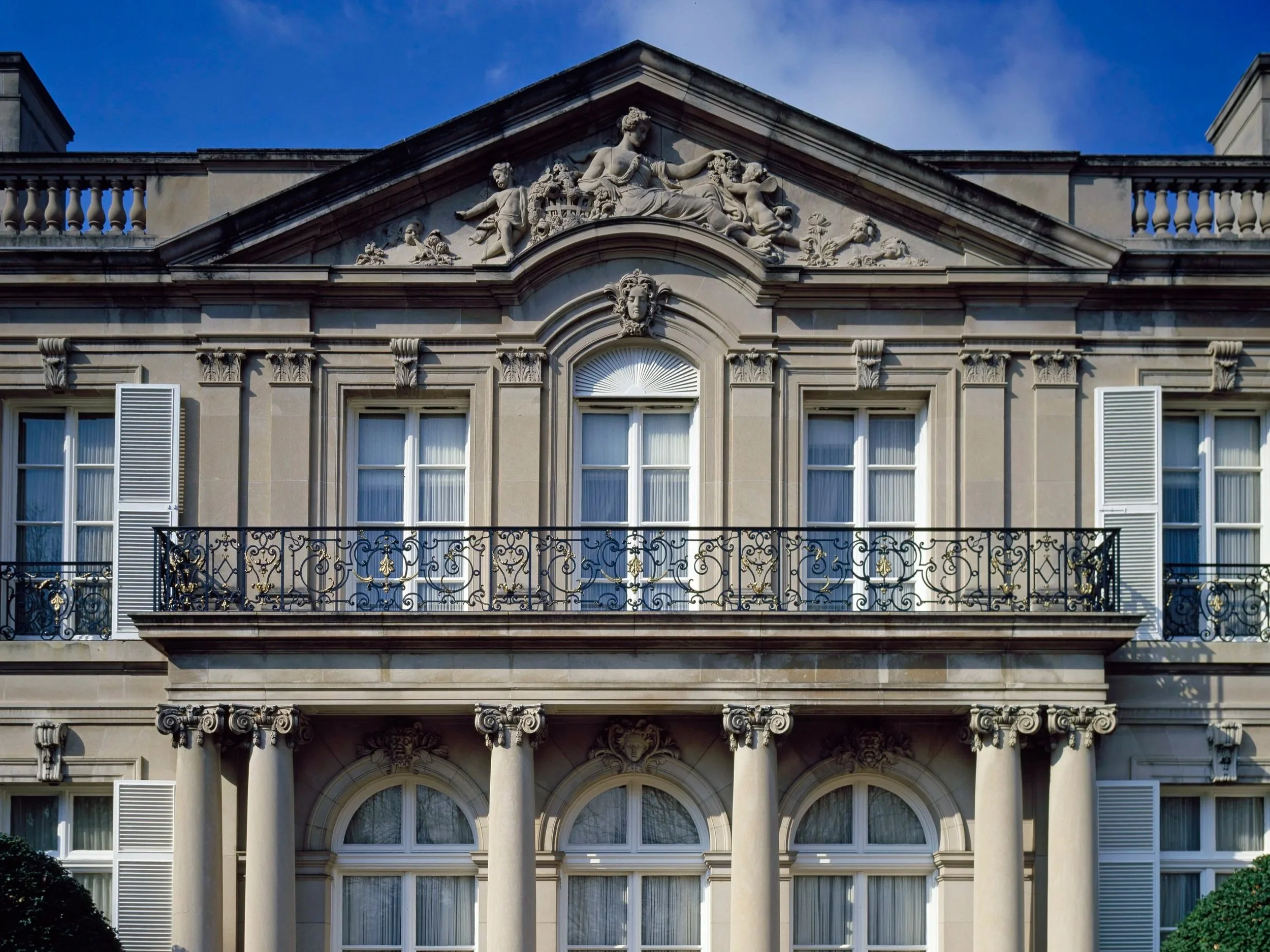
Figure 4. Architectural detail of the residence of the Ambassador of Belgium (formerly Delphine Baker House), Julian Abele, chief architect for Horace Trumbauer firm, 1931, Washington, D.C. Photograph by Carol M. Highsmith. Undated. Carol M. Highsmith Archive, Library of Congress, Prints and Photographs Division.
Since Trump’s first term, the Make America Great Again movement has been criticized as a covert — sometimes overt — Make America White Again movement. Does that analysis extend to architecture? Last year’s executive order emerged against a backdrop of nationwide raids targeting immigrant families, a proposed refugee policy that grants preferential treatment to White South Africans and Europeans, and plans to deny naturalized citizens the same rights as U.S. born ones. Given MAGA’s preferential treatment of White people and associations of neoclassicism with Whiteness, is Trump ushering in a White architecture?
Echoing the earlier Promoting Beautiful Federal Civic Architecture executive order of December 2020, the new order argues that neoclassical architecture is the people’s architecture, and that most Americans not only dislike modern buildings but can’t recognize a federal building as federal unless it’s neoclassical. In Trumpian fashion, it insults the very people whose perspectives it claims to uphold. As Allen argued of the older order, not only does this position resurrect “old myths” about elitist modernist architecture but it promotes a reductive interpretation of neoclassical architecture that frames it as a mere inheritance from ancient Greece and Rome and dismisses the invention and architectural pluralism that defined the work of American architects who employed it. Buildings like Julian Abele’s Beaux-Arts Delphine Baker House (now the Residence of the Belgian Ambassador), completed in 1931 (Figure 4).
Trump’s quarrel with modernism also negates the neoclassical principles of solidity, harmony, and restraint that twentieth-century architects often applied to even modernist designs. Consider Washington’s Langston Terrace, one of the nation’s first public housing projects, built between 1935-1938 (Figure 5). Modeled loosely after social housing in Europe, its two-story row-house type units and three-story walkup apartment buildings were nothing if not plain, with their symmetrical plans, regular fenestration, and ornamentation that was limited, in the apartments, mostly to The Progress of the Negro Race, Daniel Olney’s terra-cotta frieze in the central courtyard (Figure 6). This pioneering example of modernist American architecture was built to provide high quality affordable housing for African Americans, named for Black abolitionist and politician John Mercer Langston, designed by Black architects Hilyard Robinson and Paul R. Williams, and constructed by Black builders. If any federal building is decidedly not White, this is it.
Figure 5. Neoclassical principles such as solidity, regularity, and restraint define the modernist Langston Terrace Dwellings, Hilyard Robinson with Paul R. Williams, architect, 1935-1938, Washington, D.C. Photograph by “Smallbones” c. 2012. Courtesy of Wikimedia Commons.
Figure 6. Terracotta panels depict the twentieth-century transition from farm labor to industrial work in The Progress of the Negro Race, Daniel Olney, artist, 1935-1938, Langston Terrace, Washington, D.C. Photograph by Carol M. Highsmith. Undated. Carol M. Highsmith Archive, Library of Congress, Prints and Photographs Division.
The idea of an explicitly “White architecture” would surely make MAGA leaders uncomfortable. The success of the Trump administration may be attributed in no small part to the power that results from invoking whiteness while never naming it. The administration has courted a wide number of White Americans and a smaller group of White nationalists by pandering to the long-held belief that White people are non-raced and therefore speak for everyone — in contrast to raced people who have an agenda that prohibits them from unbiased representation. Richard Dyer has persuasively argued that White people never refer to whiteness while frequently referring to other races. By omitting references to whiteness, White people maintain the widespread if implicit belief that whiteness is normative: that “white people are just people,” which, Dyer reminds us, is not far from saying that “whites are people whereas other colours are something else.”[1]
Trump maintains the power and invisibility of whiteness by producing endless ciphers for it that find their way into political discourse: U.S. born citizen, patriot, 0% liberal, Proud Boys, Oath Keepers. And neoclassicism (Figure 7). The question “Is there a White architecture?,” then, has real stakes, because in the affirmative it exposes whiteness as a racial category with an architectural lineage, weakening White people’s ability to define normality and compromising neoclassicism’s presumed capacity to speak for all.
Figure 7. Proud Boys (see yellow neckerchiefs and “PB” insignia) and other Trump supporters join Million MAGA March in Washington, D.C. on Nov. 14, 2020. Photograph by Elvert Barnes. Courtesy of Wikimedia Commons.
I have never been asked, “Is there a White architecture?” but I have been asked, many times, “Is there a Black architecture?,” especially after giving a talk on a Black architect such as Abele, Robinson, or Williams. The question always confounds me. It presumes that African American architects have some essentialist connection to ancestral homelands that shapes their approach. It presumes there is an inherent quality shared by Black architects that dictates their design decisions — perhaps a material thing (like a preference for bee-hive shaped structures, perhaps?) which, although heretofore unnamed, an expert like I might be so kind as to point out? It presumes that Black architects build only for Black users, which in the case of prolific figures like Williams was far from the case.
The question also ignores how architecture takes place. To ask if there is Black architecture dismisses the confluence of forces necessary for any architect to succeed, including her education, relationship with the client, communication with builders, mastery (and often coordination) of regional and global design ideas, knowledge of materials and construction techniques, and ability to work within the limits of budgets, municipal regulations, and the mercurial temperaments of everyone involved. Not to mention the profound effects of chance, accident, and circumstance. The question “Is there a Black architecture?” dismisses not the agency of the architect but the factors beyond any individual’s control in the production of buildings.
““Trump maintains the power and invisibility of whiteness by producing endless ciphers for it that find their way into political discourse.””
By now, you will have surmised that the question “Is there a White architecture?” is a provocation. Just as there is no inherent quality that dictates the design decisions made by architects who identify as Black, neither are there essentialist reasons that explain why a building designed by a White architect might look the way that it does.
A symptom of the invisibility of whiteness is the acceptance that White people speak for all. When politicians imbue buildings with romantic-nationalist sentiment, they associate architecture with imagined histories of nation states. Making Federal Architecture Beautiful Again and the proposed White House renovations exemplify such a romantic nationalism. Both are predicated on a fantasy, untethered to reality, of a time before racial (and ethnic) diversity and architectural diversity, when American architects worked in a single architectural style befitting a monolithic culture.
Citation:
Kristina Borrman, “Is there a White Architecture?,” Platform, February 2, 2026.
Note:
[1] Richard Dyer, “The Matter of Whiteness,” in White Privilege: Essential Readings at the Other Side of Racism, ed. Paula Rothenberg, 9-14 (New York: Worth Publishing, 2005), 10.