Expanding Historic Preservation: Thinking Through China
The US State Department recently announced its decision to withdraw from UNESCO, arguing that UNESCO’s “globalist, ideological agenda” is “at odds with our America First foreign policy.” This refusal to engage with international heritage norms threatens to further isolate American historic preservation from the complex and interesting ideas and practice debated internationally. Indeed, ‘historic preservation’ is a distinctly American term. US preservation practice has experienced an expansion of the number of buildings and landscapes considered as heritage during the last six decades, largely through innovations administered by the National Park Service, and has expanded its attention to sites attached to minoritized groups and to difficult histories. However, it largely remains focused on the mid-century ideals of the 1966 National Historic Preservation Act. This practice, arguably, has been little engaged with international conversations about heritage as a discourse engaging the politics of the present, or with preserving heritage beyond the built environment. Notably, the US is one of the very few countries that have not ratified UNESCO’s 2003 Convention for the Safeguarding of the Intangible Heritage.
We preserve buildings in the US because of their relationship to significant events, people or moments in design history, or because they contain important historical information. But heritage goes beyond the narrow interpretation in the National Register, as has been explored at length by Critical Heritage scholars. Heritage is a social process in which we negotiate our inheritance and legacy. It is fundamental to who we are and to our lives. Heritage can be manifest in the tangible, a place or an object, but only as interpreted through the intangible, the knowledge and skills inherited from our ancestors and that we pass on to descendants. Heritage, as a social process, is practiced country by country, group by group, and is always political and contingent on power relations and cultural norms. There are global guidelines that have benefitted the world’s people, but these guidelines work more or less well in different places around the world.
Before I joined the University of Virginia’s School of Architecture in 2016 as Director of the Program in Historic Preservation, I taught and practiced in China for the better part of four years. During these years I experienced a wide range of heritage-related projects as an educator and as a practitioner. Much of what I encountered was outside my range of experience in heritage work in the United States and Europe and challenged my assumptions about what preservation should or could be. In the United States we are good at saving old buildings and creating museums. We understand heritage to be a thing embodied in built forms, coming from our focus on the preservation and curation of material fabric. This focus comes directly from ideas promulgated by UNESCO and the Venice Charter in the mid-Sixties, which were reflected in the National Historic Preservation Act. Heritage preservation practice in China, in contrast, while it engages with the international norms expressed through UNESCO, has different roots and can lead to quite different practices which challenge our ossified thinking.
In recent years, China has been a dynamic proving ground of heritage practice where international ideas are debated, fought over, and realized in many forms within the context of complex economic, political, and reputational forces. Heritage practice in China engages with many of the central themes of heritage theory and practice, shedding new light on considerations of authenticity, intangible heritage, politics and nationalism, tourism, and development. These forces lie at the heart of contemporary heritage practice, not only in China but internationally. In my book, Thinking Heritage Through China, I explore a wide range of case studies of recent heritage practice in China. Examining international heritage through the lens of Chinese practice makes visible the contradictions and possibilities, the many different theories and methods available on the international scene, for engaging cultural heritage sites.
Figure 1. View of the Chaiyuan Garden with WHITRAP workshop participants. Photo by author, 2014.
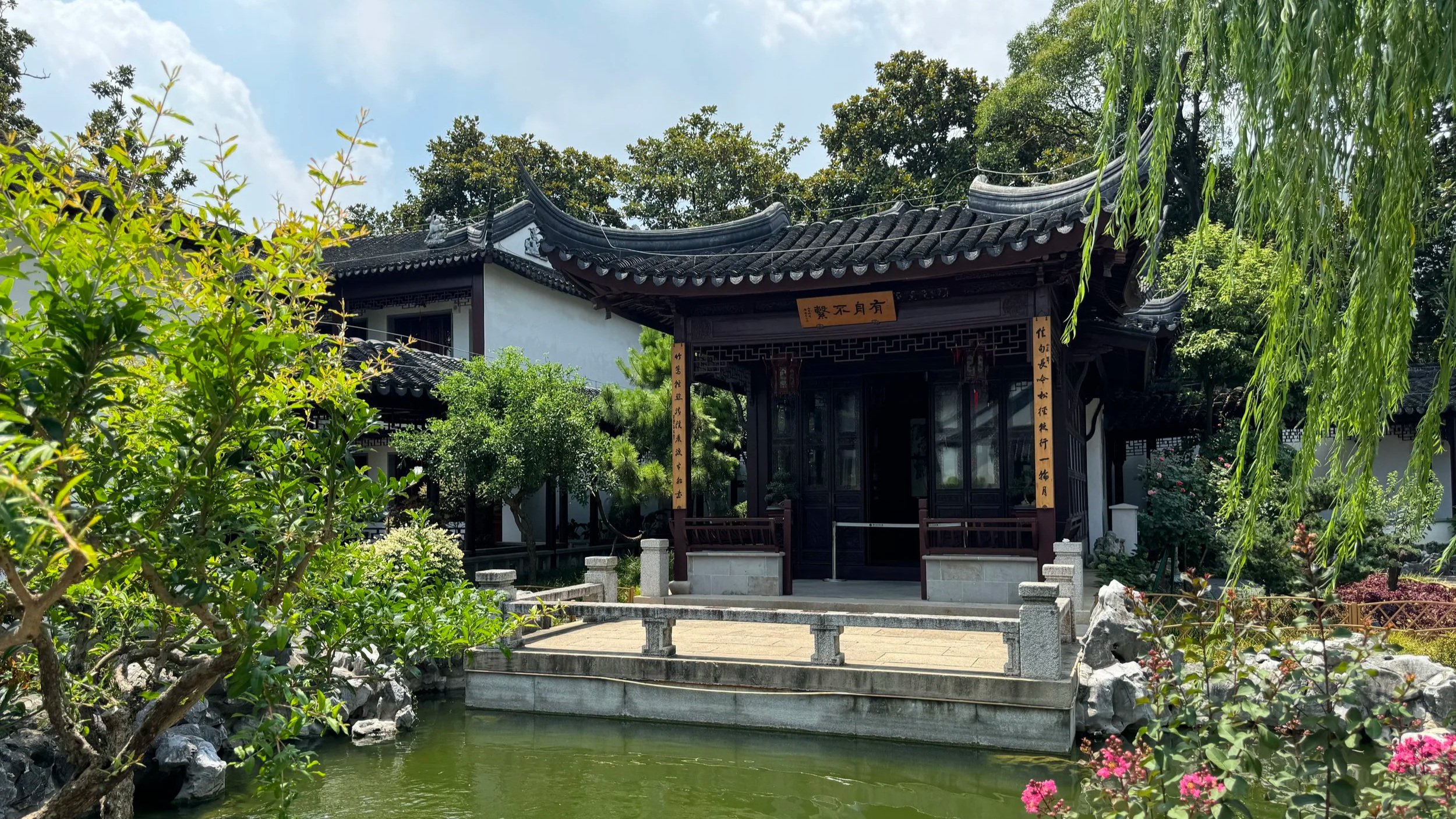
While in China, I joined a workshop on heritage practice run by WHITRAP, an educational arm of UNESCO. During this workshop, an international group of heritage practitioners were tasked with proposing a preservation plan for the Chaiyuan Garden, a much abused Suzhou garden created in the early 19th century (Figure 1). After the Communist revolution, the garden had been repurposed as a school, and its material integrity was challenged. However, we considered/examined the garden using a value‑based approach, which aims to retain the cultural significance of places by balancing, in decision‑making, the aesthetic, historic, scientific, spiritual, and social values held by past, present, and future generations. We examined archives, detailed surveys, maps, and drawings, as well as verses and texts that referenced the garden. The Chinese preservation experts we were working with argued for a principle of authenticity based in the knowledge and practices of the garden designer and builder, which could then be then applied to the reconstruction of the garden. Their understanding was that Suzhou garden restoration should not be based on recreating what was there historically from archaeological, pictorial, and other data. Instead, the goal was to protect the artistic intention and the techniques and skills used. Through this process, engaged with the ‘intangible’ heritage enacted by the designers and builders, the reconstructed garden is authentic. (Figure 2) The authenticity of the garden was arguably strong, based on the modest existing material evidence combined with the existence in Suzhou of strong and unquestioned local traditional gardening techniques, as well as garden masters and their skills.
Figure 2. The Pleasure Boat of the Chaiyuan Garden as restored, Suzhou, 2024. The garden was built by the Pan Zengqi family in the late Qing Dynasty, reign of Daoguang, 1820-1850. Photograph by Bo Bian.
The preservation process we engaged with at Chaiyuan Garden reflects the idea of the ‘past of the mind.’ US and, historically, international Western norms have been focused on the material built environment. Authenticity is seen to be based in the actual historical building fabric, and memories cleave to the material places where events occurred. But in Chinese tradition, if a building, a garden, a plaza can be rebuilt embodying the feeling and essence expressed in the artwork, then their function and meaning remain. Buildings, gardens, and plazas are significant because of their embodiment in art, both paintings and poems. Historian F.W. Mote argues that the history of China was not understood as based in buildings, but instead that the shaping of spaces and grand layout were of prime importance, with buildings being temporary and replaceable. Chinese history was not lost when buildings were lost if they could be rebuilt to continue their function. What was not perishable was human experience as recorded in literature, ‘a past of the mind.’[1]
Figure 3. The new Suzhou walls and Xiangmen Gate, as seen approaching the old city of Suzhou from the east, 2015. Photograph by author.
The past of the mind underlies many heritage projects in China. While I was living in Suzhou, large sections of the city walls, mostly destroyed decades earlier following the Communist Revolution, were re-created from scratch. (Figure 3) The new walls were built in reinforced concrete that allows for housing a museum, shops, restaurants, and even a movie theater within them. In high-traffic areas, they are faced with quality reproduction historic brick. My colleagues with Western educations largely described these walls as fake, pointing to the lack of existing old wall, or even remnants of old wall, on which to base reconstructions. (Figure 4) But inside Xiangmen Gate the Suzhou Wall Museum makes a counterargument. Exhibits connect this new iteration of the wall with a narrative detailing a long history of building and rebuilding walls. This museum helps visitors make the leap across generations, from today’s grandparents who remember earlier iterations of the city walls to today’s grandchildren who experience the new walls, skipping over the adult generation born after the Revolution who have lived with no walls. In displays within the museum, oral histories of the wall are offered by older city residents, and an area is set aside for children to make and represent their own memories of the wall. (Figure 5) These displays strongly argue that the “memory” of the wall–the feeling attached to it–is what matters, personally and collectively; the reconstruction of it (no matter in different materials and often not on the same site) is about making that “memory” concrete, and therefore real and legitimate. The memory of the wall, then, makes reconstruction authentic.
Figure 4. Rebuilt Suzhou walls, some falling into “ruin.” Photograph by author, 2015.
Figure 5. The ‘CITY WALL’ of memory exhibit in the Suzhou City Wall Museum includes contemporary drawings of the wall by children. Photograph by author, 2015.
“In recent years, China has been a dynamic proving ground of heritage practice where international ideas are debated, fought over, and realized in many forms within the context of complex economic, political, and reputational forces.”
Yungang Grottoes, a UNESCO World Heritage site in Shanxi province near the city of Datong, which features ancient caves and Buddhist statues created from 435 to 495 CE, is also a site of significant construction in a style that imitates antiquity (仿古 (fǎng gǔ)). (Figure 6) This new architecture carefully orchestrates tourists’ visits to the grottoes, which start along grand processional ways, punctuated by groups of ‘traditionally styled’ buildings forming a series of plazas and museum displays telling a careful narrative of the flowering of Buddhism in a Chinese context, and lead through a reconstructed temple on an artificial island before finally visiting the grottoes and Buddhas. (Figure 7) As with any World Heritage Site, the Yungang Grottoes themselves are managed in accordance with UNESCO World Heritage Convention guidelines, which prioritizes the protection of original context and material authenticity. In the area around the World Heritage Site however, in efforts to bolster tourism, Datong Mayor Geng oversaw a grand development overshadowing the scale of the Grottoes, creating an impactful tourist experience that was for me both impressive and exhausting. Geng’s goal was to build a much larger scenic park, an amphitheater, an extensive museum, and shopping venues for tourists.
Figure 6. Yungang Grottoes, seated Buddha, Cave 20. Photograph by author, 2012.
Figure 7. A grand axial way leading to the Yungang Grottoes World Heritage Site. This photograph shows but one of several axial ways, newly built, that are necessary for tourists to traverse as part of their visitor experience. Photo by author, 2015.
The tourist development of Yungang Grottoes illustrates heritage practices in China that are flexible, relative, contextual, and non-confrontational. Pristine UNESCO World Heritage can be encircled by new buildings in the style of the old, without any contradiction. In this site, heritage is the interface of past and present, and in the physical landscape traditions can be venerated, ignored, or discarded according to what is seen as valuable for the present. Yungang Grottoes are simultaneously World Heritage and an engine of local tourism; development that promotes that tourism is seen as harmonious with the aura of the authentic, not contradictory to it. The Yungang Grottoes are exemplary of China’s choice to participate in UNESCO’s World Heritage program and adopt the universalized heritage guidance it demands while also being sites of negotiation of culturally specific desires. China’s interests have been furthered by this participation, and Chinese officials have become skilled at using this engagement for political and economic reasons.
Figure 8. Map of the city of Datong and nearby heritage sites. Map drawn by Bo Bian.
Figure 9. The Jinhua Palace National Mine Museum with mine train in foreground for children. The museum, a contemporary faceted design of darkened glass, is meant to mimic a lump of coal. Built on top of the still marginally active mines, the museum offers tours of the underground.
Across the river from the Grottoes the Jinhua Palace National Mining Museum (opened 2012) provides a second tourist destination near the Grottoes. (Figure 8) The site of a coal mine from the early Communist era, today the still-active mine boasts a signature high-style museum extolling the role of the mines and the miners in the development of China since the Communist revolution; extensive manicured grounds with exhibits of machinery, including machinery parts welded into whimsical sculpture; and a newly built but traditionally styled palace complex remembering one that once reputedly existed in the area. (Figure 9) Yungang Grottoes and the nearby Jinhua National Mine Museum demonstrate that in China today the management of heritage sites, including UNESCO designated World Heritage Sites, can include substantial modernization to enhance the tourist experience. (Figure 10) Conservation and modernization are not necessarily in tension as they often are in the West. As well, these interventions to heighten the tourist experience are not seen in a Chinese context as imposing on the authenticity of the site or on an authentic experience for the tourist. Instead, these interventions are created to aggrandize and honor the grottoes and the visitors.[2]
Figure 10. Aerial view of the Yungang Grottoes Area. The World Heritage site is north of the Shili river, with the Grottoes carved into a cliff that is visible as a line across the top of the image. Between the cliff and the river are the landscapes and facilities for tourists, to the upper left a pleasure garden with meandering paths, plazas, and amphitheaters, and to the upper right a new lagoon with newly built traditionally styled buildings framing grand courts and housing commercial spaces and exhibits. The lagoon area is connected to the grottoes and parking (upper right) by grand axial ways. Below the river is the Jinhua Palace National Mine Museum (opened 2012), with a showpiece new museum building (center) just below extant mine processing buildings adjacent to the river. At center bottom is a new old-style palace complex housing commercial space as well as exhibits. The city of Datong is 20km distant. Google Maps, accessed July 2023.
Questions of authenticity and tourism and the relationship between development and heritage have been engaged in multiple ways in China, particularly in the frenzy of development of the first part of the 21st century. The many cases in my book go more deeply into these central heritage questions, as well as addressing difference and ethnicity and the use of heritage to the present. I am fascinated by heritage practice in China not because I see in it a model for practice, but rather because of the way its many experiments and engagements with multiple ideas about heritage make visible the limits of how we think about and practice heritage preservation in the US. While our national policies may have us withdrawing from UNESCO, focusing on a history of triumph, and retreating from efforts to make historic preservations reflect all communities, I hope that US preservationists and preservation professors will join me in thinking more expansively about what heritage practice can be and in learning from practice in China and throughout the world.
Citation:
Andrew Scott Johnson, “Expanding Historic Preservation: Thinking Through China,” Platform, December 8, 2025.
Notes:
[1] F. W. Mote, "A Millennium of Chinese Urban History: Form, Time, and Space Concepts in Soochow." Rice Institute Pamphlet - Rice University Studies, 59, no. 4 (1973), 51.
[2] Tim Winter, “Cultures of Interpretation,” in Russell Staiff, Robyn Bushell, and Steve Watson eds. Heritage and Tourism (New York: Routledge, 2013), 181.